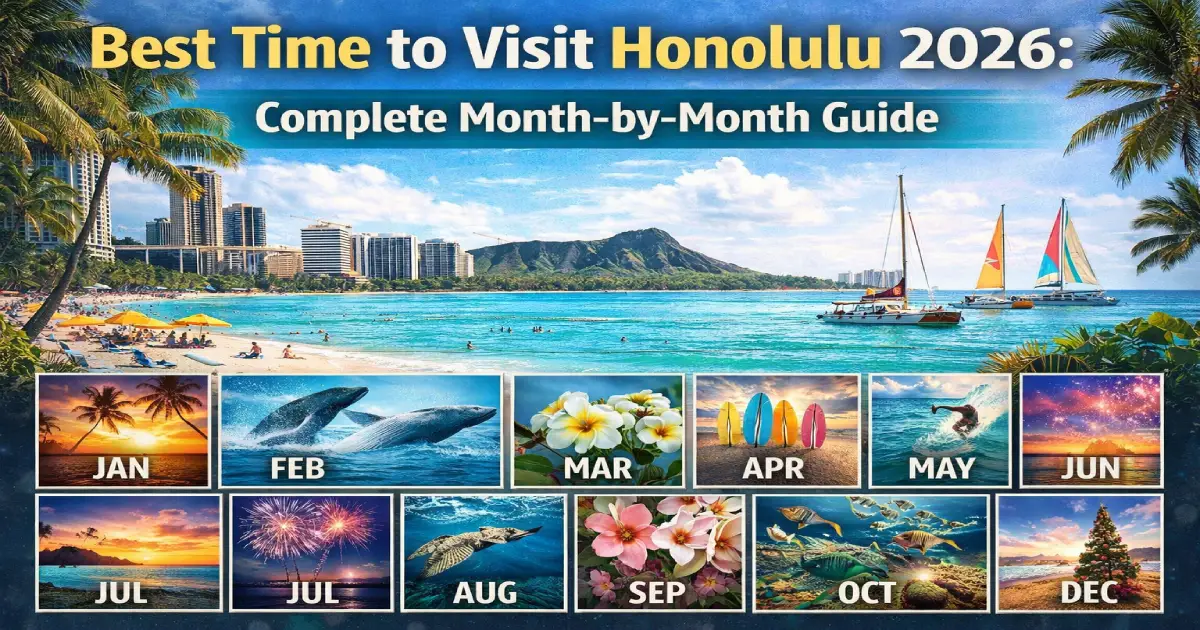
Best Time to Visit Honolulu 2026: Complete Month-by-Month Guide
Published on : 24 Mar 2026
Best Time to Visit Honolulu — Paradise Has Seasons Worth Understanding
By Travel Tourister | Updated March 2026
Honolulu is the closest thing to a year-round destination that any major American city offers — a place where the average temperature difference between the coolest month (January, 80°F) and the warmest month (August, 88°F) is 8 degrees, where it never snows, where the trade winds make 85°F feel like the finest temperature imaginable, and where the Pacific Ocean is swimable, snorkelable, and surfable every single day of the year. The question is not whether you can visit Honolulu in any given month — you can, and you will have a genuinely excellent time in any of them. The question is what specific version of Honolulu you want, what you’re willing to pay for it, and whether your schedule aligns with the specific experiences that make certain months irreplaceable.
I’ve visited Honolulu across multiple seasons and months — the December Honolulu Marathon morning when 30,000 runners move through the dawn streets to Diamond Head and back, the January morning at the Banzai Pipeline when 30-foot waves are breaking 100 yards offshore and the world’s finest big-wave surfers are paddling out while the spectators on the beach stand in stunned silence, the April afternoon at Hanauma Bay when the reef is clearest and the Achilles tang schools are thickest and the water temperature is 78°F and every Hawaiian green sea turtle in the bay is present and visible, and the June week when the North Shore is flat and the Waikiki hotels are at their best pricing and the trade winds are perfect and the shave ice at Matsumoto’s in Haleiwa is the finest cold thing available in any American city. Each visit confirmed the same truth: Honolulu rewards careful timing in specific ways — the North Shore surfer, the budget traveler, the honeymooner, the marathon runner, and the whale watcher each have different optimal windows, and understanding those windows turns a great Honolulu trip into the finest version of a great Honolulu trip.
This comprehensive 2026 guide breaks down Honolulu’s best and worst visiting times using verified weather data from National Weather Service Honolulu, event calendars, hotel pricing patterns, and honest assessments of what each month actually delivers. We cover every month in detail, identify the best times for specific activities, flag the major annual events that make specific weeks uniquely rewarding, and give you the complete strategic intelligence to choose the right Honolulu window for your trip priorities.
Whether planning a winter escape from a cold American city, a summer family beach vacation, a fall budget value trip before the holiday surge, or a March visit to catch whale season’s final weeks and the North Shore’s spring transition, this guide gives you the honest, month-by-month picture of what Honolulu is actually like throughout the year — including the honest costs, the crowd reality, and the specific experiences that each season delivers best.
Honolulu: Quick Season Overview
Season / Month
Weather
Crowds
Hotel Prices (Waikiki)
Best For
January
78–82°F, occasional rain, whale season
High (post-marathon)
$220–$380
North Shore big surf, whale watching
February
76–81°F, some showers, whale peak
Moderate–High
$210–$360
Whale watching peak, North Shore surf
March
77–82°F, variable, final whale weeks
Moderate–High
$225–$385
Spring break, snorkeling improving
April
78–84°F, pleasant, trade winds
Moderate
$195–$320
Best overall value, Lei Day, snorkeling
May
80–85°F, excellent, low rain
Moderate
$200–$335
Lei Day, surf calm, best snorkeling start
June
82–87°F, sunny, trade winds perfect
High
$240–$420
Summer beach, North Shore flat calm
July
84–88°F, warm, low humidity
Peak
$270–$460
4th of July, peak beach season
August
84–88°F, warmest month, occasional hurricanes
Peak
$265–$455
Peak beach, Aloha Festivals begin
September
83–87°F, warm, hurricane risk
Moderate
$210–$355
Aloha Festivals, post-summer value
October
82–86°F, warm, some rain
Low–Moderate
$195–$330
Best budget month, North Shore waking
November
80–84°F, some rain, North Shore begins
Moderate
$205–$345
North Shore surf season, good value
December
78–82°F, some showers, festive
High (holiday peak)
$255–$480
Honolulu Marathon, holiday season, big surf
Best Overall Times to Visit Honolulu
1. April — THE BEST OVERALL MONTH TO VISIT HONOLULU
Why April Is Perfect: April is Honolulu’s finest month for the largest number of visitor priorities simultaneously — hotel prices drop 15–20% from the March spring break peak, the trade winds are blowing reliably (making 82–84°F feel like the finest weather on earth), the whale watching season is entering its final spectacular weeks (humpbacks are most visible February–April), Hanauma Bay’s snorkeling is at its clearest (reduced winter swell means calmer, clearer water), the North Shore winter surf crowds have departed leaving the beaches nearly private, Diamond Head hike is at its most comfortable temperature, and Lei Day (May 1) preparation events begin in late April with the most specifically Hawaiian cultural programming of any spring month.
April Highlights:
Weather: 78–84°F average; trade winds consistent at 10–15 mph making the temperature feel 5–8°F cooler; lowest rainfall of any month in the dry season; 13 hours of daylight
Whale watching (final peak weeks): Humpback whales are in Hawaiian waters from approximately November through May, with peak activity February through April — the final weeks of April often produce the most dramatic surface activity as whales prepare to migrate north
Hanauma Bay snorkeling: The reduced winter swell has dissipated; the bay is calm, clear, and the reef fish populations are at their most active in the warming spring water
Hotel pricing: $195–$320/night at Waikiki mid-range properties — 20–30% below summer peak, the best sustained value in the first half of the year
North Shore: The winter surf crowds have cleared; Sunset Beach and Waimea Bay are accessible and nearly private, with the ocean transitioning from big-wave territory to swimming conditions by mid-month
Average temperatures: 78–84°F daytime; 68–72°F overnight; ocean temperature 78–80°F
Hotel rates: $195–$320/night Waikiki mid-range; $380–$600 luxury
2. October — Best Budget Month
Why October Delivers the Best Value: October is Honolulu’s quiet month — the summer families have gone home, the holiday surge has not yet arrived, the North Shore surf season is just beginning (producing the most dramatic surf without the peak-season contest crowds), and hotel prices are at their annual lowest outside the post-marathon January lull. The weather is still genuinely excellent (82–86°F, summer warmth lingering), the water is at its warmest (82°F ocean temperature), and the Aloha Festivals — Honolulu’s most significant cultural celebration — run through October with free hula performances, floral parades, and community events that provide the most accessible Hawaiian cultural immersion available in any month.
Hotel prices: $195–$330/night Waikiki mid-range — the lowest sustained pricing outside January post-marathon
Ocean temperature: 82°F — the warmest ocean of the year, the finest swimming conditions
Aloha Festivals (September through October): The most significant Hawaiian cultural celebration — free hula performances, floral parades, and community events throughout Oahu
North Shore surf beginning: The first North Shore swells of the winter season arriving in October — dramatic surf viewing without the peak-season contest crowds of November–January
Whale season approaching: Humpbacks begin their return to Hawaiian waters in late October–November — the anticipation and occasional early sightings
Hotel rates: $195–$330/night — the finest value month for Waikiki beach and water activities
3. January — Best for North Shore Big Surf and Whale Watching
Why January Is Worth Planning Around for Specific Purposes: January delivers two of Honolulu’s most irreplaceable specific experiences — the North Shore big-wave surf season at its peak (the Banzai Pipeline, Eddie Aikau Big Wave Invitational, and Sunset Beach competitions all in their finest month) and the opening of the humpback whale season (whales begin arriving in Hawaiian waters in November and peak in February–March, with January producing the first reliable offshore breaches). For the visitor whose priorities are big-wave surf and whale watching, January is the only month that delivers both at maximum intensity simultaneously.
Banzai Pipeline (North Shore): The world’s most dangerous and most watched surf break at its peak — 20–30 foot face heights, the world’s finest surfers, free to watch from the beach at Ehukai Beach Park
Eddie Aikau Big Wave Invitational: The most prestigious big-wave surfing event in the world, held at Waimea Bay only when waves reach 20 feet — has been held only 10 times since 1984; check surfline.com for current year holding status
Humpback whale watching: January–April is the Hawaiian humpback whale season; January produces the first high-density offshore concentrations of the year
Hotel rates post-marathon: January hotels drop from December peak after the marathon weekend — the week of January 6–13 is typically the lowest-priced Waikiki week of the year
Hotel rates: $220–$380/night; drops to $190–$300 mid-January post-holiday
4. May — Best Shoulder Month
Why May Delivers Exceptional Value: May is Honolulu’s finest shoulder month — the spring break crowds have gone, the summer peak hasn’t started, the weather is at its most reliably excellent (80–85°F, consistent trade winds, lowest annual rainfall), the ocean is calm from the south (allowing excellent Waikiki surfing) while the North Shore has fully transitioned to flat summer conditions (making it the finest month for North Shore snorkeling and swimming), and Lei Day (May 1) delivers the most specifically Hawaiian public cultural celebration of the year — the Queen Lili’uokalani hula competitions, the lei competition at Thomas Square, and the Ala Moana center performances are all free and all genuinely extraordinary.
Lei Day (May 1): The most Hawaiian of all Hawaiian holidays — free public lei competition at Thomas Square, hula performances throughout the city, and the specific cultural expression of a day when the entire island smells like plumeria and pikake
North Shore snorkeling season begins: The North Shore transitions from big-wave to flat-calm in April–May, with the clearest water of the year available for snorkeling at Shark’s Cove and Three Tables
Hotel rates below summer: $200–$335/night — the last month of pre-summer pricing before the June–August peak
Hotel rates: $200–$335/night; the sweet spot between spring break and summer peak
Month-by-Month Breakdown
January: North Shore Peak and Whale Season Opening
Weather: 78–82°F daytime; 65–70°F overnight; trade winds consistent; occasional rain showers (Hawaii’s “wet season” is November–March, though “wet” is relative — even the rainiest Honolulu months average only 2–3 inches of rain in Waikiki); ocean 76–78°F
What’s Great:
North Shore big wave surf at annual peak — Pipeline, Sunset Beach, and Waimea Bay all receiving the largest swells of the year; free to watch from the beach
Eddie Aikau Big Wave Invitational holding window (January–February): The most legendary surf competition in the world; check surfline.com for current year status
Humpback whale season opening: Whales in Hawaiian waters from November; January produces increasing offshore sightings; whale watching cruises from Honolulu Harbor highly productive
Honolulu Marathon aftermath energy: The December marathon produces a specific January glow — the city is recovering, the runners are still in town for the first week, and the hotels are transitioning from holiday peak pricing
Hotel rates drop mid-January: After January 6–7 (the end of the holiday window), Waikiki hotel prices fall sharply — the week of January 12–19 is often the cheapest Waikiki week of the year
Pearl Harbor anniversary (January 7): The commemorative events at the USS Arizona Memorial are the most attended of any annual ceremony — somber, significant, and free
What’s Challenging: January is Hawaii’s wettest month in the mountains and valleys, though Waikiki itself (on the rain-shadow side of the Ko’olau Range) averages only 2.4 inches — more frequent brief showers than prolonged rain. The North Shore road (Kamehameha Highway near Sunset Beach) can flood in heavy rain events. Waikiki beach is swimmable but the winter swells make the water choppier than summer.
Verdict: Excellent for North Shore surf viewing, whale watching, and budget value (mid-January); challenging for calm beach swimming and snorkeling
Average hotel rate: $220–$380/night; drops to $190–$300 after January 6
February: Whale Watching Peak
Weather: 76–81°F daytime; 64–68°F overnight; highest probability of brief rain showers of any month; trade winds variable; ocean 76–78°F
What’s Great:
Humpback whale watching at annual peak: February is the finest month for humpback whale watching in Hawaiian waters — the Pacific Whale Foundation’s research suggests peak calf births occur in February and March, producing the highest density of whale activity and the most dramatic surface behavior of the season. The Pacific Whale Foundation whale watches from Honolulu Harbor deliver the most professionally narrated and most educationally rich whale watching experience in Hawaii.
North Shore surf still excellent: February maintains excellent big-wave conditions on the North Shore — Pipeline and Sunset Beach competitions may still be running
Valentine’s Day: The most romantic week in Waikiki’s hotel and restaurant calendar — special menus, beachfront dinners, and the most deliberately romantic version of the destination available
Chinese New Year (late January or February depending on year): Honolulu’s Chinatown celebrates with the most elaborate Chinese New Year events in Hawaii — lion dances, firecrackers, and the specific festival energy of a century-old Chinatown community celebration
What’s Challenging: February is statistically Honolulu’s rainiest month — still only 2.8 inches in Waikiki, but brief shower frequency is highest. The Ko’olau Range and windward Oahu receive significantly more rain (8–12 inches in February) — keep this in mind for day trips to the Nuuanu Pali Lookout and the windward coast.
Verdict: Excellent for whale watching (the best month for the specific experience); good value relative to summer and the holiday season
Average hotel rate: $210–$360/night
March: Spring Break and the Final Whale Weeks
Weather: 77–82°F daytime; 65–70°F overnight; rain decreasing through the month; trade winds increasing; ocean 77–79°F warming
What’s Great:
Final whale weeks: March delivers the last consistent humpback whale sightings before they migrate north — the whales are still present in high numbers through mid-to-late March, and the Pacific Whale Foundation’s whale watches remain highly productive
St. Patrick’s Day (March 17): Honolulu’s St. Patrick’s Day parade in Waikiki — the most unexpected Irish-Hawaiian cultural mashup in the Pacific
North Shore transitioning: March marks the transition from big-wave to medium-swell conditions on the North Shore — excellent intermediate surfing conditions and the beginning of the season’s best snorkeling at Shark’s Cove
Honolulu Festival (mid-March): The most internationally focused cultural festival in Hawaii — Pacific Rim performers, Japanese entertainment, and a Grand Parade through Waikiki ($0 for outdoor events)
What’s Challenging: Spring break (mid-March through early April) drives significant hotel price spikes and Waikiki crowd increases — families from the continental US make March one of the busiest beach months. Book 8–10 weeks ahead for spring break period hotels.
Verdict: Good for the specific combination of final whale season + improving beach conditions; expensive during spring break week
Average hotel rate: $225–$385/night (spring break weeks significantly higher)
April: The Best Month — Perfect Balance
Weather: 78–84°F daytime; 68–72°F overnight; lowest rainfall of the dry season beginning; consistent NE trade winds; ocean 78–80°F; 13 hours of daylight
What’s Great:
Post-spring-break pricing: Hotel rates drop 15–20% immediately after spring break ends in early April — the finest sustained value in the first half of the year
Hanauma Bay at its clearest: Reduced winter swell has fully cleared; visibility in the bay reaches 40–60 feet; the Hawaiian green sea turtle population is present and active in the warming water
Diamond Head hike at its best: 84°F with trade winds and 13 hours of daylight make April the most comfortable Diamond Head hiking month — start by 7 AM to complete before peak heat
North Shore swimming season beginning: Waimea Bay and Sunset Beach transition to calm summer conditions by late April — the most beautiful beaches on Oahu accessible for swimming and sunbathing without winter surf crowds
Whale watching final weeks: April is the last reliable month for humpback whale sightings — the final offshore breaches of the season often occur in late April as the last whales begin their northward migration
Verdict: The strongest recommendation in this guide for most visitors — best weather, best snorkeling, best pricing relative to conditions, and multiple major experiences available simultaneously
Average hotel rate: $195–$320/night
May: The Finest Shoulder Month
Weather: 80–85°F daytime; 70–74°F overnight; consistently excellent; trade winds perfect; virtually no rain in Waikiki; ocean 79–81°F
What’s Great:
Lei Day (May 1): The most specifically Hawaiian public holiday — lei competition at Thomas Square (free), hula performances at Ala Moana and throughout Waikiki, and the queen’s lei ceremony at the State Capitol. The day when the entire island celebrates the most beautiful aspect of Hawaiian culture in public.
North Shore snorkeling season peak: Shark’s Cove and Three Tables on the North Shore are at their clearest in May–June — visibility 50–80 feet, the finest snorkeling on Oahu accessible without a tour from the roadside parking at Pupukea
Waikiki surfing conditions excellent: The south swells that produce Waikiki’s famous gentle surf begin in May — the best month for beginner surf lessons, with consistent 2–4 foot waves and warm water
Mother’s Day: The most significant flower and lei week in Hawaii — the plumeria and pikake garlands available at Chinatown’s lei shops are at their peak quality in May
Verdict: The finest shoulder month — better weather than April, lower prices than June, and Lei Day as a specific cultural event worth planning around
Average hotel rate: $200–$335/night
King Kamehameha Day (June 11): The most important Hawaiian state holiday — the King Kamehameha statue at Iolani Palace is draped in flower leis, a floral parade moves through downtown Honolulu, and the cultural programming at the Bishop Museum and throughout the city represents the most Hawaii-specific public holiday celebration of the year
North Shore flat calm: The North Shore in June is the most beautiful version of the most beautiful coastline on Oahu — flat, turquoise water, virtually no crowds, and the finest North Shore snorkeling and swimming of the year
Honolulu Pride (early June): One of the most festive LGBTQ celebrations in the Pacific — events throughout Waikiki, parade on Kalakaua Avenue
Summer surf season: The south shore (Waikiki) receives consistent summer swells — the most reliable surf lesson conditions of the year
What’s Challenging: Hotel prices jump significantly from May — the summer family season begins with the school year’s end. Book 4–6 weeks ahead for June summer weekends.
Verdict: Excellent summer month — all outdoor activities optimal; more expensive than April–May but below July–August peak
Average hotel rate: $240–$420/night
July: Peak Summer
Weather: 84–88°F daytime; 74–78°F overnight; warmest and sunniest conditions; trade winds moderate; ocean 81–83°F; longest days of the year
What’s Great:
July 4th celebrations: The most spectacular fireworks display in Hawaii — Waikiki Beach fireworks visible from the shore and from the water (catamaran sunset cruises sell out for July 4th months ahead), the Waikiki 4th of July parade through Kalakaua Avenue
Waikiki Beach at peak summer conditions: The south swells are at their most consistent — 2–5 foot waves breaking at Canoes and Queens reef, the finest beginner and intermediate surf conditions of the year
Ocean temperature at peak: 82–83°F ocean water requires no wetsuit and produces the most comfortable snorkeling conditions at Hanauma Bay of any month
Na Hula Festival (late July): A major outdoor hula competition at Kapiolani Park — free to attend, the finest hula performance accessible during the summer tourism peak
What’s Challenging: July is Honolulu’s most expensive and most crowded month — Waikiki Beach and Hanauma Bay at their maximum tourist density; Hanauma Bay requires advance reservations ($30/person, book at hanauma bayreservations.com weeks ahead in July). July 4th weekend drives hotel prices to annual peaks.
July 4th booking: Book hotels 10–12 weeks ahead for July 4th weekend; catamaran sunset cruises for July 4th fireworks sell out months ahead.
Verdict: Best weather month; highest cost; all bookings require significant advance planning
Average hotel rate: $270–$460/night (July 4th weekend $350–$600+)
August: Summer Peak Continues
Weather: 84–88°F; warmest month of the year; low humidity relative to continental US cities; trade winds variable; ocean 82–84°F; Hawaiian hurricane season (June–November) — the risk remains low but increases slightly in August–September
What’s Great:
Ocean at its warmest: 83–84°F water temperature — the warmest ocean of the year, maximum comfort for snorkeling, swimming, and all water sports
Aloha Festivals launch (late August): The most significant Hawaiian cultural festival — beginning in Waikiki in late August with the Royal Court selection, running through October with events across all islands
Duke Kahanamoku Challenge (August, Waikiki): A longboard surfing competition honoring the father of modern surfing at his home break — free to watch from Waikiki Beach
Summer surf school peak: The most beginner-friendly surf conditions of the year — consistent small south swells, warm water, maximum surf school availability
What’s Challenging: Peak prices continue from July; hurricane season technically active (though direct Oahu hits are historically rare); Hanauma Bay reservations essential weeks ahead in August
Verdict: Excellent outdoor and water conditions; expensive; plan all activities 4–6 weeks ahead
Average hotel rate: $265–$455/night
September: Value Begins, Aloha Festivals Continue
Weather: 83–87°F daytime; 73–77°F overnight; still excellent summer weather; trade winds returning; ocean 82–84°F (warmest sustained temperature of the year); hurricane risk slightly elevated but historically rare for Oahu
What’s Great:
Post-Labor Day price drop: Hotel rates fall 15–20% within days of Labor Day — a significant pricing shift that makes September the first genuinely good-value month since May
Aloha Festivals peak: September is the most event-rich Aloha Festivals month — the Floral Parade through downtown Honolulu (free from the sidewalk), the Royal Court Ho’olaule’a (free celebration at Iolani Palace grounds), and the week of hula, music, and cultural programming that is the most concentrated Hawaiian cultural immersion of the year
Ocean temperature at annual warmest: September and October are the warmest ocean months of the year — 83–84°F water creates the most comfortable extended snorkeling conditions
Waikiki beach crowd reduction: The summer families have departed; the holiday surge has not arrived; Waikiki in September has the best crowd-to-beach-space ratio since May
Verdict: Excellent — summer beach conditions, Aloha Festivals, and post-Labor Day price reduction; one of the best months for a Honolulu visit overall
Average hotel rate: $210–$355/night, dropping post-Labor Day
Lowest hotel prices of the non-winter year: October is consistently the month with the most attractive hotel pricing in Honolulu — the summer families are gone, the holiday season hasn’t arrived, and Waikiki’s hotels are motivated to fill rooms at the annual discount
North Shore surfing begins: The first substantial North Shore swells arrive in October — dramatic surf viewing is beginning, with waves building through the month toward November’s contest season
Oahu LGBTQ+ Pride Events (October): Secondary Pride events throughout Honolulu through October
Halloween in Waikiki (October 31): The annual Waikiki Halloween street party on Kalakaua Avenue — the largest Halloween street celebration in the Pacific, free to attend, and one of the most costumed events in any American city
Aloha Festivals continuing: Cultural events throughout October across Oahu
Verdict: The finest value month in Honolulu — summer warmth, beginning North Shore excitement, low prices, and Halloween as a uniquely Waikiki annual event
Average hotel rate: $195–$330/night — the lowest sustained pricing of any warm-weather month
Vans Triple Crown of Surfing begins (November–December): The most prestigious surf contest series in the world — three events (Hawaiian Pro at Haleiwa, Vans World Cup at Sunset Beach, Billabong Pipe Masters at Pipeline) held when swells exceed 8 feet at the respective breaks. The Haleiwa and Sunset events typically run in November; the Pipeline Masters typically December. Free to watch from the beach.
Whale watching early sightings: The first humpback whales of the season return to Hawaiian waters in November — early-season sightings are increasingly common in the second half of the month
Thanksgiving week (moderate impact): Unlike the continental US cities, Honolulu’s Thanksgiving week is a moderate price increase rather than a dramatic spike — families escaping the mainland’s November weather boost demand modestly
Hotel value before holiday season: November’s first three weeks are among the year’s most favorable pricing windows before the holiday surge
What’s Challenging: Rain frequency increasing toward December; Waikiki’s south shore beach conditions begin to show winter chop; the North Shore is exciting for surf watching but not yet for casual swimming
Verdict: Excellent for surf watching and good beach conditions; the last good-value month before the holiday premium arrives
Average hotel rate: $205–$345/night (Thanksgiving week higher)
December: Honolulu Marathon and Holiday Season
Weather: 78–82°F daytime; 66–70°F overnight; rain showers more frequent; trade winds variable; ocean 78–80°F; North Shore at peak surf season
What’s Great:
Honolulu Marathon (second Sunday of December): The most distinctive marathon in the United States — 30,000+ runners from Japan, the continental US, and the world start at 5 AM in the darkness, run through the pre-dawn Honolulu streets with lighted skyscrapers as backdrop, reach Diamond Head as the sun rises over the ocean, and finish along Kalakaua Avenue in full daylight. The Japanese participation (typically 15,000–18,000 runners from Japan) makes the Honolulu Marathon the most internationally diverse marathon in America. Free to spectate from the entire course.
Billabong Pipe Masters (December): The final event of the Vans Triple Crown — the most prestigious single surf contest in the world, held at the Banzai Pipeline when waves exceed 8 feet. Free from the beach at Ehukai Beach Park.
Holiday Hula Show (throughout December, Ala Moana Center): Free hula performances throughout December at the most accessible Honolulu shopping center
Waikiki Parade of Lights (December): The most festive free public event in December Waikiki
What’s Challenging: December 20–January 1 is the most expensive hotel window in Honolulu — holiday week prices spike significantly. The Honolulu Marathon weekend (second Sunday of December) drives additional price spikes in the pre-marathon week. Book 10–12 weeks ahead for the marathon weekend and holiday week.
Verdict: Excellent for the marathon and the Pipe Masters; expensive in the holiday window; the early-December pre-marathon period (December 1–7) offers festive atmosphere at pre-holiday pricing
Average hotel rate: $255–$480/night (holiday week $350–$600+)
Best Times for Specific Honolulu Activities
Best Time for Whale Watching
Optimal: February–March — peak humpback whale density in Hawaiian waters, highest probability of surface activity (breaching, pec slapping, tail lobbing), most whales per trip on Pacific Whale Foundation tours from Honolulu Harbor.
Season structure: November (first arrivals, early sightings), December–January (numbers increasing), February–March (peak activity — highest density, most dramatic behavior), April (final weeks — last reliable sightings before the northward migration). Pacific Whale Foundation tours from Maalaea Harbor (Maui) deliver the highest per-trip sighting probability in Hawaii; Honolulu tours are also productive and more convenient for Oahu-based visitors.
Best Time for North Shore Surf Watching
Optimal: November–January — the Vans Triple Crown contest series runs through November and December, with the Pipe Masters in December representing the peak of the professional surfing calendar. January maintains excellent big-wave conditions. The Eddie Aikau invitational holding window is January–February (held only when waves reach 20 feet at Waimea Bay).
Good: October (first swells, no crowds) and February (post-contest season big waves without the December holiday crowds)
Avoid for surf watching: April–September (the North Shore is flat in summer — beautiful for swimming, snorkeling, and scenic drives, but no surf to watch)
Best Time for Hanauma Bay Snorkeling
Optimal: April–June — the reduced winter swell produces the clearest water and calmest bay conditions; visibility reaches 40–60 feet; the reef fish populations are most active in the warming spring water. Book Hanauma Bay reservations at hanaumabayreservations.com at least 2–4 weeks ahead for April–August visits ($30/person non-resident); the bay is closed Tuesday.
Good: September–October (warm water, reduced summer crowds); July–August (excellent water temperature but maximum crowds — book weeks ahead)
Avoid: December–January (winter swells can reduce visibility and create choppy conditions; the bay closes when surf exceeds safety limits)
Best Time for Diamond Head Hike
Optimal: April–June and September–October — temperatures of 80–85°F with consistent trade winds make the 1.6-mile round-trip summit hike (560 feet elevation gain) comfortable. Start before 8 AM to avoid crowds and midday heat. December–March is also excellent temperature-wise but book parking reservations ahead as capacity is managed.
Avoid: July–August midday — 87–88°F without trade winds makes the crater’s exposed summit trail genuinely hot; always start before 8 AM in summer regardless of month
Best Time for Budget Travel
Optimal: October is the single best budget month — lowest hotel prices of any warm-weather month, summer beach conditions still present, Aloha Festivals cultural programming free throughout the month. January (post-holiday, mid-month) is the cheapest sustained window but with less ideal beach conditions.
Price spike events to avoid if budget-sensitive: Honolulu Marathon weekend (second Sunday December, +$80–$150/night citywide), July 4th weekend (annual price peak), holiday week (December 22–January 2, +$100–$200/night), and spring break (mid-March through early April, +$50–$100/night).
Best Time for the Honolulu Marathon
Exact timing: Second Sunday of December — always. In 2026, the Honolulu Marathon falls on December 13. The 5 AM start is the most memorable aspect — running in darkness through the Honolulu streets, reaching Diamond Head as the sun rises over the Pacific Ocean, and finishing on Kalakaua Avenue. Registration opens at honolulumarathon.org typically in January for the following December; Japanese participants fill the field quickly. Book hotels for the marathon weekend 10–12 weeks ahead — the Thursday–Sunday of marathon weekend is the most price-sensitive hotel window of early December.
Honolulu Timing: Practical Tips
Topic
What to Know
Hawaii’s Weather Reality
Honolulu’s “wet season” (November–March) and “dry season” (April–October) are far milder distinctions than in any continental US city. The wettest Waikiki month (February) averages only 2.8 inches of rain — less than Seattle averages in its driest month. The rain that does fall is typically brief afternoon showers, not all-day soaks. The Ko’olau Mountains on the windward side of Oahu receive dramatically more rain (the Manoa Valley averages 150+ inches annually while Waikiki averages 17 inches) — day trips to the windward coast and the interior valleys should account for this reality, especially November–March.
Hanauma Bay Reservations
Hanauma Bay requires advance timed-entry reservations April–October (when demand exceeds capacity) — book at hanaumabayreservations.com. The reservation system opens 2 days ahead at midnight Hawaii time; July–August reservations fill within minutes of opening. Strategy: Set a calendar reminder for midnight Hawaii time (6 AM ET / 3 AM PT) exactly 2 days before your intended visit. Closed Tuesdays. Non-resident entry fee $30/adult. Morning slots (7–9 AM) have the best snorkeling visibility. Arrive 15 minutes early for the mandatory conservation video before entering the water.
North Shore Strategy
The North Shore’s personality changes completely between seasons: November–April (big wave season) — arrive early, park at Ehukai Beach Park for Pipeline, expect crowds of 500–2,000 spectators on contest days, and stay away from the water (waves are genuinely dangerous even at beach level). May–October (summer season) — the North Shore is transformed: Waimea Bay and Sunset Beach are flat, turquoise, and empty, Shark’s Cove has the finest snorkeling on Oahu, and the drive up Kamehameha Highway from Haleiwa to Sunset is the most scenic coastal drive on Oahu. Matsumoto Shave Ice in Haleiwa is worth the visit year-round ($3–$5 for the finest shave ice in Hawaii).
Hotel Location Strategy
Waikiki is where almost all visitors stay — the most convenient location for the beach, Diamond Head, and the city’s main attractions. Within Waikiki: oceanfront hotels command a 30–50% premium over hotels 1–2 blocks inland; the quality of the actual Waikiki Beach varies by section (the stretch from the Royal Hawaiian to the Outrigger Reef is the finest; the section near Kuhio Avenue is more crowded and narrower). For North Shore focus: Turtle Bay Resort is the only major hotel on the North Shore — significantly more expensive than Waikiki but eliminates the 45-minute drive for surf viewing.
Flight Timing
Hawaii Standard Time (HST) is UTC-10 — there is no daylight saving time change in Hawaii. From the continental US East Coast, Honolulu is 5–6 hours behind (depending on DST season). Most mainland-to-Honolulu flights are overnight red-eyes arriving early morning, which is ideal for getting a full first day. The best flight value windows align with the hotel value windows: January (mid-month), April, May, and October. Hawaiian Airlines, Alaska Airlines, and United offer the most direct service from major mainland hubs. Flights from Los Angeles average 5.5 hours; from New York, 10–11 hours.
Honolulu Marathon Planning
The Honolulu Marathon (second Sunday of December, 2026 date: December 13) is one of the most unique marathon experiences in the world — the 5 AM darkness start, the Diamond Head sunrise, the Japanese community participation (the largest international runner group of any US marathon), and the no-cutoff policy (finishing times of 8–10+ hours are common and celebrated equally). Register at honolulumarathon.org; Japanese runners typically fill their allocated spots fastest. Hotels for marathon weekend: book at least 10 weeks ahead; the Waikiki hotels immediately adjacent to the finish line on Kalakaua Avenue command the highest premium. The free spectating spots at Diamond Head turnaround (mile 12.5) deliver the most dramatic marathon sunrise experience.
Frequently Asked Questions: Best Time to Visit Honolulu
What is the best month to visit Honolulu?
April is the best single month to visit Honolulu for most travelers — delivering the ideal balance of excellent weather (78–84°F with consistent trade winds), the clearest Hanauma Bay snorkeling of the year, the final weeks of humpback whale watching season, hotel prices 20–30% below summer peak, and the transition from the winter’s crowded North Shore to the summer’s calm and swimmable beaches. For budget travelers specifically, October delivers the lowest hotel prices of any warm-weather month with excellent summer conditions still present. For whale watching specifically, February–March is the optimal window. For the Honolulu Marathon, December is the only option. And for North Shore big-wave surf viewing, November–January is when the world’s finest surf occurs. October and April serve the largest number of visitor priorities at the lowest cost.
What is the cheapest time to visit Honolulu?
Mid-January (after the holiday window closes and before spring break begins, approximately January 6–February 14) and October (the entire month) deliver the lowest sustained hotel prices. The single cheapest week of the year is typically the week of January 12–19, when the holiday premium has fully cleared, the marathon runners have gone home, and the spring break demand has not yet arrived. Specific dates to avoid for budget travel: Honolulu Marathon weekend (second Sunday of December), July 4th weekend, the Christmas-New Year’s holiday week (December 20–January 4), and spring break (mid-March through early April). October avoids all of these price spikes while maintaining warm ocean temperatures (82°F) and genuinely excellent beach and outdoor activity conditions.
Does it rain a lot in Honolulu?
Much less than most visitors expect. Waikiki averages only 17 inches of rain annually — less than Los Angeles (15 inches) and far less than most American cities. The rainiest months are December through February, but even those months average only 2–3 inches in Waikiki. The typical Hawaiian rain pattern is brief afternoon showers (often 10–20 minutes) followed by sunshine and frequently a rainbow — not the prolonged gray rain of the Pacific Northwest or the summer thunderstorm system of the Midwest. The important distinction: the windward (northeast) side of Oahu — Kailua, Kaneohe, the Nuuanu Valley — receives dramatically more rain than Waikiki due to the Ko’olau Mountains. Visitors planning day trips to the windward coast should check the weather forecast for windward Oahu specifically, not just the Waikiki forecast.
When is whale watching season in Honolulu?
Humpback whale season in Hawaiian waters runs approximately November through May, with peak activity from February through early April. The whales migrate from their summer feeding grounds in Alaska to winter in the warm, protected Hawaiian waters for calving and mating — Hawaiian waters are one of only a handful of places in the world where humpbacks concentrate in this density and engage in this level of surface activity. The Pacific Whale Foundation’s whale watching cruises from Honolulu Harbor operate from December through May, with February–March tours delivering the highest per-trip sighting probability. The ocean off the Waianae Coast (the leeward side of Oahu) is the most productive Oahu whale watching area; the Maui Channel (visible from Maui and accessible from Lahaina) is the most famous Hawaiian whale watching location.
What is the North Shore surf season?
The North Shore’s big wave season runs November through March, with peak activity in December and January. The Vans Triple Crown of Surfing (three contest events held when swells exceed the required minimum size at each break) typically runs from late November through mid-December. The Eddie Aikau Big Wave Invitational at Waimea Bay is held during the January–February holding window only when waves reach 20 feet — it has been held only 10 times in its history. Pipeline reaches its most consistent 20–30 foot conditions in January. February maintains excellent big wave conditions with slightly smaller crowds than the December contest period. April through September, the North Shore is flat and completely transformed — the world’s most dangerous winter surf breaks become the most beautiful summer swimming beaches on Oahu, accessible and calm.
Is Honolulu crowded in summer?
Yes — July and August are Honolulu’s most crowded months, with Waikiki Beach at its maximum tourist density and Hanauma Bay requiring reservations booked weeks ahead. The specific crowding: Waikiki Beach itself (especially the stretch in front of the major hotels) feels dense but never genuinely unpleasant — the beach is wide enough to absorb summer crowds. Hanauma Bay is the most significantly impacted site — the timed-entry reservation system limits capacity, but securing a July–August reservation requires booking at midnight Hawaii time exactly 2 days ahead. The North Shore is almost completely uncrowded in summer (the surf crowds depart with the surf in April). September offers summer conditions with the crowd level returning rapidly to something more comfortable than July–August peak.
What should I pack for a Honolulu trip?
Honolulu packing is among the simplest of any American travel destination — the range of conditions is narrow and the requirements are consistent. Year-round essentials: high-SPF reef-safe sunscreen (Hawaii law requires reef-safe formulations — oxybenzone and octinoxate are banned), water shoes or reef shoes (essential for Hanauma Bay and any snorkeling entry), a rash guard for extended water time (prevents sunburn and is required by many snorkel tour operators for children), one light layer for air-conditioned restaurants and the Diamond Head summit (the summit has a breeze even in August), and swimwear rated for reef entry (a separate set from beach relaxation swimwear is practical). November–March additions: a light waterproof jacket for brief showers and slightly cooler evenings, and water-resistant footwear for the occasional wet sidewalk. July–August specific: Reef-safe sunscreen in the highest available SPF — the Hawaiian sun at 20 degrees north latitude is significantly more intense than the continental US at 35–45 degrees north, and sunburn is the most common visitor complaint in peak summer.
Final Thoughts: Choosing Your Honolulu Season
After multiple Honolulu visits across the full range of seasons — the December marathon dawn, the February whale breach, the April Hanauma Bay clarity, the October budget evening with the North Shore first swell arriving — three principles emerge for choosing the right Honolulu window:
1. April and October are the months Honolulu keeps for travelers who pay attention — and they consistently outperform their reputation. April is not marketed as Hawaii’s finest month because it lacks the July summer narrative and the January surf drama. But the trade winds are more consistent in April than in any other month. The snorkeling is clearer. The hotel prices are better. The whale watching is still producing. The Diamond Head hike is most comfortable. The North Shore has just become swimmable. And the spring plumeria bloom fills the air in a way that July’s heat cannot quite replicate. October is not marketed because the narrative requires “North Shore season” or “summer beach” — but the ocean is its warmest, the crowds are at their annual low, the Aloha Festivals are running, and the hotel value is the finest of any warm-weather month. These are the months when the travel industry’s narrative and the visitor’s actual experience most significantly diverge in Honolulu’s favor.
2. The North Shore is two completely different places depending on the season — and both versions are genuinely extraordinary. The North Shore in November through March is the most dramatic surf coast in the world: waves of 20–30 feet, the world’s finest athletes paddling into surf that a thoughtful person watches from a safe distance on the beach, the Vans Triple Crown events that concentrate the professional surfing world in a series of free-admission beach contests that are the most athletically impressive free sporting events in American recreational culture. The North Shore in May through September is a completely different place: flat, turquoise, empty, with the world’s most dangerous winter breaks transformed into the most beautiful swimming beaches on Oahu. Shark’s Cove snorkeling in June, when visibility reaches 80 feet and the parrotfish population is at its peak. Waimea Bay in July, when the same bay that held Eddie Aikau 30-foot swells in January is a flat, calm cove with families swimming to the rock. Understanding that the North Shore changes personality entirely with the season is the most important single piece of Oahu knowledge for a visitor planning a trip.
3. The Honolulu Marathon is worth building a December trip around specifically — it is the most beautiful marathon course in the world, and the 5 AM darkness start produces an experience that no other marathon in any city delivers. Running through the pre-dawn Honolulu streets from Ala Moana toward Diamond Head, with the city lit against the dark sky, the Trade Wind warm against your face, the Japanese runners beside you (15,000 of them, many running their first marathon ever, none of them carrying a time goal), reaching Diamond Head as the sun rises over the Pacific in the specific angle of a December Hawaiian dawn — this is the single most beautiful experience that a recreational marathon runner can access anywhere in the world. The no-cutoff policy means every finisher is celebrated equally. The Japanese participation means the field is international in a way that no continental US marathon replicates. And the finish on Kalakaua Avenue in full morning light, with the Diamond Head crater visible behind the skyline, makes arriving in Honolulu on the second Sunday of December one of the most specifically justified travel decisions available.
Honolulu is the most forgiving major travel destination in America — there is no genuinely bad month, no weather condition that closes the beaches, and no season that prevents the essential Honolulu experiences. The question is which version of paradise you want: the winter surf drama of January’s Pipeline, the spring clarity of April’s Hanauma Bay, the summer warmth of July’s Waikiki at full capacity, or the autumn quiet of October’s Aloha Festivals and empty North Shore beaches. All of them are Hawaii. All of them are extraordinary. Choose the one that matches what you came for. The trade winds will be blowing when you arrive. The water will be warm. The plumeria will be somewhere in the air. That is Honolulu, in any month you choose it.
For current event schedules, hotel availability, and Honolulu visitor information, consult Hawaii Tourism Authority (Oahu), National Weather Service Honolulu for seasonal forecasts, and Honolulu Marathon for current year race registration and spectator information.
—
—
About Travel TouristerTravel Tourister’s Honolulu specialists provide honest seasonal guidance based on extensive year-round exploration of Waikiki, the North Shore, Hanauma Bay, Diamond Head, and every neighborhood, beach, and cultural event that Oahu offers. We understand that Honolulu’s seasons serve different travelers and that the best time to visit depends entirely on whether you came for the whale watching, the North Shore surf, the Honolulu Marathon, the snorkeling clarity, or simply the finest value on the world’s most beautiful beach.Need help choosing the right time for your Honolulu visit? Contact our specialists who can recommend optimal travel windows based on your specific priorities — from North Shore surf contest timing to Hanauma Bay reservation strategies to Honolulu Marathon hotel booking to whale watching season planning. We help travelers find their perfect Honolulu season.
Posted By : Vinay
As a lead contributor for Travel Tourister, Vinay is dedicated to serving our Tier 1 audience (US, UK, Canada, Australia). His mission is to deliver precise, fact-checked news and actionable, data-driven articles that empower readers to make informed decisions, minimize travel risks, and maximize their adventure without compromising safety or budget.
Travel Tourister is a leading Travel portal where we introduce travellers to trusted travel agents to make their journey hasselfree, memorable And happy. Travel Tourister is a platform where travellers get Tour packages ,Hotel packages deals through trusted travel companies And hoteliers who are working with us across the world. We always try to find new and more travel agents and hoteliers from every nook and corners across the world so that you could compare the deals with different travel agents and hoteliers and book your tour or hotel with the one you have chosen according to your taste and budget.




 Call
Call Enquiry