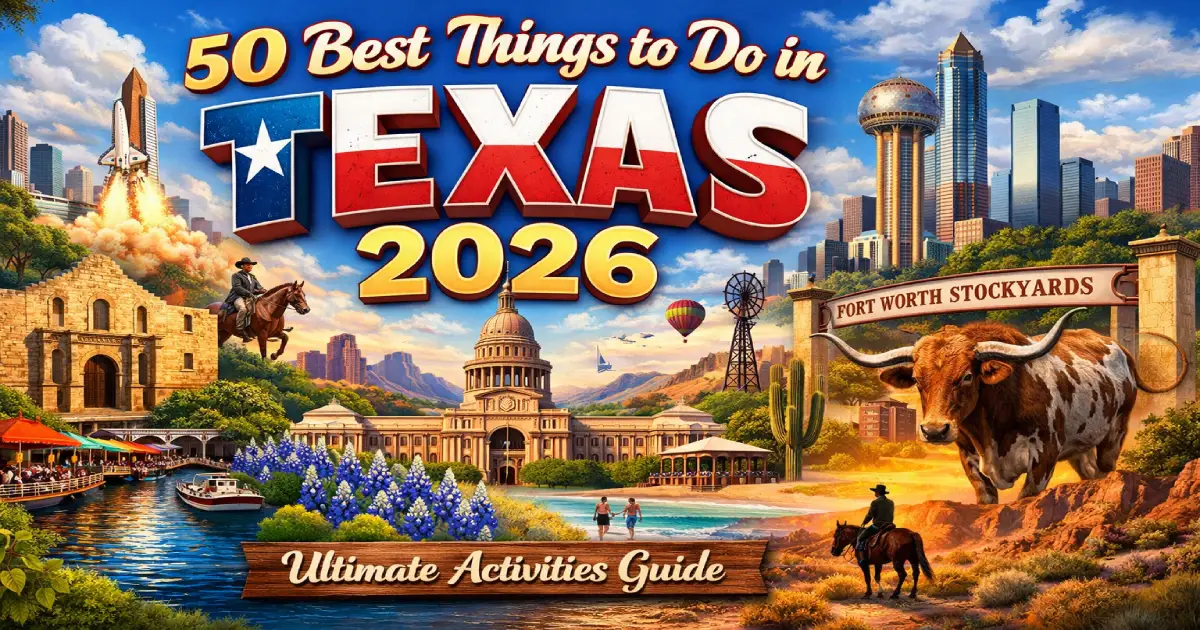
50 Best Things to Do in Texas 2026: Ultimate Activities Guide
Published on : 28 Mar 2026
Things to Do in Texas — America’s Most Activity-Diverse State, Region by Region
By Travel Tourister | Updated March 2026
Texas offers more genuinely distinct activities per square mile driven than any other American state — a place where you can hike through the Rio Grande’s most dramatic canyon in the morning, stargaze at one of America’s darkest skies that same night, tube down a spring-fed Hill Country river on the weekend, eat the most celebrated barbecue in the world the following afternoon, attend the world’s largest livestock show and rodeo the week after, and watch 1.5 million Mexican free-tailed bats spiral into the Austin dusk from the Congress Avenue Bridge at zero cost on any evening from March through October. The challenge of Texas activities is not finding things to do — it is making a plan that acknowledges the 800-mile width of the state, the specific seasonal windows that make each activity best, and the honest truth that the finest Texas activities require getting in the car and driving somewhere specific rather than waiting for the tourist corridor to deliver the experience.
I’ve done all of it in Texas across dozens of visits — the Santa Elena Canyon trail in Big Bend at 7 AM in November when the canyon walls are gold and the Rio Grande is jade-green and no other trail in the lower 48 produces this specific geological drama, the Franklin BBQ line at 7 AM on a Tuesday morning (arriving two hours before the 9 AM opening for the brisket that runs out by 1 PM at the most celebrated barbecue restaurant in America), the Kerrville Folk Festival on a Tuesday afternoon when the songwriter stage has three people watching and the song being performed is as good as anything on the main stage, and the Marfa Lights viewing area on a moonless October night when the unexplained lights appear and the West Texas desert is so quiet that you can hear the highway trucks 5 miles away. Each activity confirmed the same truth: Texas’s finest things to do are specific, seasonal, and rewards-compounding — the visitor who understands what makes each activity best will find experiences that no amount of money or planning can manufacture at a less optimal time or place.
This comprehensive 2026 guide breaks down Texas’s 50 best activities using verified information from Travel Texas, National Park Service resources, and years of on-the-ground expertise. We organize activities by category — outdoor and nature, history and culture, food and drink, music and entertainment, sports and adventure, family activities, and unique Texas — with realistic costs, timing, and strategic advice for experiencing the most versatile state in America.
Texas Activities by Category
Category
Top Activities
Best Region
Best Season
Outdoor & Nature
Big Bend hiking, Enchanted Rock, river tubing
West Texas, Hill Country, Gulf Coast
Oct–May
History & Culture
Alamo, Stockyards cattle drive, Space Center
San Antonio, Fort Worth, Houston
Year-round
Food & Drink
Texas BBQ, Tex-Mex, Hill Country wine
Central Texas, Hill Country
Year-round
Music & Entertainment
Austin live music, SXSW, Gruene Hall, ACL Fest
Austin, Hill Country
Year-round; festivals spring/fall
Unique Texas
Marfa Lights, bat colony, bluebonnets, rodeo
West Texas, Austin, Hill Country, Houston
Season-specific
Outdoor & Nature Activities
1. Hike Santa Elena Canyon in Big Bend National Park — MUST DO
Why It’s the Finest Hike in Texas: The Santa Elena Canyon Trail — a 1.6-mile round trip from the canyon trailhead in Big Bend National Park, crossing Terlingua Creek and entering the Rio Grande canyon where the limestone walls rise 1,500 feet directly above the river — is the single most dramatic short trail in Texas and one of the most geographically specific hikes in the American Southwest. The canyon walls that took the Rio Grande 1.4 million years to carve are close enough to touch on both sides in the narrowest section; the Mexican cliff on the right and the American cliff on the left are separated by 50–100 feet; and the light that enters the canyon in the morning hours produces a quality of illumination available at no other accessible trail in Texas.
Trail Details:
Distance: 1.6 miles round trip; 30 minutes to the canyon mouth, 45 minutes to the trail’s end at the narrowest section and back
The creek crossing: Terlingua Creek must be forded at the trail’s beginning — in dry conditions, this is an ankle-deep wade; after rain, assess before crossing
The canyon interior: 1,500-foot walls, 50–100 feet apart at the narrowest point, with the Rio Grande running between Mexican and American limestone. No trail exists in either country that produces this specific combination of scale, intimacy, and international context.
Best time: Morning (7–10 AM) in October–March for the finest light; summer temperatures in the canyon can reach 115°F — avoid June–September
Cost: $35/vehicle (7-day Big Bend pass); trailhead 35 miles from the Chisos Basin visitor center; nps.gov/bibe
2. Hike Enchanted Rock
The 425-foot pink granite batholith in the Hill Country — the 1.4-mile round trip summit trail climbs the open granite dome surface to a panoramic view of the Hill Country’s layered ridges that is the finest elevated view in Central Texas. The summit at sunrise, when the Hill Country mist is still in the valleys below and the granite is cool underfoot, is one of the finest free sunrise experiences in Texas.
Summit trail: 1.4-mile round trip, 450-foot elevation gain; moderate difficulty on open granite surface; no shade — bring water and sun protection
Back country trails: The 8-mile back-country loop encompasses the full rock formation and the surrounding creek drainage — the finest extended hiking in the Hill Country outside the state natural area’s extended trail system
Reservations required: tpwd.texas.gov; $8/adult; books out weeks ahead on spring and fall weekends
Cost: $8/adult; tpwd.texas.gov; 18 miles north of Fredericksburg; reservation required
3. Tube the Guadalupe or Comal River
Why It’s Texas’s Most Beloved Outdoor Activity: Hill Country river tubing — floating an inner tube down a spring-fed river at a constant 68–72°F through a tunnel of cypress trees, drinking a cold beer in the current, occasionally getting stuck on a submerged limestone ledge, and eventually arriving at the takeout point having accomplished nothing more purposeful than being carried downstream by cold clear water — is the most quintessentially Texas summer activity available anywhere in the state. New Braunfels (Guadalupe and Comal Rivers) is the epicenter; Wimberley (Blanco River) and Kerrville are the Hill Country alternatives.
Comal River (New Braunfels): The shortest tubing float (45 minutes, 1.8 miles) — the most popular, the most social, and the most consistently reliable flow. Tube rental from Rockin’ R River Rides or multiple New Braunfels outfitters ($15–$25/tube)
Guadalupe River (New Braunfels above Canyon Lake): A longer and wilder float — 3–5 hours depending on section; Class I–II rapids in the upper sections; the most adventurous accessible tubing in Central Texas
Best season: Memorial Day through Labor Day — the rivers are most crowded but most socially active; spring and fall offer more peaceful floats at the same 68°F temperature
Cost: $15–$25/tube; shuttle included from most outfitters; New Braunfels, 35 miles from San Antonio via I-35
4. Visit Big Bend’s Night Sky
Big Bend National Park’s International Dark Sky Park designation produces the darkest accessible sky in the lower 48 states on moonless nights — the Milky Way visible to the naked eye, with sufficient brightness to cast a shadow on clear August and September nights when the galactic core is overhead. The Chisos Basin campground, the Sam Nail Ranch ruins area, and the Rio Grande Village campground are the three finest stargazing locations inside the park.
Night sky conditions: Bortle Class 1–2 (the darkest scale category available in the continental United States) — the Andromeda Galaxy visible to the naked eye, the Orion Nebula distinguishable as non-stellar, and the Milky Way producing structural detail (dark nebulae, star clouds) that requires a dark-sky site of this quality to perceive
Best months: August–September (Milky Way galactic core overhead, longest darkness windows) and February–March (winter constellations, clear desert sky)
Cost: Included in Big Bend vehicle pass ($35); nps.gov/bibe
5. Drive the Hill Country Wildflower Season
Why It’s the Most Beautiful Annual Event in Texas: The Texas bluebonnet bloom (peak mid-March to mid-April, varying 1–2 weeks annually by winter rainfall) transforms the Hill Country’s roadsides, ranch fields, and highway medians into the most extensive wildflower display in the American South — 3,000+ square miles of blue-purple Texas lupine stretching from the I-35 corridor west to Fredericksburg, north to Llano, and south to San Antonio on routes that the Texas Department of Transportation has been seed-bombing since the Lady Bird Johnson Highway Beautification Act of 1965. The Willow City Loop (18 miles north of Fredericksburg), the US-290 Bluebonnet Highway, and the Ennis Bluebonnet Trails (45 miles south of Dallas) are the three finest bluebonnet corridors in Texas.
Willow City Loop (FM-1323, Gillespie County): 18 miles of ranch road through the most concentrated wildflower landscape in the Hill Country — bluebonnets, Indian paintbrush, and Texas phlox in the creek drainages and open granite fields from late March through mid-April. The ranchers leave their gates unlocked; the road is unpaved in sections; the beauty is genuine.
US-290 from Austin to Fredericksburg: 78 miles of the most accessible bluebonnet corridor in Texas — the highway median and the ranch roadsides bloom simultaneously in mid-March to mid-April
Texas Wildflower Hotline: 1-800-452-9292; daily updates on peak bloom locations during the season
Cost: FREE; rental car or own vehicle; peak mid-March to mid-April
6. Hike McKittrick Canyon (Guadalupe Mountains)
The most beautiful canyon in Texas — McKittrick Canyon in Guadalupe Mountains National Park is a spring-fed canyon of limestone walls and bigtooth maple trees that turns scarlet and gold in late October–early November, producing the most surprising and most spectacular fall foliage display in Texas. The 6.8-mile round trip trail to the Pratt Cabin and the Hunter Line Camp delivers the full canyon experience through the maple grove at peak color.
Fall color peak: Late October–early November (varies annually by 1–2 weeks depending on temperature and moisture) — the most specifically timed hike in Texas, where the optimal window may be only 7–10 days
Year-round value: The spring-fed creek, the limestone geology, and the canyon wildlife (mule deer, elk, and the largest population of Texas madrone trees in the park) make McKittrick Canyon excellent in any season
Cost: $15/person (Guadalupe Mountains); nps.gov/gumo; 110 miles east of El Paso
7. Watch the Congress Avenue Bat Colony Emergence (Austin)
The largest urban bat colony in the world — 1.5 million Mexican free-tailed bats living under the Congress Avenue Bridge in Austin, emerging at sunset from mid-March through late October in a 20–30 minute spiral that is the most spectacular free wildlife event in any American city. The bats emerge in groups beginning 20–30 minutes before sunset; the full colony’s emergence takes 30–45 minutes; the torrent of bats heading north up Barton Creek toward their foraging territory above the urban heat island is visible from both the Congress Avenue Bridge and the riverbank below.
Best viewing positions: On the Congress Avenue Bridge itself (walk to the middle for the eruption beneath your feet), the Bat Bar and Terrace at the W Hotel (elevated paid seating), or the Esther’s Follies outdoor deck ($0 with a drink purchase)
Best months: August–September for the largest colony (the pups have fledged and joined the adults, maximizing colony size)
Cost: FREE; Congress Avenue Bridge over Lady Bird Lake; March–October, sunset nightly
8. Kayak the Rio Grande (Big Bend Ranch State Park)
The Rio Grande through Big Bend Ranch State Park — the 67-mile stretch of river accessible by raft or kayak through the Colorado Canyon and the Closed Canyon, with 1,000-foot walls and the most remote river corridor accessible in Texas — is the finest multi-day river experience in the state and one of the finest wilderness paddling trips in the American Southwest. Day trips through the Closed Canyon (accessible from FM-170 near Redford) provide the most dramatic single-day paddling accessible in West Texas.
Closed Canyon (FM-170 near Redford): A 5-mile round trip walk up the slot canyon — narrow enough in sections to touch both walls simultaneously, the most dramatic slot canyon accessible on foot in Texas
Cost: State park day use $5; guided Rio Grande trips $95–$200/person from Terlingua outfitters; FM-170 River Road, West Texas
9. Swim at Barton Springs Pool (Austin)
The 68°F spring-fed pool in Zilker Park — a 1,000-foot-long natural swimming hole fed continuously by the Edwards Aquifer, open year-round, the most democratic and most quintessentially Austin public space in the city. The contrast between Austin’s 98°F August afternoons and the 68°F spring water is one of the most immediate and most reliably enjoyable physical experiences in Texas.
Year-round swimming: The constant 68°F means the pool is genuinely cold in winter (bracing, popular with the hardiest Austinites) and refreshingly cold in summer (the most effective natural air conditioning in Central Texas)
Cost: $5/adult; Zilker Park, Austin; open daily (hours vary seasonally)
10. Hike Palo Duro Canyon
The Lighthouse Trail in Palo Duro Canyon State Park — 5.8 miles round trip to the canyon’s signature 75-foot rock formation, through the multi-colored layers of red, purple, and white rock that make the “Grand Canyon of Texas” the most dramatic geological landscape in the Panhandle. The canyon walls (up to 800 feet deep, 6 miles wide) produce a landscape of genuine grandeur in an otherwise entirely flat region.
The Lighthouse Trail: The most rewarding Palo Duro hike — the rock formation at the end is the most photogenic single geological feature in the Panhandle, and the 2.9 miles of multi-colored canyon walking to reach it justifies the full round trip
Cost: $8/adult; tpwd.texas.gov; 12 miles east of Canyon, TX; 25 miles south of Amarillo
11. Snorkel at Pedernales Falls State Park
The Edwards Plateau’s finest swimming holes — Pedernales Falls State Park’s swimming area and the natural limestone pools immediately downstream of the falls provide the most accessible and most geologically interesting swimming in the Hill Country, in water so clear that the individual limestone layers of the river bottom are visible from the surface
The swimming hole: A deep pool below the falls — accessible via a 0.5-mile trail from the parking area, the most popular swimming destination in the LBJ country Hill Country day-trip range from Austin
Cost: $6/adult; tpwd.texas.gov; 32 miles west of Austin via Highway 290
12. Walk the Texas State Parks Birding Trails (South Texas / Gulf Coast)
The Great Texas Coastal Birding Trail — 43 wildlife viewing sites along the Gulf Coast from the Louisiana border to the Mexico border — is the most productive birding corridor in the United States and one of the most diverse in the world, accessible to any visitor with binoculars and a willingness to drive FM roads through the coastal prairies, freshwater marshes, and barrier island habitats where over 600 bird species have been documented
Aransas National Wildlife Refuge (Rockport): The winter home of the whooping crane — the most endangered large bird in North America; viewing accessible by boat tour from Rockport ($45–$75/person) or from the refuge’s observation tower ($3/person, free with America the Beautiful pass)
South Padre Island World Birding Center: The premier fall raptor migration observation platform in Texas — October hawk counts regularly exceed 10,000 birds per day during peak migration
Cost: Free to drive the trail; individual site fees vary; tpwd.texas.gov/huntwild/bird/coastal/
History & Culture Activities
13. Visit the Alamo (San Antonio) — MOST IMPORTANT HISTORICAL ACTIVITY
Why Essential: The Alamo — the 1718 Spanish mission, 1836 battle site, and most loaded three acres in Texas — is the physical location of the state’s founding mythology and the most visited historical site in Texas. The 13-day siege and battle (February 23–March 6, 1836) where 189–257 Texian defenders held against Mexican forces before being overwhelmed produced the rallying cry that secured Texas independence 46 days later at San Jacinto. Standing in the Alamo church, reading Travis’s letter (displayed in the Long Barracks museum), and understanding the specific geography of the compound — far smaller than the paintings suggest — is the most specific and most essential Texas historical activity.
The church (free entry): The 1757 mission church with its distinctive curved facade — the most recognizable building facade in Texas; the interior flags of the six nations that have governed Texas and the battle artifacts
The Long Barracks and museum ($22/adult): The oldest surviving structure on the site, where the final defenders made their last stand — Travis’s letter (“I will never surrender or retreat”), Bowie’s knife, and the most comprehensive archaeological documentation of the 1836 battle
The new Alamo museum (2024): The recently opened cultural center providing the most thorough historical context for the site’s full 300-year history
Cost: Church free; museum $22; thealamo.org; Alamo Plaza, downtown San Antonio; open daily
14. Watch the Fort Worth Stockyards Cattle Drive
Why It’s the Most Texas Activity Available: The twice-daily longhorn cattle drive on Exchange Avenue in the Fort Worth Stockyards (10 AM and 4 PM, seven days a week, every week of the year) is the only twice-daily scheduled longhorn cattle drive in the world — Texas longhorns with 6-foot horn spans driven by cowboys on horseback down the brick-paved Exchange Avenue while the tourist crowd parts for the animals and the cowboys holler and the specific atmosphere of a working cattle town that has been doing this since 1890 fills the air. It is free. It happens twice a day. Nothing in Texas is more continuously and more reliably itself than this.
Arrive 15 minutes early on Exchange Avenue between Main Street and Stockyards Boulevard — the cattle come from the west and the crowd closes behind them heading east
The cowboys: Working cowboys employed by the Stockyards — not actors performing a simulation but genuine practitioners of the cattle-handling tradition that made Fort Worth’s economy for 100 years
After the drive: The White Elephant Saloon (open since 1887 in its current form), the Stockyards Hotel, and Billy Bob’s Texas are within 200 feet of the cattle drive route
Cost: FREE; Exchange Avenue, Fort Worth Stockyards; 10 AM and 4 PM daily
15. Tour Space Center Houston
The Apollo Mission Control room, the Saturn V rocket, and the active Johnson Space Center campus — Space Center Houston delivers the most hardware-rich spaceflight experience accessible at any American museum. The tram tour of the active JSC campus (including the International Space Station training mockup) produces the most direct engagement with current human spaceflight operations available to the general public anywhere in the world.
Strategy: Book online for $5 discount; arrive at 10 AM opening; tram tours depart every 20 minutes and fill quickly; the Saturn V Center (separate tram stop) requires 90 minutes of its own
Cost: $35/adult; spacecenter.org; Clear Lake, 25 miles from downtown Houston
16. Tour the San Antonio Missions
The five Spanish colonial missions along the San Antonio River — the Alamo plus Mission Concepción, Mission San José, Mission San Juan, and Mission Espada — constitute the only UNESCO World Heritage Site in Texas and the most intact Spanish colonial mission system in the United States. The 9-mile Mission Trail connects all five by bicycle (rentals at the Alamo Visitor Center) or car, and three of the four non-Alamo missions are still operating as active Catholic parishes with Sunday masses open to respectful visitors.
Mission San José: The “Queen of the Missions” and its Rose Window (a Spanish Baroque stone carving that is the finest piece of 18th-century decorative stonework in Texas) — the most architecturally significant stop on the Mission Trail
Cost: FREE; nps.gov/saan; 9-mile Mission Trail, San Antonio; open daily
17. Attend the Houston Livestock Show and Rodeo
The world’s largest livestock show and rodeo — 2.5 million attendees over 20 consecutive days every March, combining world-class rodeo competition, major country and pop music concerts, the world’s largest junior livestock auction, and the specific civic energy that Houston generates for this single annual event. Attending the Rodeo is the most broadly immersive Texas cultural experience available in a single evening — the bull riding, the barrel racing, the livestock barns, the carnival midway, and the concert that follows the rodeo combine into an experience that is simultaneously spectacular entertainment and genuine agricultural heritage.
Strategy: General admission ($20) gets you into everything except the concert seating; concert floor tickets ($35–$125) sell out within hours of release in December/January; go on a Tuesday night when the livestock barns are full and the crowds are manageable
Cost: General admission $20; concert floor $35–$125; rodeohouston.com; NRG Stadium, Houston; March annually
18. Visit the Sixth Floor Museum at Dealey Plaza (Dallas)
The most carefully presented and most emotionally specific history museum in Dallas — the Sixth Floor Museum in the former Texas School Book Depository documents the Kennedy assassination with primary source audio, video, and artifacts (the sniper’s perch window preserved behind glass, the original Zapruder film, Warren Commission documentation) in the most intellectually honest and most moving single-building museum experience in Texas
The audio guide: Included with admission — the most essential museum audio guide in Texas, providing context that transforms the physical space from a building with a view to the most specific room in American political history
Cost: $18/adult; jfk.org; 411 Elm Street, Dallas; open daily
19. Tour the Chinati Foundation (Marfa)
Donald Judd’s permanent installation in the former Fort D.A. Russell artillery sheds — 100 untitled works in mill aluminum arranged in two artillery sheds (15,000 square feet each) that constitute the most significant minimalist art installation in the world. The Thursday–Sunday guided tours are the only way to access the aluminum works and the adjacent fluorescent light sculptures by Dan Flavin; the experience of the aluminum’s reflections in the shed’s light at different times of day is specifically what Judd designed the installation to produce.
The experience: 2+ hours for the full foundation tour — the aluminum works in the morning light versus the afternoon light produce genuinely different visual experiences; the tour guides’ knowledge of Judd’s philosophy is essential context
Cost: $25/adult; chinati.org; Fort D.A. Russell, Marfa; Thursday–Sunday tours
20. Experience the San Antonio River Walk at Night
The San Antonio River Walk after dark — the cypress trees strung with lights, the mariachi music from the outdoor restaurant patios, the reflections of the illuminated bridges in the river, and the 20-foot-below-street-level perspective that makes the sounds of the city above inaudible — is the most atmospheric evening walk in any Texas city and the most specifically un-Texas outdoor experience in the state: a romantic, European-feeling canal city that exists nowhere else in the Southwest.
Best time: 8–10 PM on a weekend evening in the spring or fall — warm enough for outdoor dining, cool enough for comfortable walking, and the string lights at their most atmospheric against the dark sky
Cost: FREE; downtown San Antonio; open 24 hours; thesanantonioriverwalk.com
Food & Drink Activities
21. Eat Central Texas BBQ — THE MOST TEXAS FOOD ACTIVITY
Why Texas BBQ Is the Most Important Food Activity in the State: Central Texas barbecue — post-oak smoked beef brisket, sold by the pound on butcher paper with white bread and pickles in a no-frills dining room by pit masters who arrive at 2 AM to tend a fire that will produce lunch at 11 AM — is the most celebrated regional food tradition in American barbecue and the most specifically Texas food experience available anywhere in the world. The “barbecue belt” from Austin through Lockhart to Luling contains the most concentrated excellence of any regional food tradition in the state.
Franklin Barbecue (Austin): The most celebrated barbecue restaurant in America — Aaron Franklin’s East Austin operation produces brisket of extraordinary quality to a line that forms before the 9 AM opening and sells out by 1–2 PM daily. Arrive by 7 AM for the line; bring lawn chairs; the brisket is worth every minute ($25–$30/lb)
Kreuz Market (Lockhart): The 1900 institution that defines the Lockhart barbecue tradition — no sauce, no forks, shoulder clod and brisket cut to order on the butcher’s counter, the most historically continuous barbecue experience in Texas ($18–$24/lb)
City Market (Luling): The most atmospheric barbecue room in Texas — a meat market since 1958 with a smoke room in the back, brisket and ribs at the counter, and the specific dignity of a place that has been doing the same thing the same way for 66 years ($16–$22/lb)
Snow’s BBQ (Lexington): Open Saturday mornings only (8 AM until sold out, typically by noon) — the Texas Monthly No. 1-ranked barbecue, run by octogenarian pit mistress Tootsie Tomanetz; the most specifically timed barbecue pilgrimage in Texas
Cost: $15–$30/lb for brisket; sides $3–$5 each; Austin, Lockhart (30 miles from Austin), Luling (60 miles from Austin), Lexington (70 miles from Austin)
22. Do the Texas Hill Country Wine Trail
The 50+ wineries between Fredericksburg and Dripping Springs — the most concentrated wine region in Texas, with Becker Vineyards, Pedernales Cellars, Grape Creek Vineyards, and the boutique producers of the Hye and Stonewall corridor creating a self-guided trail through the most beautiful Hill Country vineyard landscape. Texas wine has improved dramatically in the past decade — the best producers are genuinely excellent, and the tasting room experiences (most with Hill Country views from the patio) are among the finest in any American wine region for atmosphere.
Strategy: Choose 3–4 wineries per day maximum; designate a driver or hire the Fredericksburg wine tour shuttle; the best tastings are at the smaller producers where the winemaker pours the flights personally
Cost: $15–$25/tasting per winery; self-guided; Fredericksburg hub, 80 miles from San Antonio
23. Eat Breakfast Tacos in Austin
The breakfast taco — a flour tortilla with scrambled eggs and any combination of bacon, chorizo, potato, cheese, beans, and salsa — is the most democratic and most beloved Austin breakfast food, available from taco trucks at 6 AM and from sit-down taquerias from 7 AM, representing the Mexican-American culinary tradition that defines Austin’s food culture more completely than any other single preparation. Juan in a Million on East Caesar Chavez is the most celebrated breakfast taco institution; Tacodeli is the most consistent; and the taco truck at whatever gas station you pass on the way out of town is probably excellent.
Juan in a Million (2300 E. César Chávez): The Don Juan breakfast taco (eggs, potato, bacon, cheese, in a flour tortilla the size of a dinner plate) — the most celebrated single breakfast taco in Austin ($4–$6)
Cost: $2–$6/taco; Juan in a Million and multiple Austin taco institutions; open daily from 6–7 AM
24. Attend a Texas Honky-Tonk Dance Night
The Texas honky-tonk — a dancehall where the dance floor is the primary feature, the beer is cold Shiner Bock or Lone Star, and the music is country, western swing, or Texas blues — is a social institution with no exact equivalent in any other American state. Gruene Hall (since 1878 — oldest continuously operating dance hall in Texas) in New Braunfels, the Broken Spoke in Austin (since 1964 — the most authentic remaining Austin honky-tonk), and Billy Bob’s Texas in the Fort Worth Stockyards (the largest honky-tonk in the world) are the three finest.
Broken Spoke (3201 S. Lamar, Austin): The last genuinely old-school Austin honky-tonk — two-step lessons before the band starts on Wednesday and Thursday nights; the best entry point for visitors who have never two-stepped ($10–$15 cover on live music nights)
Cost: $10–$25 cover; Gruene Hall, Broken Spoke, and Billy Bob’s Texas
25. Visit a Texas Craft Brewery (Austin or Fort Worth)
Texas’s craft beer scene — anchored by Austin’s Live Oak Brewing, Jester King Brewery (farmhouse ales on a 58-acre farmstead outside Austin), and Fort Worth’s Martin House Brewing (the most experimental brewery in DFW) — has produced the finest brewing culture in the South. Jester King specifically (15 miles southwest of Austin on Hamilton Pool Road) is the most atmospheric Texas craft brewery: Belgian-influenced farmhouse ales aged in oak on a working farm, with picnic tables in a Hill Country landscape that makes the barrel-aged saison taste like a specific place and a specific season.
Jester King Brewery (13187 Fitzhugh Road, Austin): Open Friday–Sunday; the most critically celebrated craft brewery in Texas; the farmhouse setting and the wild fermentation program make it the most specifically rewarding Texas brewery visit
Cost: Beer $6–$10/glass; Jester King open Friday–Sunday; 15 miles from Austin
Music & Entertainment Activities
26. See Live Music on 6th Street (Austin) — THE MOST AUSTIN ACTIVITY
Why Essential: Austin’s 6th Street entertainment district — from Congress Avenue to Red River Street — produces more live music simultaneously in a 6-block radius than any other urban location in the United States, with every bar and venue running live acts from 9 PM to 2 AM on any Friday or Saturday night. The open-container street atmosphere (Friday and Saturday nights), the music from competing stages overlapping in the street, and the specific Austin outdoor entertainment culture create an experience that is both completely democratic (free to walk, with cover charges only at the door if you choose to enter) and genuinely extraordinary for the variety and quality of music accessible without a ticket.
Continental Club (1315 S. Congress Avenue): The most serious live music venue in Austin — roots, honky-tonk, and rock and roll since 1957; the epitome of the Austin live music tradition for visitors who want quality over volume ($0–$10 cover)
Stubb’s Amphitheater (801 Red River): The outdoor limestone amphitheater — the most beloved full-production outdoor venue in Austin, the site of the Stubb’s Gospel Brunch (Sunday mornings, $30) and major touring acts ($20–$65)
The Red River Cultural District: The 3-block stretch of Red River Street containing Emo’s, Mohawk, and Antone’s — the most concentrated independent music venue block in Austin, producing the most diverse genre range of any Austin entertainment corridor
Cost: Free street walking; venue covers $0–$20; open nightly from 9 PM
27. Attend Austin City Limits Music Festival (October)
One of America’s finest outdoor music festivals — two weekends in October in Zilker Park with 130+ acts on 8 stages, the Austin skyline as backdrop, and a 75,000-person-per-day capacity that still manages to feel less crowded than most comparable festivals due to Zilker Park’s 358-acre footprint. The ACL Fest lineup consistently spans the full range of popular music (indie, country, hip-hop, electronic, rock) with headliners from the current A-list of American and international recording artists.
Single-day tickets: $110–$150 (released January–February); 3-day passes: $275–$325; book immediately on sale date
ACL TV show taping (year-round): The Austin City Limits television program (the longest-running music show in American television history) tapes at the Moody Center with individual artist tickets available at the ACL website
Cost: Single day $110–$150; aclfestival.com; Zilker Park, Austin; first and second weekends of October
28. Dance at Gruene Hall
The oldest continuously operating dance hall in Texas (open since 1878) — Gruene Hall’s corrugated tin roof, bare wood dance floor, cold Shiner Bock, and live music on Friday and Saturday nights (and many weekday evenings) delivers the most historically continuous and the most authentic Texas dance hall experience accessible. George Strait and Lyle Lovett performed their first paying gigs here; the tradition has not changed materially since 1878.
Two-step: The Texas two-step is the native dance form — the floor at Gruene Hall is the most appropriate in Texas to learn it, with locals who will help a willing beginner
Cost: $10–$25 cover on live music nights; Gruene, New Braunfels; 45 miles from Austin
29. Attend SXSW (Austin, March)
South by Southwest — the annual convergence of music, film, technology, and culture in Austin every March — is the largest interactive and music festival in the world, with 2,000+ musical acts, 400+ film screenings, and 1,000+ technology and culture sessions across 10 days in downtown Austin. The free outdoor performances (on the official outdoor stages and at the unofficial day parties that populate every available venue) provide the most accessible live music of any SXSW week for the visitor who doesn’t purchase a badge.
Free SXSW: The outdoor stages on 6th Street, Red River, and Rainey Street during SXSW week present the most concentrated free live music accessible in any American city at any time of year — dozens of free day parties from noon–7 PM at venues throughout downtown Austin
Cost: Badges $400–$1,650 (full festival access); outdoor stages and day parties often free; sxsw.com; March annually
30. Attend a San Antonio Spurs or Dallas Cowboys Game
Texas’s most successful professional sports franchises — the San Antonio Spurs (5 NBA championships, the most of any franchise outside the Lakers and Celtics in recent decades) and the Dallas Cowboys (the “America’s Team” narrative, Jerry World, and the most recognized NFL franchise globally) represent the full range of Texas sports culture from the intimate AT&T Center in San Antonio to the 80,000-seat AT&T Stadium in Arlington
San Antonio Spurs (AT&T Center): The most intimate NBA arena experience in Texas — the post-Duncan/Popovich era Spurs are rebuilding, producing the most accessible tickets at the most reasonable prices of any era in recent Spurs history ($35–$150)
Dallas Cowboys (AT&T Stadium, Arlington): The most spectacular NFL stadium experience in Texas — the 80,000-seat venue with the world’s largest high-definition video screen produces the most visually overwhelming NFL experience available ($85–$400)
Cost: Spurs $35–$150; Cowboys $85–$400; book at nba.com/spurs or nfl.com/cowboys
Unique Texas Activities
31. See the Marfa Lights
Why Marfa Lights Are the Most Mysterious Free Activity in Texas: The Marfa Lights — unexplained atmospheric light phenomena visible from the Marfa Lights Viewing Area on US-67 east of Marfa since their first documented observation in 1883 — are the most specifically mysterious free natural phenomenon in Texas and one of the most genuinely unexplained recurring natural events in North America. The lights (typically 2–5 visible on a clear night, appearing as basketball-sized glowing orbs that divide, merge, and move at varying speeds) are not car headlights, which appear on the adjacent highway as a reference point; the distinction is immediately apparent at the viewing area. The scientific explanation remains contested; the observation is free; the experience is specific to Marfa and available on most clear nights.
Viewing area: The official Texas historical marker and viewing platform 9 miles east of Marfa on US-67 — benches, interpretive signage, and the open desert horizon where the lights appear above the Chinati Mountains
Best conditions: Clear, moonless nights; the lights are most active and most distinct without the competing illumination of the moon
Reference point: The highway on the distant left shows car headlights — the Marfa Lights appear to the right of the highway, at higher elevation, and behave differently
Cost: FREE; 9 miles east of Marfa on US-67; open 24 hours; best after 10 PM
32. Walk the Apollo Mission Control Room (Space Center Houston)
The Apollo FCR-1 (Flight Control Room 1) at Johnson Space Center — preserved exactly as it appeared on July 20, 1969, including the flight controllers’ coffee cups, the ashtray on the Flight Director’s console, and the trajectory displays showing the Apollo 11 crew’s position relative to Earth and Moon — is the most moving room in any American science museum. The specific silence of the room, the specific quality of the preservation, and the specific historical weight of being in the physical space where the Moon landing was guided by a team of 26-year-old engineers produce an experience that no documentary or photograph can replicate.
Cost: Included with Space Center Houston admission ($35); spacecenter.org
33. Photograph Texas Bluebonnets in the Hill Country
The annual ritual of driving the Hill Country wildflower routes — parking on the roadside, placing children (and adults) in the bluebonnet fields for photographs, and continuing down FM roads flanked by blue-purple Texas lupine and Indian paintbrush — is the most widely participated annual photographic activity in Texas and the most specifically Texas outdoor experience available in the state’s most beautiful season. The photograph of children in a bluebonnet field is a Texas rite of passage with no equivalent in any other American state.
Willow City Loop: The most concentrated and most scenic 18 miles of wildflower photography in Texas — the loop from Fredericksburg through the granite hills to Llano and back via Highway 16 delivers the most Hill Country character per mile of any wildflower drive
34. Attend a Kerrville Folk Festival (Late May–Early June)
The longest-running folk festival in the United States — 18 days of continuous music on the Quiet Valley Ranch outside Kerrville, with the most supportive and most knowledgeable folk music audience in America, the New Folk Competition (the finest emerging songwriter competition in American acoustic music), and the camping community of festival attendees who return annually for decades. The Wednesday afternoon songwriter stage, when the audience is small and the performers are less guarded, is the finest acoustic music experience in Texas.
Cost: Day tickets $25–$35; season passes $275; kerrvillefolkfestival.org; 60 miles from San Antonio
35. Drive the River Road (FM-170, West Texas)
The most scenic paved road in Texas — FM-170 from Presidio along the Rio Grande to the Big Bend Ranch State Park entrance and continuing to Terlingua delivers 50 miles of Rio Grande canyon driving with the Sierra Madre rising in Mexico on the right and the Chihuahuan Desert on the left. The Closed Canyon (a 5-mile round trip slot canyon walk accessible from the roadside) and the Big Bend Ranch’s Colorado Canyon overlook are the two finest stops on the most scenic route in West Texas.
Cost: FREE road; Big Bend Ranch State Park day use $5; accessible from Presidio (60 miles south of Marfa)
36. Take the McDonald Observatory Star Party
The University of Texas’s public astronomy program in the Davis Mountains — Tuesday, Friday, and Saturday evening Star Parties at the McDonald Observatory ($15/adult) provide the most educationally comprehensive public astronomical viewing in the United States, with the 82-inch Struve Telescope available for public observation on designated evenings, staff astronomers providing narration throughout, and a sky so dark that the Milky Way is visible to the naked eye from the parking area before the program begins.
Cost: $15/adult; mcdonaldobservatory.org; Fort Davis; 190 miles from Midland; reservations recommended
37. Visit Prada Marfa
The Elmgreen and Dragset permanent art installation on US-90, 37 miles northwest of Marfa — a faux Prada boutique in the Chihuahuan Desert, stocked with actual Prada merchandise that cannot be purchased, permanently lit, and maintained by the art foundation that commissioned it. The most photographed free roadside attraction in Texas and the most specific expression of the art-vs-commerce argument that Marfa’s art community has been having with the international luxury brand world since Judd moved to West Texas in 1971.
Cost: FREE; US-90, 37 miles northwest of Marfa; open 24 hours
38. Swim in Jacob’s Well
The 12-foot diameter artesian spring in the Wimberley area — a vertical shaft of the clearest spring water in the Hill Country, flowing continuously from the Edwards Aquifer limestone, accessible for swimming above the underwater cave entrance (the cave system below is open to certified cave divers only). The combination of the crystal-clear water, the circular opening, and the specific turquoise-green color of the spring’s flow makes Jacob’s Well the most photogenically perfect swimming hole in Texas.
Cost: $10/person; reservation required at jacobswellnaturalarea.com; Wimberley; 45 miles from Austin
Family Activities in Texas
39. San Antonio Zoo
One of the finest zoos in the South — 750+ species in 35 acres of Brackenridge Park, with the Africa Live exhibit (the largest natural habitat gorilla exhibit in any Texas zoo), the Natural Bridge Wildlife Ranch (22 miles north of San Antonio, 450 acres of drive-through wildlife) as the regional alternative. The most complete family wildlife destination in South Texas.
Cost: $25/adult; sazoo.org; 3903 N. St. Mary’s Street, San Antonio
40. Natural Bridge Wildlife Ranch
Texas’s finest drive-through wildlife experience — 450 acres of Hill Country ranch with 500+ animals from 40 countries viewable from your vehicle at close range (giraffes eating from your car window is the standard experience). The most accessible and most dramatically interactive wildlife experience in San Antonio’s regional day-trip range.
Cost: $25/adult; naturalbridgewildliferanch.com; 26 miles north of San Antonio
41. Six Flags Fiesta Texas (San Antonio)
The finest theme park in San Antonio — 200 acres in a former limestone quarry, with the quarry walls providing the most dramatically scenic backdrop of any Six Flags location. Iron Rattler (the hybrid steel-wood coaster) is the most celebrated single coaster in the park.
Cost: $60–$85/adult (online); sixflags.com; 17111 I-10 West, San Antonio
42. Natural Bridge Caverns
The largest commercial cavern in Texas — the 60°F underground temperature makes it the most popular summer escape in San Antonio’s day-trip geography. The Discovery Tour (1.25 miles underground) delivers the most comprehensive cave formation experience accessible from San Antonio.
Cost: $25/adult; naturalbridgecaverns.com; 26 miles north of San Antonio
43. Schlitterbahn Water Park (New Braunfels)
Consistently voted America’s best water park — Schlitterbahn in New Braunfels uses the spring-fed Comal River as the basis for its rides (the master blaster uphill water coaster was invented here) and has been the most celebrated water park in Texas since the first slide opened in 1979.
Cost: $55–$75/adult; schlitterbahn.com; New Braunfels; 35 miles from San Antonio
44. Moody Gardens (Galveston)
Three glass pyramids on Galveston Bay — the Aquarium Pyramid, the Rainforest Pyramid, and the Discovery Pyramid, with a fourth outdoor water park, a 3D IMAX theater, and a Colonel Paddlewheel boat cruise on the bay. The most comprehensive family entertainment complex on the Texas Gulf Coast.
The largest ranch in the contiguous United States (825,000 acres — larger than Rhode Island) offering guided tours of the working ranch operations, the Santa Gertrudis cattle breeding program (the first beef cattle breed developed in America, created at King Ranch in 1940), and the King Ranch Museum’s collection of ranch history artifacts and photography. The most specifically Texas large-scale working ranch experience accessible to tourists.
Cost: Ranch tour $20; king-ranch.com; Kingsville; 45 miles from Corpus Christi
46. Walk the Riverwalk During Fiesta San Antonio (April)
Fiesta San Antonio — the 11-day citywide celebration every April commemorating the battles of the Alamo and San Jacinto — is the most specifically San Antonio annual event: 100+ events including the Battle of Flowers Parade (one of the largest parades in the US), the Fiesta Oyster Bake, the Night in Old San Antonio (NIOSA) at La Villita, and the illuminated River Parade. The River Walk during Fiesta week is the most festive and the most specifically San Antonio version of itself available in any annual calendar.
Cost: Most events $10–$25; fiesta-sa.org; San Antonio; April annually
47. Visit the Panhandle-Plains Historical Museum (Canyon)
The largest state history museum in the United States — the Panhandle-Plains Historical Museum in Canyon, Texas contains the most comprehensive collection of Texas cultural, natural, and geological history at any single institution, with the finest dinosaur fossil collection in Texas (including the 40-foot Quetzalcoatlus northropi wingspan replica) and the most complete documentation of the Texas Panhandle’s petroleum and ranching economy.
Cost: $12/adult; panhandleplains.org; Canyon, TX; 15 miles south of Amarillo
48. Attend the Texas State Fair (Dallas, September–October)
The largest state fair in the United States — 24 days at Fair Park in Dallas, with the Big Tex mascot (55 feet tall), the most innovative fried food competition in America (fried butter, fried Oreos, and the annual new fried food contest winner), the Cotton Bowl football game, and the 277 acres of exhibitions, rides, and entertainment that have made the Texas State Fair the most attended annual event in the state of Texas.
Cost: $18/adult admission; bigTex.com; Fair Park, Dallas; late September–October annually
49. Kayak the Guadalupe River
The Guadalupe River above Canyon Lake — Class I–II rapids through a limestone canyon corridor with cypress trees arching over the water — produces the most adventure-oriented river experience accessible from San Antonio, with outfitters operating from multiple put-in points between Kerrville and Canyon Lake. The most commonly run section (from above Sattler to Canyon Lake) delivers 5–7 hours of continuous river canyon paddling through the finest Hill Country river scenery accessible by kayak.
Cost: Kayak rental $40–$60/day from New Braunfels or Kerrville outfitters; shuttle included
50. Experience the Cadillac Ranch at Sunset (Amarillo)
The Ant Farm’s 1974 public art installation — 10 Cadillacs buried nose-first in a wheat field west of Amarillo, spray-painted by visitors continuously since 1974 — is the most visited free roadside attraction in Texas. The experience at sunset, when the West Texas light turns the wheat gold and the spray-painted steel catches the last horizontal light, is the most specifically Texas combination of artistic ambition, automotive heritage, and High Plains landscape accessible at zero cost in the state.
Cost: FREE; I-40 frontage road west of Amarillo; open 24 hours; bring spray paint
Texas Activities: Practical Tips
Topic
What to Know
Franklin BBQ Strategy
Franklin Barbecue in Austin is the most celebrated BBQ in America — and the most logistically demanding. The restaurant opens at 9 AM Tuesday–Sunday; the line begins forming at 6–7 AM; sell-out typically occurs by 1–2 PM. Aaron Franklin’s team makes a finite quantity of brisket daily — there is no second batch. Strategy: Arrive by 7 AM; bring lawn chairs, coffee, and friends; the line conversation is genuinely enjoyable; the brisket is worth every minute. Order strategy: brisket (the primary purpose), turkey (the second-best option), and the pork ribs (underrated, excellent). Take more than you think you need — the drive back to the hotel with leftover Franklin brisket is one of the finest travel experiences in Texas.
Big Bend Logistics
Big Bend is 305 miles from San Antonio, 395 miles from El Paso — plan 3 nights minimum. Gas up completely in Alpine or Marathon (the last full-service towns before the park). Bring all food and water from Alpine or Marathon — the park’s store has limited selection at premium prices. Cell service: nonexistent inside the park (warn contacts of this before departure). Lodging: Chisos Mountains Lodge (book 6+ months ahead; chisosmountainslodge.com) is inside the park; Terlingua ghost town (10 miles from the west entrance) has funky, affordable options. Heat warning: May–September temperatures in the desert sections can exceed 110°F; the Chisos Basin (5,400 feet) stays 10–15°F cooler; Santa Elena Canyon is in a sun-exposed desert section — hike before 9 AM in summer.
Hill Country River Tubing
The Hill Country rivers (Guadalupe, Comal, Frio, Blanco) are most crowded on summer holiday weekends (Memorial Day, July 4th, Labor Day) and can feel like a moving party rather than a nature experience. For a more peaceful float: choose weekday visits in June or late August; the Frio River near Garner State Park (90 miles west of San Antonio) is less crowded than the New Braunfels rivers; the Blanco River in Wimberley is the finest scenery. Sunscreen is essential (the water reflects UV); reef-safe sunscreen is not legally required on Texas rivers but is recommended for ecological stewardship. Leave no trace: pack out everything you bring in.
Austin Live Music
The Continental Club and the Saxon Pub (the two finest small venues for authentic Austin music) have cover charges of $0–$15 and require no advance booking. 6th Street is free to walk; most venues charge $5–$15 covers at the door. For the best Austin music without the 6th Street tourist density: the Red River Cultural District (Mohawk, Emo’s, Beerland) produces the most diverse and most seriously attended live music in Austin. The Continental Club’s Monday night sets are the most consistently excellent and the least attended of any regular Austin venue programming. SXSW free day parties (March) are the single finest free live music opportunity in Austin’s annual calendar.
Seasonal Activity Windows
Spring (March–May): Bluebonnets and wildflowers (mid-March to mid-April), SXSW (March), Fiesta San Antonio (April), Hill Country comfortable hiking, Big Bend and Guadalupe Mountains ideal temperatures. Fall (October–November): Lost Maples fall color (late October), Austin City Limits Festival (October), McKittrick Canyon color (late October), post-summer price reductions statewide, Big Bend best temperatures. Summer (June–September): Hill Country river tubing peaks, Gulf Coast beaches, Austin bat colony at maximum colony size (August–September), AVOID West Texas and Big Bend desert hikes June–August (110°F+ heat is genuinely dangerous). Winter (December–February): Big Bend comfortable (50–70°F days), Houston Livestock Show and Rodeo preparation, uncrowded Hill Country, Christmas lights on the San Antonio River Walk.
Tipping
20% standard at Texas sit-down restaurants. Franklin Barbecue and other Central Texas BBQ institutions: counter service with a tip jar — $3–$5/person tip is appreciated at owner-operated BBQ restaurants that have maintained quality for decades. Fort Worth Stockyards cowboys: Do not attempt to tip the cowboys driving the cattle — they are employees doing a job, not performers expecting gratuity. Honky-tonk bars: $1–$2/drink tip at the bar, $3–$5 tip at table service. Tour guides (Space Center, Alamo, Chinati Foundation): $5–$10/person tip for a genuinely excellent tour guide is the most appreciated and least common tip in Texas’s tourism economy.
Frequently Asked Questions: Things to Do in Texas
What is the #1 thing to do in Texas?
This depends entirely on your location in the state and your interests — Texas’s geographic range makes a single #1 answer misleading. For visitors to San Antonio: the Alamo (the most specifically Texas historical experience, free to enter) combined with an evening on the River Walk is the most essential San Antonio activity pairing. For Austin: watching the Congress Avenue bat colony emergence at sunset (free, 1.5 million bats, March–October) and experiencing live music on 6th Street the same evening is the most quintessentially Austin evening available. For the Houston area: Space Center Houston’s Apollo Mission Control room (the most moving room in any American science museum). For the entire state: hiking the Santa Elena Canyon in Big Bend is the single most geographically dramatic and most specifically irreplaceable activity in Texas — the 1,500-foot canyon walls, the Rio Grande, and the international context create an experience available at no other trail in the lower 48 states.
What outdoor activities is Texas best known for?
Texas’s outdoor activity identity rests on five pillars: (1) Big Bend National Park hiking — Santa Elena Canyon and the Window Trail represent the most dramatic wilderness hiking in the state; (2) Hill Country river tubing — the Guadalupe and Comal Rivers’ spring-fed 68°F floats are the most beloved summer outdoor activity in Central Texas; (3) Gulf Coast fishing and beaching — Padre Island National Seashore and Port Aransas represent the most undeveloped and most ecologically significant coastal experience; (4) Wildflower driving — the annual bluebonnet bloom on the Hill Country’s FM roads is the most specifically beautiful seasonal outdoor event; (5) Birding the Texas Coastal Trail — the most diverse accessible birding in the United States, with Aransas NWR’s whooping crane population and the South Padre Island raptor migration representing the most spectacular accessible wildlife events. Texas’s night sky activities (Big Bend, McDonald Observatory) are the most underrated in this list and the most rewarding per hour invested.
What is the most unique thing to do in Texas?
Three activities are genuinely singular in Texas and unavailable in any comparable form elsewhere: (1) The Fort Worth Stockyards’ twice-daily longhorn cattle drive on Exchange Avenue — the only twice-daily scheduled longhorn cattle drive in the world, free, and operated by the same organization for 30+ years; (2) The Marfa Lights observation from the US-67 viewing area — the only location in Texas where a documented, scientifically unexplained recurring atmospheric phenomenon is accessible to any visitor for free; (3) The Franklin Barbecue line experience in Austin — not just the brisket (though it is genuinely the finest in America) but the specific social institution of the Franklin BBQ line, where 200 people arrive at 7 AM on a Tuesday and spend 2 hours in a shared anticipation that is the most specifically Austin food culture experience available. All three are free or inexpensive. All three are available only in Texas.
How many days do you need to experience Texas?
Texas’s scale makes a comprehensive answer impossible — the state is 800 miles wide and contains enough genuinely distinct experiences for three separate week-long trips. The most productive regional itineraries by duration: 3 days — San Antonio (Alamo, River Walk, Missions) + one Hill Country day (Fredericksburg, Enchanted Rock or river tubing); 5–7 days — the above plus Austin (6th Street, Barton Springs, State Capitol, bat colony) and 1–2 additional Hill Country days; 7–10 days — add a Houston day (Space Center, Menil Collection) or a Fort Worth day (Stockyards, Kimbell); 10–14 days — the full Texas road trip that adds Big Bend (minimum 3 nights), Marfa, and the Guadalupe Mountains as a West Texas circuit. The honest answer: Texas cannot be experienced in a single visit of any length. Plan by region and accept that each region rewards its own return trip.
What food activities should I prioritize in Texas?
Texas’s essential food activities in order of unique-to-Texas value: (1) Central Texas BBQ brisket — specifically Franklin Barbecue in Austin (the most celebrated) or Kreuz Market in Lockhart (the most historically grounded); the brisket at either restaurant is the finest expression of the Central Texas BBQ tradition; (2) Breakfast tacos in Austin — Juan in a Million or any taco truck on East César Chávez; the most democratically excellent and most specifically Austin morning food; (3) The Texas Hill Country wine trail — 50+ wineries, the most rapidly improving wine region in the American South, the finest combination of wine, landscape, and food culture in Texas; (4) Tex-Mex in San Antonio — Original Ninfa’s on Navigation in Houston (the birthplace of the fajita) or Mi Tierra in San Antonio (open 24 hours since 1941, the most atmospheric Tex-Mex restaurant in San Antonio); (5) Gulf Coast shrimp and redfish in Corpus Christi or Port Aransas — the most locally sourced and the most freshly prepared Gulf Coast seafood accessible in Texas without going offshore.
What should I skip in Texas?
Several Texas activities consistently disappoint or represent poor value: (1) Tourist-facing Tex-Mex restaurants in the Alamo/River Walk tourist corridor — the best Tex-Mex in San Antonio is 10–20 minutes from the Alamo in the neighborhoods; (2) The San Antonio River Walk at peak tourist hours (Friday and Saturday afternoons, noon–8 PM in summer) — the same walk at 9 PM or 7 AM is dramatically more atmospheric; (3) Big Bend in summer (June–August) — the desert sections reach 110°F+ and the hiking danger is genuine; plan for October–April; (4) The 6th Street tourist-facing bars with $3 cover and loud DJ music rather than live Texas music — the Continental Club, the Saxon Pub, and the Red River District deliver genuinely excellent live music at the same or lower cost; (5) Any Texas BBQ restaurant whose brisket is served with a sauce poured over the top — authentic Central Texas BBQ is served unsauced, allowing the smoke ring and the bark to speak for themselves; sauce on the side is the correct service standard.
Final Thoughts: Texas Activities Reward the Intentional Visitor
After dozens of Texas visits spanning the Franklin BBQ line at 7 AM and the Marfa Lights at midnight, the Santa Elena Canyon in November dawn light and the Congress Avenue bat colony at August sunset, the Gruene Hall two-step and the McDonald Observatory Milky Way, the Enchanted Rock summit at sunrise and the Padre Island sea turtle release at noon — three principles emerge for doing Texas brilliantly:
1. The finest Texas activities are specific, seasonal, and arrive exactly once per visit — the visitor who arrives at the Franklin BBQ line at 9 AM instead of 7 AM will not get the brisket; the visitor who drives to Big Bend in July instead of October will not have the Santa Elena Canyon experience; and the visitor who watches the Congress Avenue bats from the wrong bridge position will not feel the eruption beneath their feet. Texas activities reward advance information, specific timing, and the willingness to organize the day around the activity rather than fitting the activity into an already-organized day. The Franklin line is not a nuisance — it is the preparation. The October timing of the Big Bend visit is not a preference — it is the difference between a genuinely extraordinary experience and a genuinely dangerous one. The Marfa Lights are not guaranteed — they are a phenomenon, and the moonless-night visit is the one where the phenomenon is most visible. Texas activities are the most seasonally and logistically specific of any American state’s offerings. Understand the specificity. Plan for it. The experiences it produces are irreplaceable.
2. The Fort Worth Stockyards cattle drive at 4 PM is the most available and the most continuously underestimated free activity in Texas — and the visitor who builds an afternoon around it rather than treating it as an incidental stop will find the most honest and most unmediated expression of the cattle heritage that made Texas what it is. The twice-daily longhorn cattle drive is not a simulation. The cowboys are working, the cattle are real, the Exchange Avenue brick is original, and the White Elephant Saloon was open before most visitors’ grandparents were born. Standing on Exchange Avenue 15 minutes before the drive, watching the crowd part as the longhorns turn the corner with their 6-foot horn spans and the cowboys hold the flanks, is the single moment in Texas tourism where the state’s historical identity and its present reality are most completely and most freely expressed. It happens twice a day. Every day. Forever.
3. The best Texas activity itinerary is the one that combines a natural wonder (Big Bend, Enchanted Rock, McKittrick Canyon), a cultural institution (the Alamo, Space Center Houston, the Chinati Foundation), and a specifically Texas food experience (Central Texas BBQ, breakfast tacos, Hill Country wine) in proportions that allow each to be fully experienced rather than rushed through. The visitor who spends one day in Big Bend, one day in San Antonio, and one night on 6th Street has covered the categories but has not experienced any of them. The visitor who spends three nights in Big Bend, two days in San Antonio with one evening on the River Walk, and two Austin evenings with live music and one Franklin BBQ morning has encountered Texas in proportions that allow the specific character of each place to accumulate into a genuine understanding of what the state actually is. Texas requires time. It also returns it.
Texas’s activities span 800 miles of genuinely distinct geography and 400 years of genuinely distinct history — from the Alamo’s Spanish mission walls to the McDonald Observatory’s modern optics, from the Comanche territory that once covered most of the state to the petrochemical infrastructure that now covers the east. Every activity in this guide connects to that span in some way. The bat colony emerges because Austin built a bridge over a spring-fed river that has been flowing since the Pleistocene. The bluebonnets bloom because the German and Czech settlers who came to the Hill Country in the 1840s brought the seeds that mixed with the native lupine population. The Big Bend canyon exists because the Rio Grande has been carving limestone for 1.4 million years. Every Texas activity is specific. None of them is available anywhere else. All of them are worth the drive.
For current hours, reservation requirements, and Texas visitor information, consult Travel Texas, Texas Parks and Wildlife for state park reservations, and National Park Service Texas for Big Bend, Guadalupe Mountains, and Padre Island National Seashore information.
—
—
About Travel TouristerTravel Tourister’s Texas specialists provide honest activity recommendations based on extensive exploration across all six Texas regions — from the Franklin BBQ line at 7 AM to the Santa Elena Canyon at dawn, from the Gruene Hall two-step to the Marfa Lights at midnight, from the Fort Worth Stockyards cattle drive to the McDonald Observatory Star Party. We understand that Texas activities are specific, seasonal, and reward the visitor who arrives at the right time with the right information.Need help planning your Texas activities itinerary? Contact our specialists who can recommend optimal regional circuit planning, Big Bend logistics, Hill Country wildflower timing, Central Texas BBQ pilgrimage routing, and Austin live music venue recommendations for any visit length or travel style. We help travelers do the full Texas — from the most famous brisket to the most remote canyon.
Posted By : Vinay
As a lead contributor for Travel Tourister, Vinay is dedicated to serving our Tier 1 audience (US, UK, Canada, Australia). His mission is to deliver precise, fact-checked news and actionable, data-driven articles that empower readers to make informed decisions, minimize travel risks, and maximize their adventure without compromising safety or budget.
Travel Tourister is a leading Travel portal where we introduce travellers to trusted travel agents to make their journey hasselfree, memorable And happy. Travel Tourister is a platform where travellers get Tour packages ,Hotel packages deals through trusted travel companies And hoteliers who are working with us across the world. We always try to find new and more travel agents and hoteliers from every nook and corners across the world so that you could compare the deals with different travel agents and hoteliers and book your tour or hotel with the one you have chosen according to your taste and budget.




 Call
Call Enquiry