Published on : 18 Sep 2026
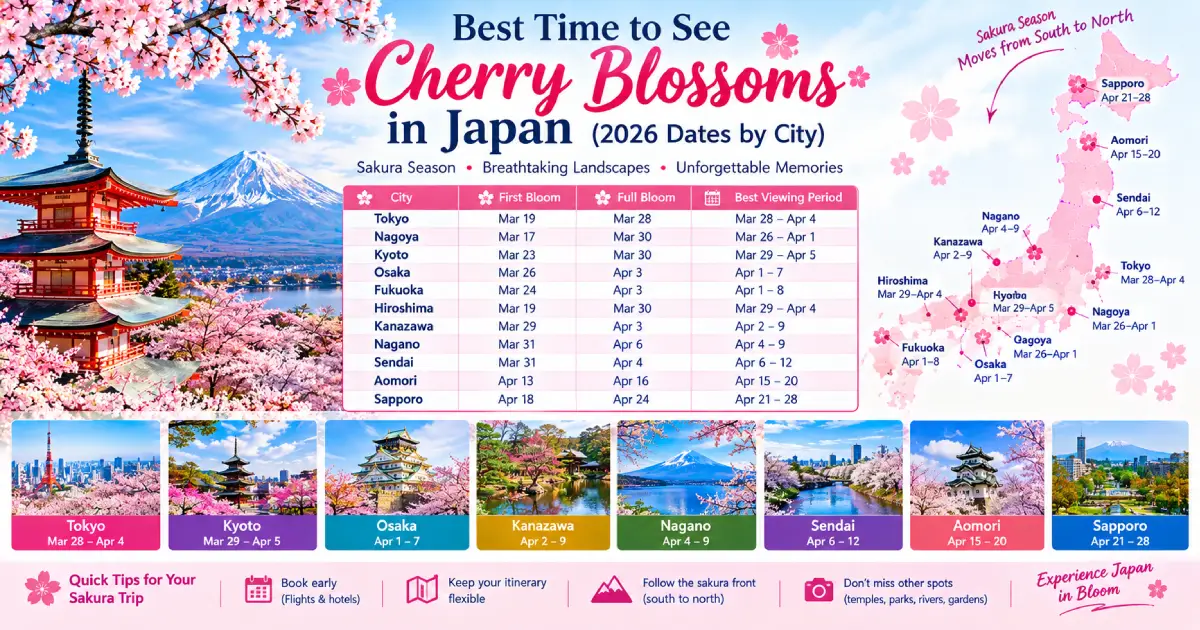
The best time to see cherry blossoms in Japan is late March to early April, when Tokyo, Kyoto, and Osaka — the three cities most first-time visitors are planning around — typically hit full bloom. Exact dates shift by up to two weeks year to year depending on winter and early-spring temperatures, and the blossom front itself moves from south to north over roughly six weeks, so “the best time” genuinely depends on which city is on your itinerary. This page gives the specific window for each major region; for the full season guide (viewing spots, hanami etiquette, what else spring offers), see Japan in Spring 2026.
| City | First Bloom | Full Bloom (Peak) | Best Booking Window |
|---|---|---|---|
| Fukuoka | Mid-March | Late March | Book by January |
| Hiroshima | Mid–Late March | Late March–Early April | Book by January |
| Kyoto | Late March | Early April | Book by December–January |
| Osaka | Late March | Early April | Book by December–January |
| Tokyo | Late March | Early April | Book by December–January |
| Kanazawa | Early April | Mid-April | Book by February |
| Sendai | Mid-April | Late April | Book by February |
| Hokkaido (Sapporo) | Late April–Early May | Early–Mid May | Book by February–March |
Why book so far ahead of the bloom itself: Peak-bloom accommodation in Tokyo and Kyoto sells out months before the actual flowering date is confirmed, because demand is driven by calendar dates (school breaks, fixed vacation windows) rather than the bloom forecast — by the time the precise date is known (roughly 3–4 weeks out), the best hotels are already gone.
Japan’s cherry blossom front (sakura zensen) is tracked and forecast the way a weather system is: the Japan Meteorological Corporation and several private forecasters issue a rough prediction in January, refine it through February, and lock in a reliable date roughly 3–4 weeks before bloom. Full bloom (mankai) typically follows first bloom (kaika) by about a week, and the most photogenic window — full bloom before the petals start falling — usually lasts only 4 to 10 days in any single location, shorter in windy or rainy weather, longer in calm, cool conditions.
“First bloom” vs. “full bloom”: First bloom is declared once a small number of flowers have opened on the reference tree meteorologists monitor in each city; full bloom (the point worth traveling for) is declared once roughly 80% of buds have opened — the two dates are typically 5–10 days apart.
Past bloom dates don’t predict any single future year with precision, but they show the realistic range a first-time visitor should plan flexibility around rather than fixing a single exact date months in advance.
| Year | Tokyo Full Bloom | Kyoto Full Bloom |
|---|---|---|
| 2016 | Apr 5 | Apr 8 |
| 2017 | Apr 2 | Apr 8 |
| 2018 | Mar 22 | Mar 29 |
| 2019 | Mar 27 | Apr 4 |
| 2020 | Mar 22 | Mar 29 |
| 2021 | Mar 22 | Mar 26 |
| 2022 | Mar 27 | Apr 1 |
| 2023 | Mar 22 | Mar 25 |
| 2024 | Mar 29 | Apr 4 |
| 2025 | Mar 30 | Apr 3 |
The pattern this reveals: Tokyo and Kyoto’s full bloom has landed anywhere from March 22 to April 8 over the past decade, with the majority of years clustering in the last week of March through the first week of April — confirming that window as the statistically strongest single bet for a first-time visitor who has to commit to dates well in advance, while also showing why anyone locking in a single fixed date (rather than a flexible 7–10 day window) has a real chance of missing peak bloom entirely.
Neither is categorically better — it depends on the specific year, since full bloom has landed on both sides of that boundary roughly evenly over the past decade (see the table above). A trip spanning both late March and early April gives the widest safety margin for Tokyo, Kyoto, and Osaka specifically.
Cherry blossoms remain attractive for roughly a week after peak as petals begin falling (particularly appealing for the “sakura fubuki,” or cherry blossom snow, effect along rivers and moats), and roughly a week before peak with partial bloom already visible — a fixed-date trip within 5–7 days of the historical average still has strong odds of good blossoms even without hitting the exact peak.
Only at the edges. Golden Week (April 29–May 5) typically falls after Tokyo, Kyoto, and Osaka’s cherry blossoms have finished, but can overlap with later-blooming northern regions like Tohoku and Hokkaido — worth checking specifically if your itinerary includes those areas.
None are perfectly reliable, but Kyoto and Osaka’s timing has historically tracked Tokyo’s closely (typically within a few days), making the three-city Kansai/Kanto core of most first-time itineraries a reasonably internally consistent bet — if Tokyo is early, Kyoto and Osaka usually are too.
Yes, if Hokkaido is part of your itinerary — Sapporo’s cherry blossoms typically peak in late April to early May, roughly a month after Tokyo and Kyoto, making Hokkaido the specific answer for visitors whose only available travel window is late spring.
About Travel Tourister Travel Tourister’s destination specialists track the sakura forecast every season, from January’s first rough predictions through the confirmed late-March/early-April peak in Tokyo and Kyoto, to give first-time visitors a specific, date-backed answer rather than a vague “spring” recommendation.
Posted By : Vinay
Latest Article
2nd Floor, 39, Above Kirti Club, DLF Industrial Area, Kirti Nagar, New Delhi, Delhi 110015



Travel Tourister is a leading Travel portal where we introduce travellers to trusted travel agents to make their journey hasselfree, memorable And happy. Travel Tourister is a platform where travellers get Tour packages ,Hotel packages deals through trusted travel companies And hoteliers who are working with us across the world. We always try to find new and more travel agents and hoteliers from every nook and corners across the world so that you could compare the deals with different travel agents and hoteliers and book your tour or hotel with the one you have chosen according to your taste and budget.
Copyright © Travel Tourister, India. All Rights Reserved

 Call
Call Enquiry