Big Island vs Maui: Which Hawaii Island Should You Visit? (2026 Guide)
Published on : 01 Jun 2026
Big Island vs Maui — Hawaii’s Two Most Dramatically Different Islands, Honestly Compared
By Travel Tourister | Updated June 2026
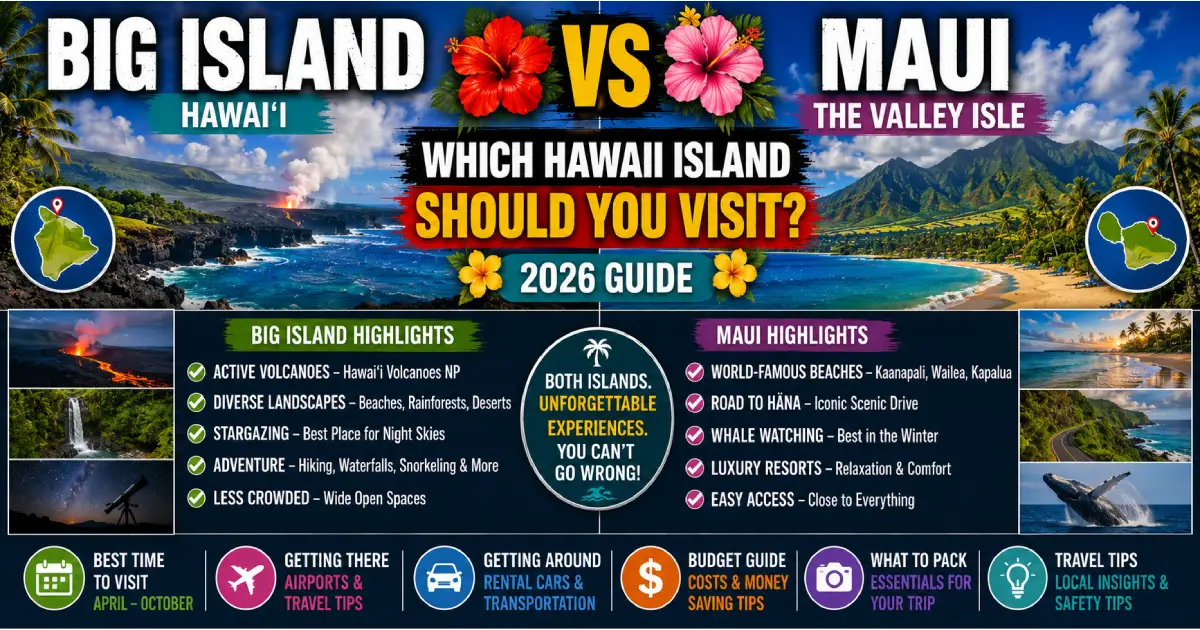
The Big Island of Hawaii and Maui are the two most geologically dramatic and the two most experientially distinct of the four major Hawaiian islands — and the comparison between them is the most specifically productive Hawaii planning decision available for the visitor who has time for only one island or who is choosing which island to prioritize on a multi-island trip. The Big Island (officially Hawaii Island, the largest island in the Hawaiian archipelago at 4,028 square miles — larger than all other Hawaiian islands combined) is the most geologically active and the most dramatically volcanic island accessible in the United States: the Kīlauea volcano in Hawaii Volcanoes National Park produces the most actively ongoing eruptions of any US national park, the Mauna Kea summit (13,796 feet) delivers the clearest night sky in the Northern Hemisphere, and the Kona coast’s manta ray night snorkel (the most reliably accessible and the most specifically magical manta encounter available from any US resort base) makes the Big Island the most specifically extraordinary natural-wonder-per-square-mile destination in the Hawaiian Islands. Maui is the most specifically scenic and the most comprehensively balanced Hawaiian island for the visitor who wants the most complete single-island Hawaii experience: the Road to Hana (the most dramatic and the most waterfall-dense coastal driving experience in the United States), Haleakalā National Park (the most spectacular volcano-summit sunrise accessible in the Pacific), the Molokini Crater’s 100-foot underwater visibility, Waianapanapa’s black sand beach, Ka’anapali’s world-class resort strip, and the December–April humpback whale season in the Maui Channel (the most reliably accessible humpback whale watching in the United States) collectively make Maui the most specifically complete and the most travel-publication-celebrated single Hawaiian island.
This guide breaks down every meaningful category — geology, beaches, snorkeling, cost, wildlife, hiking, and the specific experience of being on each island — honestly and delivers the clearest verdict for the visitor choosing between Hawaii’s two greatest islands in 2026.
For the broader Hawaii comparison, see our Puerto Rico vs Hawaii and Best Beaches in Hawaii guides.
The Most Important Facts First
Key Fact
🌋 Big Island (Hawaii)
🌺 Maui
Size
4,028 sq miles — largest US island; larger than all other Hawaiian islands combined
727 sq miles — second largest Hawaiian island
Main Airport
Kona (KOA) west coast; Hilo (ITO) east coast — two airports
Kahului (OGG) — one main airport, central north coast
Highest Peak
Mauna Kea 13,796 ft — tallest mountain in the world from ocean floor
Haleakalā 10,023 ft — dormant volcano, most visited Maui summit
Active Volcano
✅ Yes — Kīlauea, ongoing eruptions (most active volcano in world)
❌ No — Haleakalā dormant since 1790
Best Beach Type
Black sand (Punalu’u), green sand (Papakōlea), white sand (Kohala Coast)
Black sand (Waianapanapa), white sand (Ka’anapali, Wailea), red sand
Whale Watching
Good (Dec–Apr) but less reliably concentrated than Maui
Best in US — Maui Channel is primary humpback nursery (Dec–Apr)
Midrange Hotel Cost
$220–$380/night (Kohala Coast resort area)
$320–$580/night (Ka’anapali/Wailea)
Road to Hana
No equivalent
Most scenic coastal drive in Hawaii — 64 miles, 600+ turns, 74 waterfalls
Snorkeling
Kealakekua Bay, Two Step — excellent reef diversity
Molokini Crater 100ft visibility, Honolua Bay — among world’s best
Night Manta Ray Snorkel
✅ Kona coast — most reliable manta encounter in US
Available but less reliably accessible than Kona
Green Sand Beach
✅ Papakōlea — one of only 4 green sand beaches in the world
❌ No green sand beach
Coffee Culture
100% Kona Coffee — most expensive single-origin in US; farm tours
Less celebrated coffee tradition
Quick Verdict: Big Island vs Maui
Category
🌋 Big Island Wins
🌺 Maui Wins
Winner
Active Volcano
Kīlauea ongoing eruptions — most dramatic volcanic landscape in USA
Haleakalā dormant crater — spectacular but not active
🌋 Big Island
Scenic Drive
Chain of Craters Road — dramatic volcanic landscape
Road to Hana — most acclaimed coastal drive in USA
🌺 Maui
Beach Variety
Black + green + white sand — most beach color variety in Hawaii
Black + white + red sand — also exceptional variety
🌋 Big Island (has unique green sand)
Best Snorkeling
Kealakekua Bay — historically most significant Hawaii snorkel site
Molokini Crater — 100-ft visibility in submerged volcanic crater
🌺 Maui (Molokini wins on visibility)
Whale Watching
Good (Dec–Apr)
Best humpback whale watching in the US — primary nursery
🌺 Maui
Manta Ray Snorkel
Kona coast night snorkel — most reliable manta encounter in USA
Less reliably accessible
🌋 Big Island
Sunrise Experience
Mauna Kea 13,796 ft — most technically spectacular but complex logistics
Haleakalā 10,023 ft — most famous Hawaii sunrise, timed entry required
🌺 Maui (more accessible; timed entry manageable)
Hotel Cost
$220–$380/night midrange — most affordable major Hawaii island
$320–$580/night midrange — most expensive after Lanai
🌋 Big Island
Stargazing
Mauna Kea — clearest sky in Northern Hemisphere (world’s top observatory)
Haleakalā — excellent but Mauna Kea is definitively better
🌋 Big Island
Waterfalls
Akaka Falls, Rainbow Falls — good but fewer
74 waterfalls on Road to Hana — most waterfall-dense drive in USA
🌺 Maui
Coffee
100% Kona Coffee — most famous US single-origin; estate tours
Good coffee scene; less celebrated than Kona
🌋 Big Island
Overall Balance
Most geologically dramatic; best for nature and adventure
Most complete Hawaii experience; best overall balance of activities
🌺 Maui (for most visitors)
The Big Island: Hawaii’s Most Geologically Extraordinary Island
Hawaii Volcanoes National Park — The Most Active Volcanic Landscape in the USA
Why It’s the Most Essential Big Island Experience: Hawaii Volcanoes National Park — the 323,431-acre national park on the Big Island’s southeast flank, containing two active volcanoes (Kīlauea and Mauna Loa), the most actively producing lava landscape accessible in the United States, and the most dramatically volcanic road network accessible in any US national park — is the single most geologically consequential and the most specifically “nowhere else in America” experience accessible on the Big Island or in the entire Hawaiian Islands. The specific HVNP experiences:
Kīlauea Overlook (Jaggar Museum Overlook area, currently managed from the new Visitor Center): The Halemaʻumaʻu crater — the summit caldera of Kīlauea, the most actively erupting section of the world’s most productive volcano — is visible from the overlook at the park’s rim in the most dramatically and the most continuously evolving volcanic landscape accessible from any US national park observation platform. The nighttime crater glow (the most specifically red-and-orange and the most dramatically luminous crater glow accessible from any US national park observation point) is visible on any clear night when the lava lake is active.
Chain of Craters Road (20-mile one-way drive to the coast): The most dramatic single road in any US national park — the Chain of Craters Road descends 3,700 feet from the Kīlauea summit to the Pacific Ocean coast, passing 12 named craters, historic lava flows from the 1969–1974 Mauna Ulu eruption covering the former road, and the Holei Sea Arch (the most dramatically oceanic and the most specifically sea-arch-at-the-lava-coast accessible at any US national park terminus). The coastal lava fields (the most recently geologically formed land in the United States — some sections are less than 50 years old) and the steam vents visible at the road’s coastal end produce the most specifically extraordinary driving experience accessible at any Hawaiian attraction.
Thurston Lava Tube (Nāhuku): The most accessible and the most specifically walk-through volcanic tube accessible in any US national park — a 500-year-old lava tube 450 feet long, free with park entry ($35/vehicle), the most easily accessible and the most family-appropriate lava tube experience in Hawaii.
Park entry: $35/vehicle; 7-day pass; America the Beautiful Annual Pass accepted (the most financially strategic HVNP entry option for visitors who plan additional national park visits during their Hawaii trip)
Current eruption status: Kīlauea’s eruption activity is dynamic — check the USGS Hawaiian Volcano Observatory (hvo.wr.usgs.gov) for the most current eruption status before visiting. The most spectacular nighttime crater glow is visible when the lava lake is actively producing.
Manta Ray Night Snorkel (Kona Coast) — Most Magical Big Island Experience
Why It’s the Most Specifically Extraordinary Night Activity in Hawaii: The Kona coast manta ray night snorkel — departing from the Keauhou Bay or Garden Eel Cove area south of Kailua-Kona — is the most reliably accessible and the most specifically extraordinary marine wildlife encounter accessible from any US resort town. The manta rays (wingspan up to 14 feet, the largest manta rays regularly encountered in Hawaiian waters) feed nightly on the plankton attracted by the underwater lights of the dive/snorkel operators, producing the most specifically magical and the most intimately close-approach manta ray encounter accessible without traveling to the Maldives or the Coral Triangle.
How it works: Guests float on the surface holding a flotation board illuminated by an underwater light, while the manta rays (between 5–20+ rays on a typical night) circle and barrel-roll beneath the snorkelers’ boards, feeding on the plankton attracted to the light — some passing within 2–3 feet of the snorkelers’ faces in the most specifically close-proximity and the most dramatically undulating large-marine-animal encounter accessible from any Hawaii snorkel boat
Operators: Manta Ray Advocates ($90/person), Sea Paradise ($85/person), and multiple Kona-based operators offer the most comprehensively guided and the most safety-focused manta night snorkel available in Hawaii
Success rate: The Kona manta night snorkel has one of the highest success rates (manta encounter probability) of any marine wildlife tour in the world — the resident manta ray population that feeds at Garden Eel Cove has been documented visiting this site for 40+ years continuously
Cost: $85–$110/person; 2–3 hours including boat transfer
Location: Keauhou Bay, south of Kailua-Kona
Best Time: Year-round; best visibility in summer (June–September)
Papakōlea Green Sand Beach — One of Only 4 Green Sand Beaches in the World
Why It’s Extraordinary: Papakōlea — the olivine-mineral green sand beach at the southern tip of the Big Island, accessible via a 2.5-mile walk from the South Point trailhead (or by 4WD shuttle from the parking area, $20 roundtrip) — is one of only four green sand beaches in the world, produced by the erosion of the olivine crystals from the adjacent Pu’u Mahana volcanic cone into the bay below. The specific green color (a warm, sage-to-emerald green depending on the angle of light and the mineral density of the recent wave deposit) against the blue Pacific and the black lava cliffs framing the bay produces the most specifically extraordinary and the most irreplaceably unique beach composition accessible anywhere in the United States. No other US state or territory has a green sand beach.
Access: 2.5-mile walk from the South Point parking area (the most dramatically windswept and the most specifically remote access road in Hawaii — South Point is the southernmost point in the United States); or $20 roundtrip 4WD shuttle from the parking area
Important note: It is illegal to remove green sand from Papakōlea — the olivine crystals are protected federal property; the most specifically enforced single Hawaii beach regulation
Cost: FREE beach; $20 roundtrip shuttle (optional)
Location: South Point (Ka Lae), Big Island — 1 hour from Kona or Volcano village
Best For: Most unique beach in the USA; geological photography; bucket list
Punalu’u Black Sand Beach — Sea Turtles on Volcanic Sand
Why It’s Outstanding: Punalu’u Black Sand Beach — the most consistently sea-turtle-populated and the most dramatically black-volcanic-sand beach accessible on the Big Island’s east coast — produces the most accessible and the most reliably present Hawaiian green sea turtle (honu) basking experience in the Hawaiian Islands: the turtles haul out on the black volcanic sand daily, visible from the beach at close range (observe from a minimum 10-foot distance as required by Hawaiian Monk Seal and Sea Turtle Protection laws). The specific Punalu’u beach composition (the most recently geologically formed black sand in Hawaii — produced by the quenching of lava flows entering the ocean and shattering into the most specifically black and the most specifically geologically fresh sand accessible at any Hawaiian beach) and the turtle colony make Punalu’u the most specifically dramatic and the most wildlife-combining beach accessible on the Big Island.
Cost: FREE; county beach park with facilities
Location: Punalu’u, South Kona — 1 hour south of Kona airport on Highway 11
Best Time: Early morning for the most turtle basking and the most crowd-free beach
Mauna Kea Summit and Stargazing — Clearest Sky in the Northern Hemisphere
Why It’s Outstanding: Mauna Kea — at 13,796 feet the highest mountain in Hawaii and, measured from its ocean floor base, the tallest mountain on earth — is home to the world’s most significant astronomical observatory complex (13 major telescopes from 11 countries, the most internationally consequential single observatory site in the world) and produces the most specifically clear and the most astronomically productive night sky accessible in the Northern Hemisphere. The Onizuka Center for International Astronomy visitor facility at 9,200 feet provides the most accessible stargazing introduction (free, open 6–10 PM, telescopes available with volunteer astronomers) before the summit drive.
Summit access: 4WD vehicle required above 9,200 feet (rental car companies’ standard policy prohibits summit driving — verify your rental agreement before departing); temperatures at the summit drop to 30–40°F at night regardless of the Kona coast temperature below
Onizuka Center (9,200 ft, free): The most accessible and the most telescope-equipped stargazing visitor facility in Hawaii — free nightly programs with volunteer astronomers from 6–10 PM; the most specifically educational and the most publicly accessible astronomical visitor experience in the state
Acclimatization requirement: Spend 30 minutes minimum at the Onizuka Center before proceeding to the summit — altitude sickness at 13,796 feet is the most specific and the most commonly reported health concern at any Hawaii destination; visitors with heart or respiratory conditions should consult a physician before visiting
Cost: FREE (summit road access); Onizuka Center free
Location: Mauna Kea summit, Big Island — 45 minutes from Hilo or Waimea
Best Time: Clear nights November–April; avoid when summit is under lenticular cloud (check conditions at ifa.hawaii.edu/info/vis)
Kohala Coast: The Big Island’s Resort Beaches
The Kohala Coast — the dry, sunny leeward coast of the Big Island’s northwest, where the most specifically sunny and the most consistently non-cloudy weather in Hawaii is concentrated — is the Big Island’s luxury resort corridor, with the most architecturally dramatic and the most specifically Hawaiian-cultural-program resort hotels accessible on the island:
Hapuna Beach State Park: The most consistently Dr. Beach-ranked and the most specifically award-winning Big Island beach — the wide crescent of white sand on the Kohala Coast with the most calm and the most specifically Pacific-ocean-temperature-warm swimming water accessible at any Big Island beach. The most recommended single Big Island beach for the visitor who wants the most Caribbean-quality swimming experience accessible in Hawaii without leaving the Big Island. Free; limited parking.
Mauna Kea Beach (Kauna’oa Beach): The most historically celebrated and the most specifically luxury-resort-adjacent white sand beach on the Kohala Coast — the Mauna Kea Beach Hotel’s private beach is accessible to the public (12 visitor parking passes available daily on first-come basis from the hotel guard gate, arrive by 8 AM)
Kua Bay (Manini’ōwali Beach): The most emerald-water and the most specifically turquoise-visible Big Island white sand beach — the most photogenically Hawaii and the most specifically tropical-blue-Pacific accessible at any Big Island public beach
Kealakekua Bay — Most Historically Significant Hawaii Snorkel Site
Why It’s Outstanding: Kealakekua Bay — the most historically significant bay in Hawaii (the site of Captain James Cook’s 1779 death, the most consequential single event in early Hawaiian contact history), accessible by kayak, boat tour, or hiking trail — is the most specifically coral-rich and the most spinner-dolphin-populated snorkel destination accessible from the Kona coast. The underwater visibility at Kealakekua Bay (50–80 feet on calm days) and the specific coral density produce the most specifically Hawaiian reef character snorkel accessible on the Big Island. The spinner dolphins that rest in the bay’s morning shallows (protected from disturbance by federal regulations — stay 50+ yards from dolphins at rest) are the most reliably present wild Hawaiian spinner dolphin population accessible from any Big Island snorkel site.
Cost: Kayak rental from Napo’opo’o ($55–$75 half-day) or boat tour ($125–$165/person)
Location: Kealakekua Bay, South Kona — 20 miles south of Kailua-Kona
Maui: The Most Complete Single-Island Hawaii Experience
The Road to Hana — Most Acclaimed Scenic Drive in the USA
Why It’s the Most Essential Maui Experience: The Hana Highway — 64 miles of Hawaii’s most specifically dramatic and the most waterfall-dense coastal road, running from Kahului to Hana on Maui’s northeast coast with 600+ turns, 59 bridges (54 of them single-lane), 74 named waterfalls, bamboo forests, black sand beaches, and the most specifically remote and the most specifically un-developed section of any major Hawaiian island’s coastline — is the most nationally acclaimed and the most travel-publication-celebrated single scenic drive in the United States. The specific Road to Hana highlights:
Twin Falls (mile marker 2): The most accessible and the most specifically waterfall-swimming-pool-complete first Road to Hana stop — a 10-minute walk from the highway to twin waterfalls with the most accessible freshwater pool accessible at any Maui roadside stop; the most recommended first swim of any Road to Hana day
Waikamoi Nature Trail (mile marker 9): The most accessible bamboo forest walk on the Road to Hana — a 20-minute loop through the bamboo grove that produces the most specifically atmospheric and the most bamboo-canopy-complete nature walk accessible without a full hike
Garden of Eden Arboretum ($20/vehicle): The most comprehensive collection of introduced and native Hawaiian plants accessible as a Road to Hana stop, with the most specifically dramatic waterfall viewpoints (Puohokamoa Falls and Haipua’ena Falls) accessible without a trail descent
Waianapanapa State Park (black sand beach, free with reservation): The most dramatically black-volcanic-sand and the most sea-arch-surrounded beach accessible in Maui — the Waianapanapa black sand beach, the sea caves (the most specifically Hawaiian folklore-embedded sea cave accessible at any Maui beach), and the coastal trail to the blowholes produce the most specifically dramatic and the most photographically extraordinary Road to Hana intermediate stop. Timed entry reservation required at recreation.gov (free); the most consistently sold-out single Road to Hana stop reservation in 2026 — book 60 days ahead.
Wai’anapanapa to Hana (continuing): After Waianapanapa, the most dramatically scenic remaining road section delivers the most bamboo-cathedral-drive and the most cascading-waterfall-roadside of any Hawaii coastal highway section
Cost: Free to drive; Waianapanapa reservation required (free); Garden of Eden $20; plan 10–12 hours for the full round trip
Best Time: Depart before 7 AM to beat traffic; avoid weekends and holiday periods when the road becomes a single-file procession
Haleakalā National Park: Hawaii’s Most Famous Sunrise
Why It’s Outstanding: Haleakalā National Park — the dormant shield volcano at 10,023 feet that occupies the center of Maui, with the most specifically sunrise-celebrated summit in the Hawaiian Islands — is the most nationally recognized and the most travel-publication-recommended single Maui experience after the Road to Hana: standing at the Haleakalā summit as the sun rises above a blanket of clouds 3,000 feet below the observation platform, illuminating the world’s largest dormant volcano crater in the most dramatically red-and-gold-and-purple sequence of any Hawaii dawn, is the most cited single Maui experience by returning visitors and the most specifically booked-60-days-ahead single Hawaii activity available.
Sunrise timed entry reservation (required, free, opens 60 days ahead): The most critical single Maui booking step — Haleakalā’s sunrise timed entry (3–7 AM, March 16–November 30) opens at recreation.gov exactly 60 days before the visit date at midnight Hawaii time and sells out within minutes. Set a calendar reminder 60 days before your intended sunrise visit; the most consistently unavailable-at-the-last-minute single Hawaii reservation.
Temperature: 30–50°F at the summit year-round regardless of Maui beach temperature — bring warm layers (fleece, wind jacket) for the most specifically temperature-unprepared single Maui visitor mistake accessible at any Hawaiian attraction
Cycling downhill: The Haleakalā downhill bicycle tour ($165–$220/person) — descending 38 miles from the summit on a bicycle with gravity as the primary engine — is the most specifically exhilarating and the most specifically Haleakalā-character activity accessible without hiking the summit’s trail network
Park entry: $30/vehicle; 3-day pass; America the Beautiful Annual Pass accepted
Molokini Crater — World-Class Snorkeling in a Submerged Volcano
Why It’s Outstanding: Molokini — the partially submerged volcanic crater 2.5 miles off Maui’s south coast, accessible only by boat tour, with 100-foot underwater visibility on the clearest days and 250+ fish species documented in the protected crater — is the most specifically Hawaii and the most internationally recognized single snorkel destination in the United States. The combination of the crystal-clear blue water (the deepest blues of any Hawaii snorkel site, produced by the absence of runoff and the sheltered crater position), the fish density (the federally protected Molokini Shoal Marine Life Conservation District limits snorkel operators and eliminates fishing pressure, producing the most specifically abundant and the most specifically diverse reef fish accessible at any Hawaii snorkel site), and the dramatic above-water crater rim (the most cinematically specific volcanic-crater-as-snorkel-location visual accessible in the Pacific) makes Molokini the most specifically world-class and the most specifically non-replaceable snorkel experience in Maui or any other Hawaiian island.
Boat tour operators: Trilogy Excursions (the most consistently award-winning and the most locally respected Maui snorkel operator, $150–$175/adult for Molokini + Turtle Town half-day), Four Winds II (the most glass-bottom-boat-complete Molokini tour, $120–$140/adult), and Pacific Whale Foundation (the most whale-watching-additional and the most conservation-focused operator, $110–$135/adult)
Best time: Early morning departure (6:30–7 AM) for the most calm and the most wind-free Molokini crater conditions before the afternoon trade winds build; the most consistent snorkel visibility is the earliest-departing Molokini boat of any given day
Cost: $110–$175/adult; boat tour only (no independent access)
Location: 2.5 miles off Ma’alaea Harbor, South Maui
Best Time: November–April (calmest ocean; whale season bonus)
Humpback Whale Watching (December–April) — Best in the USA
Why It’s the Most Specifically Maui Wildlife Advantage: The Maui Channel — the shallow (300-foot maximum depth) ocean channel between Maui, Lana’i, and Moloka’i — is the primary Hawaiian humpback whale nursery, hosting 60–70% of the entire North Pacific humpback whale population during the December–April winter season (approximately 10,000–12,000 whales). The humpback whales visible from Maui’s shores are the most accessible and the most reliably present wild whale population in the United States — visible without a boat from the Ka’anapali Beach shoreline on clear winter days, and the most dramatically close-range on whale watching boats ($45–$75/adult for 2-hour tour departing from Ma’alaea Harbor).
Shore watching (free): Ka’anapali Beach’s north end, McGregor Point lookout on Highway 30 south of Lahaina, and the Papawai Point whale watching overlook (the most consistently whale-active viewpoint accessible from any Hawaii highway pull-off) all produce free humpback whale viewing on any clear December–April day
Peak season: February–March is the most whale-dense and the most breach-active window of the Maui season; the most productive single whale watching month in the United States
Pacific Whale Foundation ($45–$75/adult): The most conservation-focused and the most naturalist-guided whale watching operator accessible from Ma’alaea Harbor, with the most Pacific Whale Foundation marine biologist narration accessible on any Maui whale tour
Cost: Free (shore); $45–$75/adult (boat tour, 2 hours)
Location: Ka’anapali Beach, McGregor Point, or Ma’alaea Harbor
Season: December–April; peak February–March
Waianapanapa State Park and the Black Sand Beach
Why It’s Outstanding: Waianapanapa State Park — the most dramatically positioned and the most historically specific state park accessible on Maui’s Road to Hana — is the most specifically ancient and the most specifically dramatically-set black sand beach in Hawaii: the volcanic black sand, the sea arches visible from the coastal trail, the sea caves (the most specifically Hawaiian myth-embedded — legend has it that Ka’ahumanu, the favorite wife of King Kamehameha I, hid in the caves and was found and killed by her jealous husband; her blood is said to turn the cave pool water red each April), and the blowhole accessible on the coastal walking trail collectively produce the most historically layered and the most geologically specific single state park day visit accessible on any Maui scenic drive.
Cost: FREE (timed entry reservation required at recreation.gov, opens 60 days ahead)
Location: Waianapanapa State Park, Hana Highway, Maui
Best Time: Early morning; weekday reservations sell slower than weekend
Ka’anapali and Wailea Beaches — Maui’s Resort Beach Corridors
Maui’s west and south coast resort beaches are the most specifically luxury-beach-resort-complete and the most consistently calm-swimming Hawaiian beaches accessible on any Hawaiian island outside Oahu:
Ka’anapali Beach (3 miles, West Maui): The most consistently award-winning and the most specifically whale-watching-in-season resort beach in Hawaii — the most reliably calm morning swimming, the most specifically dramatic Black Rock (Pu’u Keka’a) cliff diving at sunset, and the most whale sighting from a beach chair of any Hawaii resort beach in February and March. Free public access from multiple beach parking lots.
Wailea Beach (South Maui): The most specifically polished and the most luxury-resort-corridor-adjacent beach in Maui — the Four Seasons, Grand Wailea, and Fairmont Kea Lani all front Wailea Beach, the most specifically resort-completed and the most specifically calm-Pacific-crescent beach accessible in South Maui. Free public access via the Wailea Beach Path (the most beautiful coastal walking path in Maui, connecting all South Maui resort beaches).
Honolua Bay (Northwest Maui, November–March): The most specifically winter-surf-and-snorkel-simultaneously-excellent single Maui bay — the winter surf (when the bay is not surfed, accessible November–March for snorkeling in the most coral-dense Maui Marine Life Conservation District outside Molokini) is the most specifically variable and the most surf-and-snorkel-seasonally-inverted beach accessible in West Maui.
Big Island vs Maui: Cost Comparison
Cost Category
🌋 Big Island
🌺 Maui
Cheaper?
Midrange Hotel (per night)
$220–$380 (Kohala Coast)
$320–$580 (Ka’anapali/Wailea)
🌋 Big Island (significantly)
Budget Hotel (per night)
$130–$210 (Kona town, Hilo)
$195–$310 (Kahului, Central Maui)
🌋 Big Island
Vacation Rental (per night)
$185–$350
$250–$480
🌋 Big Island
National Park Entry
HVNP $35/vehicle
Haleakalā $30/vehicle; sunrise timed entry free
🤝 Comparable
Key Activity
Manta ray snorkel $85–$110
Molokini snorkel $110–$175
🌋 Big Island
Whale Watching
$55–$85/adult
$45–$75/adult (or free from shore)
🌺 Maui (shore viewing free)
Rental Car (per day)
$65–$95 (essential on Big Island)
$70–$100 (essential on Maui)
🤝 Comparable
7-Night Total (per person, midrange)
~$2,800–$4,200
~$3,600–$5,500
🌋 Big Island (20–25% cheaper)
Cost verdict: Big Island is 20–25% cheaper than Maui — the hotel differential ($100–$200/night less for comparable Kohala Coast vs Ka’anapali/Wailea properties) is the most consequential single budget factor. The Big Island is consistently cited as the most affordable Hawaii island for quality accommodation — the combination of lower hotel rates, comparable activity costs, and the free national park experiences (HVNP and the Onizuka Center stargazing) makes the Big Island the most financially rewarding single Hawaii island visit accessible for the budget-conscious Tier 1 traveler who wants genuine Hawaii national park experiences at a more affordable price than Maui.
Who Should Visit the Big Island?
Choose the Big Island if you:
Want to see active volcanic activity — Kīlauea’s ongoing eruptions in Hawaii Volcanoes National Park are the most geologically active and the most specifically “watching the earth being created” experience accessible in the United States; nothing in Maui or any other Hawaiian island approximates this
Want the Kona manta ray night snorkel — the most reliably accessible and the most specifically magical marine wildlife encounter accessible in the United States; the Kona resident manta ray population is the most consistently present of any manta ray feeding site outside the Maldives and Bora Bora
Want to stand on a green sand beach — Papakōlea is one of only four green sand beaches in the world; no other US state or territory has one
Want Mauna Kea stargazing — the clearest night sky in the Northern Hemisphere at 13,796 feet produces the most specifically astronomically productive stargazing accessible in the United States
Are on a Hawaii budget — the Big Island is 20–25% cheaper than Maui across hotels, activities, and vacation rentals
Want 100% Kona Coffee at the source — the most expensive and the most celebrated US single-origin coffee, available at the estate for $20–$40/pound at the most authentic and the most specific coffee-tourism experience accessible in Hawaii
Want the most geologically diverse and the most specifically landscape-extraordinary single Hawaiian island — the Big Island spans 11 of the world’s 13 climate zones (from the alpine desert of Mauna Kea’s summit to the tropical rainforest of Hilo), producing the most dramatically varied landscape accessible on any single Hawaiian island
Who Should Visit Maui?
Choose Maui if you:
Want the Road to Hana — the most acclaimed scenic coastal drive in the United States; 74 waterfalls, bamboo forests, and Waianapanapa’s black sand beach in a single day; not available on any other Hawaiian island at any comparable scale or drama
Want the Haleakalā sunrise — the most famous and the most travel-publication-celebrated Hawaii sunrise experience; book the timed entry reservation exactly 60 days ahead at recreation.gov (opens midnight Hawaii time)
Want the best humpback whale watching in the United States — the Maui Channel’s December–April humpback whale population (10,000+ whales, the most densely concentrated in the Pacific) is visible from Ka’anapali Beach shore on winter mornings at no cost and from whale watching boats for $45–$75/adult
Want Molokini Crater snorkeling — the most specifically clear (100-foot visibility) and the most federally protected reef accessible in Hawaii; the most internationally celebrated single Hawaii snorkel destination
Want the most complete and the most balanced single-island Hawaii experience — Maui combines the most scenic drive, the most famous sunrise, the best snorkeling, the best whale watching, the most polished resort beaches, and the most comprehensive tourism infrastructure of any Hawaiian island into the most consistently complete single-island Hawaii trip
Are a first-time Hawaii visitor and want the most immediately rewarding and the most comprehensively famous single-island experience — Maui is the most travel-publication-awarded Hawaiian island and the most commonly recommended for first-time visitors who have one island and one week
Can You Visit Both the Big Island and Maui?
Yes — and combining the Big Island and Maui in a single Hawaii trip produces the most geologically complete and the most experientially diverse Hawaii experience accessible in a 10–14 day visit. The routing:
10-day combination: Fly into Kona (KOA) → Big Island 5 days (HVNP and lava, manta ray night snorkel, Papakōlea green sand beach, Mauna Kea stargazing, Kohala Coast beaches, 100% Kona Coffee estate) → inter-island flight to Maui OGG ($65–$120, 45 minutes on Hawaiian Airlines or Southwest) → Maui 5 days (Road to Hana full day, Haleakalā sunrise timed entry, Molokini snorkel, Ka’anapali beach, Wailea sunset dinner) → fly home from OGG
Inter-island flight booking: Book inter-island flights at least 3–4 weeks ahead for the most competitive pricing; Hawaiian Airlines and Southwest both serve the Big Island–Maui route at $65–$120 each way
Big Island vs Maui: Practical Tips
Topic
🌋 Big Island
🌺 Maui
Best Time to Visit
April–June (shoulder season, great weather, lower prices); December–March for whale watching; best volcanic activity varies — check USGS HVO
December–April for whales + best weather; April–May shoulder for value; September–November for lowest prices but some trade wind inconsistency
Where to Stay
Kailua-Kona town (most affordable, most central for Kona activities); Kohala Coast resorts (most luxury, most beach-resort); Volcano village (closest to HVNP, most rainforest character, most affordable)
Ka’anapali (most resort beach access, most whale watching season location); Wailea (most luxury, most polished resort strip); Kihei (most affordable South Maui alternative); Paia (most Road to Hana-adjacent)
Must-Book in Advance
Manta ray night snorkel ($85–$110, book 1–2 weeks ahead peak season); Mauna Kea summit tours (if guided, 1 week ahead); Kealakekua Bay boat tours (2–3 days ahead)
Haleakalā sunrise timed entry (recreation.gov, EXACTLY 60 days ahead — opens midnight Hawaii time, sells out in minutes); Waianapanapa State Park reservation (recreation.gov, 60 days ahead); Molokini boat tour (1–2 weeks ahead)
Rental Car
Essential — the Big Island’s 4,028 sq miles are the most car-dependent of any Hawaiian island; pick up at KOA; note that most rental companies prohibit driving the rental car to the Mauna Kea summit (verify policy)
Essential for Road to Hana and Haleakalā; pick up at OGG; note that many rental companies now prohibit the Hana Highway — verify your specific rental agreement before planning Road to Hana
Don’t Miss
HVNP Chain of Craters Road at sunset (most dramatic lava landscape lighting); manta ray night snorkel; Papakōlea green sand beach hike; Punalu’u for morning turtle basking
Haleakalā sunrise (book 60 days ahead — non-negotiable); Road to Hana Waianapanapa reservation (60 days ahead); Molokini early morning departure; Ka’anapali shore whale watching Feb–March (free)
Frequently Asked Questions: Big Island vs Maui
Is the Big Island or Maui better for first-time Hawaii visitors?
Maui is the most consistently recommended Hawaii island for first-time visitors — the combination of the Road to Hana (the most specifically acclaimed single Hawaii experience), the Haleakalā sunrise (the most famous Hawaii dawn), the Molokini snorkeling (the most celebrated Hawaii snorkel site), the December–April humpback whale watching (the most reliably whale-visible Hawaii season), and the Ka’anapali and Wailea resort beach corridors produces the most comprehensively balanced and the most travel-publication-complete single-island Hawaii experience accessible for a first visit. The Big Island is the more specifically rewarding second Hawaii island — the active volcanoes, the green sand beach, and the manta ray night snorkel provide the most dramatically different and the most geologically extraordinary complement to a first-visit Maui experience.
Is the Big Island cheaper than Maui?
Yes — the Big Island is consistently 20–25% cheaper than Maui across hotel, vacation rental, and dining categories. The most specific hotel differential: Kohala Coast resort properties run $100–$200/night less than comparable Ka’anapali or Wailea resort properties. Kona town and Volcano village offer the most affordable Big Island accommodation at $130–$210/night for quality midrange options, compared to Maui’s most affordable South Maui (Kihei) options at $195–$310/night. Over a 7-night trip, the Big Island saves a couple approximately $700–$1,400 in accommodation compared to Maui at comparable quality tiers.
Which is better for snorkeling — Big Island or Maui?
Maui wins on overall snorkeling quality — Molokini Crater’s 100-foot visibility and 250+ fish species in a federally protected marine reserve is the most internationally recognized and the most specifically extraordinary Hawaii snorkel experience. The Big Island wins on the most specific underwater encounter: the Kona manta ray night snorkel delivers the most reliably close-approach and the most emotionally extraordinary marine wildlife encounter accessible anywhere in the Hawaiian Islands at any time of year. Snorkelers who want the clearest water and the most reef diversity: Maui (Molokini). Snorkelers who want the most dramatically wildlife-encounter-specific experience: Big Island (manta ray night snorkel and Kealakekua Bay).
Do you need a car on the Big Island and Maui?
Yes — a rental car is essential on both islands. The Big Island’s 4,028 square miles are the most car-dependent geography of any Hawaiian island; without a car, Hawaii Volcanoes National Park, Papakōlea Green Sand Beach, Punalu’u Black Sand Beach, and the Kohala Coast beaches are all inaccessible. Maui’s Road to Hana (the most essential single Maui experience) and Haleakalā National Park are both car-dependent. Book rental cars at the same time as flights — Hawaii rental car availability is the most frequently depleted and the most rapidly price-escalating of any US domestic travel destination’s car rental market, particularly in peak season (December–April and June–August).
Final Verdict: Big Island vs Maui
The Big Island and Maui are Hawaii’s two most geologically dramatic and most experientially rewarding islands — genuinely different in what they offer and in the specific kind of Hawaii experience they produce for every visitor who arrives having made the 5–11 hour mainland flight investment. The most honest single-sentence verdict:
Choose the Big Island if you want the most geologically active, the most volcanically dramatic, and the most specifically “the earth is being made right now under your feet” experience accessible in the United States — the Chain of Craters Road descending past 12 craters to the Pacific lava coast, the Halemaʻumaʻu crater glowing red at 9 PM from the Kīlauea overlook, the Kona manta rays circling under your flotation board at Garden Eel Cove on a Tuesday night in November when 12 rays with 14-foot wingspans barrel-roll through the plankton-lit water three feet from your face, the green sand at Papakōlea that no other US state produces, the Milky Way visible overhead at the Mauna Kea summit at 11 PM in absolute clarity and absolute cold, and the 100% Kona Coffee served at the estate tasting room for $4 a cup in the most coffee-historically specific and the most specifically volcanic-mountain-grown context accessible in American territory. The Big Island is cheaper than Maui. It has the world’s most active volcano. It has the only green sand beach in the US. It has the most reliable manta ray encounter in the country. It is one of the most extraordinary places on earth.
Choose Maui if you want the most balanced, the most scenically complete, and the most specifically travel-publication-famous single-island Hawaii experience accessible in the Pacific — the Road to Hana’s 74 waterfalls and Waianapanapa’s black sand sea caves in the same 12-hour day, the Haleakalā summit sunrise at 10,023 feet above a cloud blanket that turns pink and gold in the first light over the Pacific, the Molokini Crater’s 100-foot visibility and the yellow tangs and Moorish idols at 20 feet below the surface in the most specifically clear snorkel water accessible in the Hawaiian Islands, the humpback whale breach visible from the Ka’anapali Beach shore chair in February when 12,000 whales are in the channel between Maui and Lanai and the most spectacular marine mammal display accessible in the United States is occurring free of charge 300 yards from your beach chair. Maui is the most travel-celebrated Hawaiian island. It is the most complete. It is the most road-trip-scriptable, the most whale-watching-in-season-productive, and the most specifically “this is what Hawaii means when Hawaii means everything at once.” Go to Maui first. Book the Haleakalā sunrise exactly 60 days ahead. Drive the Road to Hana early. Watch for whales from Ka’anapali in February. Understand, standing at the Haleakalā summit above the clouds at 6 AM with the Pacific visible in every direction below, that you are on the most remote island chain in the world and that the sun rising over it has been doing so for 2 million years and that the silence above the clouds at Haleakalā is the most specifically and the most irreplaceably Hawaiian silence accessible in any of the eight islands of the most isolated archipelago on earth.
Both islands are genuinely extraordinary. The Big Island is more affordable and more geologically dramatic. Maui is more scenic and more comprehensively balanced. The best Hawaii trip includes both — and the 45-minute inter-island flight between them on Hawaiian Airlines costs $65 and is the most productively different single island transition available in the Pacific.
—
Go Hawaii — Hawaii Tourism Authority (Official State Government) — Official Hawaii state government tourism resource covering both the Big Island and Maui destination information, inter-island flight options, national park visitor guidelines, Haleakalā and Hawaii Volcanoes NP timed entry reservation information, and all current Hawaii visitor resources from the Hawaii Tourism Authority.
Hawaii Volcanoes National Park — National Park Service (Official US Federal Government) — Official NPS resource for Hawaii Volcanoes National Park covering current Kīlauea eruption status, Chain of Craters Road conditions, Thurston Lava Tube access, park entry fees, and the most authoritative volcanic activity updates from the USGS Hawaiian Volcano Observatory partnership.
Haleakalā National Park — National Park Service (Official US Federal Government) — Official NPS resource for Haleakalā National Park covering the sunrise timed entry reservation system at recreation.gov, summit road conditions, Road to Hana access to the park’s coastal district (Kīpahulu), entry fees, and all official visitor guidelines for both the summit and coastal sections of Maui’s most visited national park.
About Travel TouristerTravel Tourister’s Hawaii specialists have extensively explored both the Big Island and Maui — from the Kīlauea Chain of Craters Road at sunset and the Kona manta ray night snorkel to the Haleakalā sunrise timed entry and the Road to Hana’s Waianapanapa black sand — to provide the most honest and most specific comparison available for Tier 1 travelers choosing between Hawaii’s two most geologically dramatic and most experientially distinct islands.
Posted By : Vinay
As a lead contributor for Travel Tourister, Vinay is dedicated to serving our Tier 1 audience (US, UK, Canada, Australia). His mission is to deliver precise, fact-checked news and actionable, data-driven articles that empower readers to make informed decisions, minimize travel risks, and maximize their adventure without compromising safety or budget.
Travel Tourister is a leading Travel portal where we introduce travellers to trusted travel agents to make their journey hasselfree, memorable And happy. Travel Tourister is a platform where travellers get Tour packages ,Hotel packages deals through trusted travel companies And hoteliers who are working with us across the world. We always try to find new and more travel agents and hoteliers from every nook and corners across the world so that you could compare the deals with different travel agents and hoteliers and book your tour or hotel with the one you have chosen according to your taste and budget.




 Call
Call Enquiry