Published on : 08 Sep 2026
By Travel Tourister | Updated Sep 2026
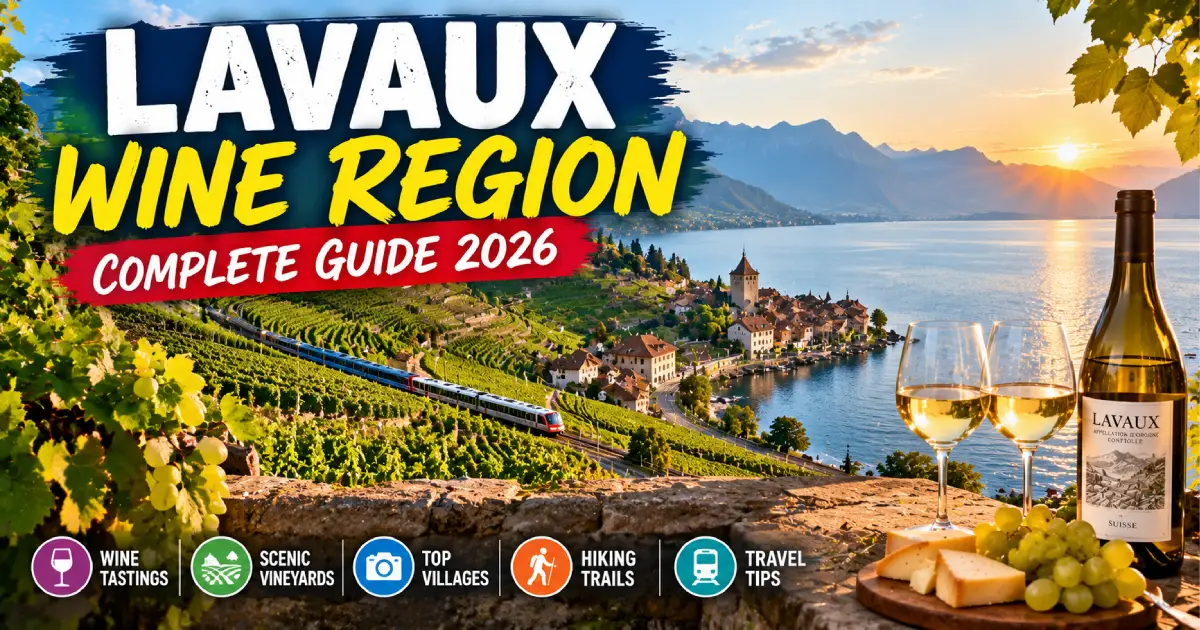
The Lavaux wine region — the 800-hectare arc of terraced vineyards running along the northern shore of Lake Geneva between Lausanne in the west and Montreux in the east, inscribed as a UNESCO World Heritage Site in 2007 — is Switzerland’s most visually dramatic wine-producing landscape and one of the most specifically extraordinary wine regions in Europe: a 12th-century stone-wall terrace system (originally constructed by Cistercian monks from the Hauterive Abbey, maintained with continuous effort across 900 years by the wine-growing families of the Vaud canton) covering 30 kilometers of south-facing lake shore in a system of near-vertical stepped terraces whose collective labor requirement (every single vineyard operation — pruning, soil management, canopy adjustment, and harvest — performed by hand on gradients reaching 45 degrees where no machinery can operate) represents one of the most concentrated examples of sustained human agricultural commitment to a specific landscape in European viticulture history.
The Lavaux’s specific viticultural identity centers on Chasselas — the grape variety that wine-growing regions worldwide regard as too neutral for serious wine production but that the Lavaux’s specific combination of three suns (the direct sun from the sky, the reflected sun from Lake Geneva’s water surface below, and the radiated heat from the stone terrace walls that absorb daytime heat and release it slowly through the night — extending the ripening season into October in most years) produces with the complexity, mineral precision, and specific terroir-expression that makes the finest Lavaux Chasselas among Switzerland’s most compelling wine arguments. Outside Switzerland (where Lavaux wine is almost entirely consumed domestically, the export volumes negligible despite the wine’s quality), Chasselas is primarily known as a table grape — a perception that a single glass of wine from a premier cru Lavaux Chasselas at proper service temperature (10–12°C, in a tulip glass) consistently revises.
Planning a Lavaux visit in 2026 requires understanding the region’s specific village structure (the six main wine-producing villages of Lutry, Villette, Epesses, Rivaz, Saint-Saphorin, and Chexbres each maintaining their own wine identity and tasting room access), the hiking trail network (the Lavaux UNESCO Vineyard Terrace trail and the various connecting routes that allow hiking through the vineyards themselves, between and above the vine rows), the seasonal calendar (the harvest in mid-September to mid-October being the most specifically rewarding period for visitors who want the agricultural event alongside the wine tasting), and the practical access from Lausanne and Montreux (both reachable by frequent SBB regional trains that stop at the Lavaux villages along the lake shore). This complete guide covers all dimensions of a 2026 Lavaux visit.
For related guides, see our Geneva Travel Guide 2026, Best Restaurants in Geneva 2026, Switzerland Travel Guide 2026, and Best Places to Visit in Switzerland 2026.
| Category | Details |
|---|---|
| Location | Northern Lake Geneva shore, between Lausanne and Montreux, Vaud canton |
| UNESCO Status | World Heritage Cultural Landscape since 2007 |
| Area | 800 hectares (30 km of terraced vineyards) |
| Primary Grape | Chasselas (white, 85% of production) |
| Secondary Grapes | Pinot Noir (red), Gamay (red), various specialty varieties |
| Main Villages | Lutry, Villette, Epesses, Rivaz, Saint-Saphorin, Chexbres, Cully |
| Premier Cru Appellations | Calamin Grand Cru, Dézaley Grand Cru (the two highest Lavaux designations) |
| Access from Lausanne | 10–30 min by SBB regional train (R4 line) |
| Access from Montreux | 15–25 min by SBB regional train |
| Swiss Travel Pass | Covers all SBB trains to Lavaux villages |
| Best Season | April–October (vineyards); September–October (harvest) |
| Average Wine Price | CHF 15–35 (standard); CHF 35–80+ (Grand Cru) |
| Cave (Cellar) Tastings | Available at most village producers, typically CHF 5–15 per tasting |
Chasselas (also known as Gutedel in German-speaking wine regions, Fendant in the Valais, and Perlan in Geneva — the same grape wearing different regional names) is a wine grape of specific paradox: a variety described in most international wine education as “neutral” and “best suited to table grape consumption” that in the Lavaux’s specific conditions produces some of Switzerland’s most terroir-expressive and most age-worthy white wines. Understanding this paradox — why the same grape that produces an insipid table wine in many contexts produces a compelling and complex wine in the Lavaux — requires understanding the “three suns” concept that Lavaux winemakers use to explain their terroir.
The three suns of the Lavaux:
This accumulated heat energy allows Chasselas — a late-ripening variety that struggles in cooler growing conditions — to achieve complete phenolic ripeness (the grape’s seeds, skins, and flesh all reaching the maturity required for wine production rather than the common partial-ripeness that produces the “neutral” character the grape is criticized for) while retaining the specific acidity that lake-influence provides, creating a wine with genuine textural interest, mineral precision, and the capacity for 3–8 years of bottle development that the “neutral” characterization completely misrepresents.
The Swiss wine appellation system (the AOC system, structured at the cantonal rather than federal level — each canton maintains its own appellation regulations) creates the Lavaux’s specific hierarchy:
Grand Cru (the highest designation):
Premier Cru (second designation): The various Lavaux villages maintain Premier Cru designations for their most distinguished individual vineyard plots — Epesses, Rivaz, Saint-Saphorin, Lutry, and Villette all producing Premier Cru wines of genuine distinction within their respective terroirs.
Village/Appellation Level: The broad Lavaux appellation covers the entire region’s production — the entry point to Lavaux wine quality, widely available in Lausanne and Geneva restaurants and supermarkets.
Altitude: 375 meters | Character: The Lavaux’s primary wine tourism hub, annual wine market | Access: SBB regional train from Lausanne (20 min, covered by Swiss Travel Pass)
Cully (the largest Lavaux village and the primary hub of wine tourism infrastructure — the annual Caves Ouvertes de la Côte et du Lavaux weekend in late May, when virtually every Lavaux producer opens their cellar for free public tasting, concentrated most heavily in Cully) provides the most immediately accessible wine tourism experience in the region. The village’s wine bars (the cave à vin format — informal wine bars in traditional stone cellar spaces where wines from the surrounding producers are served by the glass or carafe alongside simple food) and the Lavaux Vinorama (the visitor center specifically dedicated to Lavaux wine education — a contemporary wine interpretation center with tasting facilities, a permanent exhibition on Lavaux wine history and terroir, and the region’s widest single tasting selection from across the village appellations) make Cully the most practical starting point for first-time Lavaux visitors.
Cully Lavaux Vinorama: The most structured single wine-tasting facility in the Lavaux — the Vinorama (via-vinorum.ch) provides guided tastings (CHF 15–30 for 3–6 wine flights), the permanent Lavaux terroir exhibition (free with tasting), and the most organized wine-buying experience in the region. The tasting room’s glass walls directly overlook the terraced vineyards, providing the specific visual connection between the landscape being discussed and the wine being tasted that makes the Vinorama’s educational content specifically effective.
The Café du Raisin: Cully’s most specific wine-associated dining address — a restaurant in a traditional vine-covered building whose wine list (predominantly Lavaux producers, many available by the glass or carafe rather than only full bottle) and seasonal Vaud cooking create the most coherent food-and-local-wine pairing experience available in the village.
Altitude: 420 meters | Character: The Calamin Grand Cru village, highest gradient sections | Access: SBB train from Lausanne (24 min) or bus from Cully
Epesses occupies the steepest and most dramatic section of the Lavaux terrace system — the Calamin Grand Cru’s 16 hectares of vertical-gradient vineyard rising sharply above the village, the stone terrace walls visible throughout the village from every southern-facing window. The specific Calamin terroir (a stony, well-draining soil with specific limestone character providing mineral precision to the Chasselas) and the village’s compact wine community (approximately 20 active producers, several with direct cellar-door access) create the Lavaux’s most specifically terroir-focused single-village wine experience.
Key Epesses producers:
Location: Between Rivaz and Villette communes | Access: SBB to Rivaz station (26 min from Lausanne) + footpath into the Grand Cru zone
Dézaley is not a village but a vineyard zone — the 54-hectare Grand Cru appellation straddling the administrative boundary between Rivaz and Villette communes, historically the summer vineyard of the Cistercian monks of Hauterive Abbey (the 12th-century Cistercian foundation whose monks established the terrace system that the entire Lavaux now maintains). The specific Dézaley terroir (the most complex geological substructure in the Lavaux, combining sedimentary and crystalline rock types that create specific drainage patterns and mineral availability distinct from any other Lavaux sub-zone) and the appellation’s restriction to Chasselas from this specific 54-hectare zone creates the Lavaux’s most sought-after and most consistently age-worthy single wine.
Key Dézaley producers:
Altitude: 390 meters | Character: Best-preserved traditional Lavaux village, Roman remains, atmospheric square | Access: SBB train from Lausanne (28 min) or from Montreux (18 min)
Saint-Saphorin (the Lavaux’s most architecturally complete medieval village — the tightly-packed stone buildings rising directly from the lake shore, the vine-covered facades, the ancient church whose foundations incorporate Roman period stonework, and the village square’s fountain-centered composition creating the most specifically photographic single-village composition in the Lavaux) deserves specific attention beyond its wine production. The village’s atmospheric wine bar (the Auberge de l’Onde — the most celebrated single dining address in the Lavaux, with a wine list concentrated on Saint-Saphorin appellations and a kitchen of genuine quality) and the direct lake access (the village literally touches the lake shore, the waterfront path connecting Saint-Saphorin with the neighboring villages at lake level) create the most complete single Lavaux village experience.
The Auberge de l’Onde: Saint-Saphorin’s defining dining address — a restaurant in a 15th-century coaching inn that has served travelers on the lake road since the medieval period, maintaining a kitchen focused on Vaud regional cooking and a wine list that concentrates on Saint-Saphorin appellations. The terrace (overlooking the lake directly, the French Alps visible on clear days across the water) provides the Lavaux’s most atmospheric single restaurant setting. Reservation essential — book 2–4 weeks ahead for weekend evenings.
Saint-Saphorin wine producers:
Altitude: 375 meters | Character: Gateway to Dézaley Grand Cru zone, quieter than Cully | Access: SBB train from Lausanne (26 min)
Rivaz (the administrative commune that shares the Dézaley Grand Cru appellation with Villette) provides the most direct physical access to the Grand Cru terroir — the footpaths from the Rivaz station directly into the Dézaley zone allow visiting the actual Grand Cru vineyard parcels (walking between the vine rows on the terrace footpaths that maintenance workers use during the growing season) in a way that no organized winery tour provides. Walking the Dézaley’s terrace paths in late September during the harvest — the grape pickers working the steep sections above, the specific smell of fermenting must from the nearby cave entrances, and the lake visible below through the vine rows — provides the most specifically terroir-immersive Lavaux experience available.
Altitude: 570 meters | Character: Highest Lavaux village, finest panoramic view of the entire region | Access: SBB train from Lausanne (30 min) or Montreux (22 min)
Chexbres (at 570 meters above lake level — approximately 200 meters above the vine-covered terraces immediately below) provides the Lavaux’s finest single elevated viewpoint: the entire 30-kilometer arc of terraced vineyard visible in a single southward panorama from the village’s elevated position, the lake stretching to the west toward Geneva and east toward Montreux, and the French Savoy Alps providing the distant backdrop. The specific Chexbres panorama (the terraces laid out below like a green-gold carpet, the lake below that, and the Alps above) is the view that appears most frequently in drone photography of the Lavaux and that constitutes the region’s most comprehensive single-position landscape overview.
Insider tips: The Chexbres village train station (the highest SBB station in the Lavaux corridor) provides the most economical access to the elevated viewpoint — walking 10 minutes south from the station toward the village’s southern edge delivers the complete Lavaux panorama without any additional transport cost for Swiss Travel Pass holders. The view is most photogenically rewarding in the late afternoon (approximately 3–5 PM) when the low-angle sun illuminates the vine rows from the west, creating the specific golden-green texture that distinguishes the Lavaux’s most published photographs from midday overhead-light alternatives.
Distance: 20 km (full route, Lutry to Chexbres) | Duration: 5–6 hours full route; 2–3 hours for partial sections | Difficulty: Easy to Moderate | Season: Year-round (most rewarding April–October) | Marking: Yellow Swiss hiking markers throughout
The Lavaux UNESCO Vineyard Terrace trail (the marked hiking route connecting the Lavaux villages along the mid-terrace level — neither at lake level nor at the upper agricultural plateau, but specifically through the vineyard terraces themselves) provides the most immersive available engagement with the Lavaux landscape. The trail passes between vine rows at close range (the vines’ seasonal progression — bare wood in winter, bud-burst in April, leaf canopy in June-July, grape development in August-September, harvest in October, and post-harvest color in November — visible at arm’s reach throughout), through the stone-wall terrace passages (the dry-stone walls rising 1–2 meters above the trail, the wall’s heat-radiation character physically perceptible by touching the stone after a sunny afternoon), and through the villages themselves (the trail passing directly through Cully, Epesses, Rivaz, and Saint-Saphorin’s wine bar and cave-door infrastructure).
Trail access points:
The recommended direction: East to west (Chexbres to Lutry, or Saint-Saphorin to Lutry) — walking with the afternoon sun at the back rather than in the eyes, arriving at Lutry or Lausanne at the day’s end rather than the beginning.
Seasonal trail highlights:
| Month | Vineyard Character | Specific Highlight |
|---|---|---|
| April–May | Bud-burst, intense green | First leaf canopy, spring light |
| June | Full canopy, flowers in vineyard | Vineyard in bloom (brief) |
| July–August | Dense green, grape clusters forming | Grape development visible close-up |
| September | Grapes ripening, harvest beginning | Harvesters working the terraces |
| October | Harvest in progress, leaf color changing | Most atmospheric month for the trail |
| November | Post-harvest colour, bare vines by end | Golden-red leaf colour in early November |
Type: Motorized tourist train (petit train) | Route: Cully → Epesses → Rivaz → Saint-Saphorin → Chexbres (and return) | Duration: 35 minutes one-way | Price: CHF 12–16 (adult) | Season: May–October on weekends; July–August daily | Reservation: Not required | Departure: From Cully village square
The Lavaux Vineyard Express (the small motorized tourist train that navigates the terrace roads through the vineyard zone, too narrow for standard vehicles) provides the most accessible alternative to the walking trail for visitors unable or unwilling to hike the terrace paths — traversing the same vineyard zones that the hiking trail covers, but on the vineyard service roads rather than the footpaths, and at a pace that allows the landscape to be observed without the physical effort of the uphill trail sections.
Insider tips: The Lavaux Vineyard Express’s value is specifically in the terrace road access that no other vehicle provides — the service roads running between the terrace levels at heights and angles that make the vine-row geometry most clearly visible from the small train’s open windows. For visitors with mobility limitations or simply a preference for motorized touring, the express provides genuine vine-landscape immersion. For healthy visitors on a clear day in harvest season, the walking trail’s physical engagement with the landscape at vine level is distinctly superior.
The Lavaux’s most specifically rewarding wine experience — visiting individual producers in their cave (cellar) for direct tastings of their estate wines — is available throughout the region, with varying advance-planning requirements:
Walk-in cave access (no appointment):
By appointment:
What to expect in a Lavaux cave tasting:
The village wine bars (the cave à vin format — informal wine drinking spaces in traditional stone buildings, serving wines by the glass or carafe with simple food) provide the most spontaneous wine-tasting format in the Lavaux:
Recommended wine bars:
The Lavaux harvest (vendange — typically mid-September to mid-October, varying by year and by appellation) is the region’s most specifically rewarding visiting period — the combination of the grape-picking activity (visible in the terraces from the walking trail and from the village streets), the specific harvest-season atmosphere (the smell of fermenting must from the cave entrances, the tractor-transported grape bins moving between the terraces and the cellars, and the specific social energy of communities engaged in the annual collective agricultural ritual), and the peak autumn-light visual quality create a Lavaux version unavailable in any other season.
Practical harvest visiting considerations:
Timing: The harvest typically runs from mid-September (the lower-altitude, south-facing sections and the Gamay and Pinot Noir red grapes usually harvested first) through mid-October (the Grand Cru Chasselas sections harvested last, the extended ripening that the three-suns effect enables specifically valued for the additional flavor development). Checking the Lavaux Tourism website (lavaux-patrimoine.ch) for the current year’s harvest progress in September provides realistic timing guidance.
Where to watch: The Dézaley Grand Cru zone (the steep terraces above Rivaz and Villette visible from the Rivaz SBB station and from the terrace footpaths) and the Calamin zone above Epesses are the harvest’s most photogenic watching positions — the pickers working the steep terrace gradient with hand-carried baskets (no mechanical harvesting possible at the gradient angles that the steepest Lavaux sections involve), the manual labor’s specific character most visible from the terrace paths.
The harvest festival: Several Lavaux villages organize specific harvest weekend events (the Fête des Vendanges in various communities — the Cully harvest festival and the Saint-Saphorin vendange day being the most established) — the specific events including the traditional harvest pressing demonstrations, open cellar access during the fermentation period (the new wine — “vin bourru,” unfinished, still fermenting, sweet and lightly alcoholic — available as a harvest-season specific taste), and the communal harvest meal (the vendange meal served by local restaurateurs, using traditional Vaud recipes appropriate to the harvest season).
The SBB regional train (R4 line, Lausanne to Vevey-Montreux corridor) stops at all the main Lavaux villages in approximately 10–30 minutes from Lausanne — the most practical, most environmentally appropriate, and most scenically rewarding access. The SBB line runs along the lake shore between Lausanne and Montreux, the villages’ stations positioned either at lake level (Cully, Rivaz, Saint-Saphorin) or a short walk from the upper village (Chexbres, Epesses). All portions covered by Swiss Travel Pass.
Train timing note: Services run approximately every 30 minutes on the R4 regional service — checking the current SBB timetable before departure and planning the return journey from the final village before starting (to avoid missing the last convenient connection) is specifically recommended for Lavaux day trips.
The Veloschnell (Swiss cycling route network) includes a Lake Geneva shore cycling path through the Lavaux — a flat, traffic-separated route at lake level connecting the villages. Bike rental from Lausanne (Lausanne-Ouchy station, several rental operators) provides the most practical bicycle access for visitors. The lake-level cycling route is distinct from the terrace hiking trail — the cycling is at lake level with the terraces visible above, the hiking is within the terrace zone itself.
The CGN (Compagnie Générale de Navigation sur le Lac Léman) lake steamers connect several Lavaux villages directly from Lausanne-Ouchy — the specific appeal of arriving in a Lavaux village by lake steamer (the terraces visible from the water as the boat approaches, the specific lake-level visual of the terrace system that the train and road don’t provide) creating the most dramatically staged Lavaux arrival available. Covered by Swiss Travel Pass. Check current seasonal timetables at cgn.ch for specific 2026 village stop schedules.
10:00 AM — SBB from Lausanne to Cully (20 min). 10:25 AM — Lavaux Vinorama (1 hour — 3-wine tasting flight, CHF 15–20, terroir exhibition free with tasting). 12:00 PM — Lunch at Le Caveau des Vignerons or Le Raisin, Cully (local wine and cheese). 1:30 PM — Walk from Cully to Epesses on the UNESCO Terrace Trail (30 min, uphill through vineyard terraces). 2:00 PM — Epesses village (Calamin Grand Cru zone view, optional cave visit). 3:30 PM — SBB from Epesses back to Lausanne (24 min).
9:00 AM — SBB from Lausanne to Chexbres (30 min). 9:30 AM — Chexbres panorama viewpoint (15 min — complete Lavaux overview, photograph the full arc of terraces below). 10:00 AM — Begin UNESCO Terrace Trail westward (Chexbres → Saint-Saphorin, 1.5 hours walking through terraces). 11:30 AM — Saint-Saphorin village (30 min — church, village square, Roman foundations). 12:00 PM — Lunch at Auberge de l’Onde, Saint-Saphorin (lake terrace, reservation essential). 2:00 PM — Continue trail westward (Saint-Saphorin → Rivaz, 30 min). 2:30 PM — Rivaz (Dézaley Grand Cru zone walk — 45 min on terrace footpaths through the Grand Cru vineyards themselves). 3:30 PM — SBB from Rivaz to Cully (5 min) or continue walking to Cully (30 min trail). 4:00 PM — Cully wine bar (Le Caveau des Vignerons — afternoon glass of Chasselas, CHF 8–12 by the glass). 5:00 PM — SBB from Cully to Lausanne (20 min) or Montreux.
Add to any itinerary:
About Travel Tourister Travel Tourister’s destination specialists have visited the Lavaux across all seasons — from April bud-burst terrace walks and June canopy hikes through August vineyard photography sessions and October harvest vendange cave visits to winter vine-pruning season contemplative walks and Caves Ouvertes weekend mass-tasting events — conducting cave tastings in Cully, Epesses, Rivaz, and Saint-Saphorin, and evaluating wines from Dézaley Grand Cru to basic village Chasselas across multiple producers, to deliver the most practical and honest guide to Switzerland’s most beautiful wine region for 2026 visitors.
Posted By : Vinay
Latest Article
2nd Floor, 39, Above Kirti Club, DLF Industrial Area, Kirti Nagar, New Delhi, Delhi 110015



Travel Tourister is a leading Travel portal where we introduce travellers to trusted travel agents to make their journey hasselfree, memorable And happy. Travel Tourister is a platform where travellers get Tour packages ,Hotel packages deals through trusted travel companies And hoteliers who are working with us across the world. We always try to find new and more travel agents and hoteliers from every nook and corners across the world so that you could compare the deals with different travel agents and hoteliers and book your tour or hotel with the one you have chosen according to your taste and budget.
Copyright © Travel Tourister, India. All Rights Reserved

 Call
Call Enquiry