Published on : 10 Sep 2026
By Travel Tourister | Updated Sep 2026
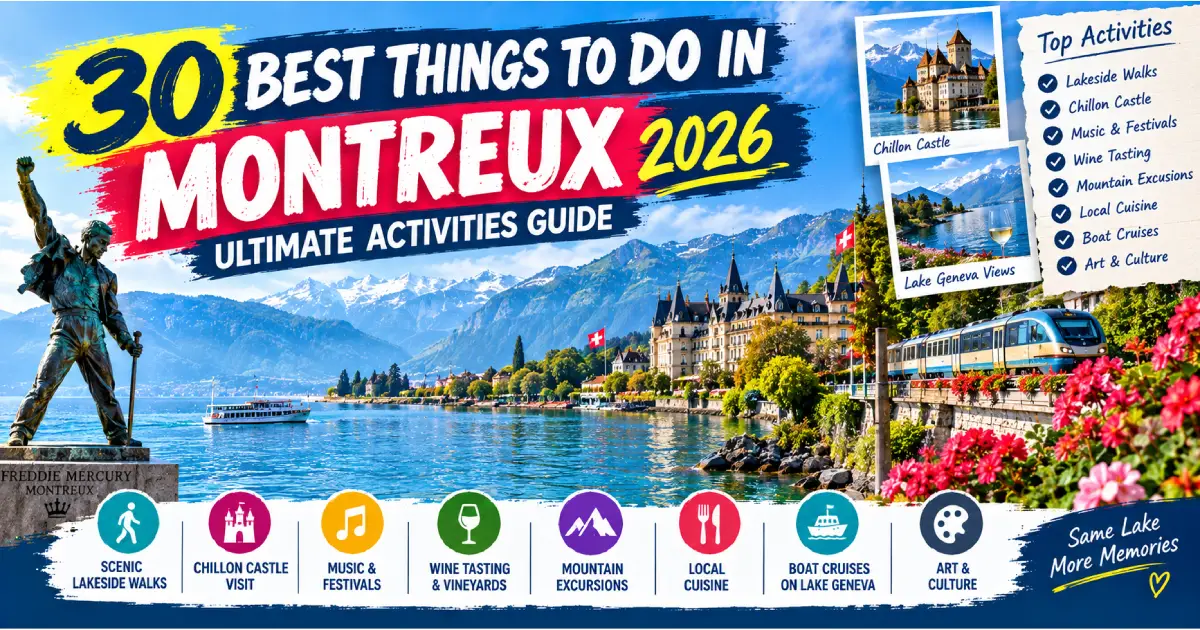
Montreux is Switzerland’s most romantic lakeside city — a resort town of approximately 26,000 permanent residents on the northeastern shore of Lake Geneva (Lac Léman), sheltered by the Vaud Pre-Alps behind the town and facing the French Savoy Alps across the water, in a specific microclimate (the warmest significant lakeside settlement in Switzerland, the mountain wall behind blocking cold northern winds while the lake’s thermal mass moderates temperature extremes) where palm trees, oleanders, and Mediterranean-climate plants grow outdoors that cannot survive the winters of Switzerland’s other major cities. The best things to do in Montreux in 2026 span the internationally famous (the Montreux Jazz Festival, now in its sixth decade as one of the world’s most prestigious music festivals; the Château de Chillon, the 12th-century island castle on Lake Geneva whose specific lakeside-and-mountain composition is Switzerland’s most photographed medieval building; and the Freddie Mercury statue on the promenade, commemorating the Queen frontman who spent his final productive years in the city) through the regionally celebrated (the Lavaux UNESCO vineyard walk departing directly from the Montreux train station, the CGN lake steamers departing for the full Lake Geneva circuit, and the GoldenPass scenic railway connection toward the Bernese Oberland) to the genuinely overlooked (the Old Town of Montreux-Clarens with its Belle Époque hotel architecture, the Rochers-de-Naye summit above the town for chamois viewing and panoramic hiking, and the specific Vevey connection 3 kilometers along the lake where Charlie Chaplin spent his final 25 years).
What makes Montreux’s position in the Swiss travel landscape distinctive is its specific role as both a destination in its own right (the Jazz Festival, the castle, the promenade, and the Belle Époque hotel tradition) and a gateway — the town sits at the precise junction of three major Swiss travel routes: the Lavaux wine region (extending west toward Lausanne), the Bernese Oberland (accessible via the GoldenPass express toward Interlaken), and the Italian-speaking Ticino (reachable via the Simplon route through Brig). Visitors who treat Montreux as a base rather than a day trip gain access to all three of these adjacent landscapes from a single lakeside accommodation — one of Switzerland’s finest single-point geographic positions for multi-directional regional exploration.
For related guides, see our Lavaux Wine Region: Complete Guide 2026, Best Restaurants in Geneva 2026, Switzerland Travel Guide 2026, and Swiss Travel Pass Guide 2026.
| # | Activity | Category | Cost | Season | Book Ahead? |
|---|---|---|---|---|---|
| 1 | Château de Chillon | Historic Site | CHF 13.50 | Year-round | No |
| 2 | Montreux Jazz Festival | Music Event | CHF 40–200+ | July | Yes (months) |
| 3 | Lavaux Vineyard Walk | Hiking | Free | Year-round | No |
| 4 | Lake Geneva Promenade Walk | Walking | Free | Year-round | No |
| 5 | Freddie Mercury Statue Visit | Sightseeing | Free | Year-round | No |
| 6 | Rochers-de-Naye by Rack Railway | Mountain | CHF 42 return | Year-round | No |
| 7 | CGN Lake Steamer to Lausanne | Boat | Swiss Travel Pass | April–October | No |
| 8 | GoldenPass Express to Interlaken | Scenic Train | Swiss Travel Pass + CHF 10–19 | Year-round | Yes (reservation) |
| 9 | Vevey Day Trip (Chaplin + Alimentarium) | Day Trip | Swiss Travel Pass | Year-round | No |
| 10 | Christmas Market (Marché de Noël) | Seasonal | Free entry | November–December | No |
| 11 | Caux Village Walk | Hiking | Free + train | June–October | No |
| 12 | CGN Full Lake Geneva Circuit | Boat | Swiss Travel Pass | April–October | No |
| 13 | Montreux Old Town (Clarens) | Culture | Free | Year-round | No |
| 14 | Lauvaux Caves Ouvertes | Wine | CHF 0–15 | Late May (annual) | No |
| 15 | Casino Barrière de Montreux | Casino/Culture | Free entry | Year-round | No |
| 16 | Les Avants and Sonloup Hike | Hiking | CHF 10–15 (train) | June–October | No |
| 17 | Swim at Montreux Plage | Swimming | Free | June–September | No |
| 18 | Visit Vevey’s Alimentarium Museum | Museum | CHF 15 | Year-round | No |
| 19 | Chaplin’s World (Vevey) | Museum | CHF 28 | Year-round | Yes (online) |
| 20 | Day Trip to Gruyères | Day Trip | Swiss Travel Pass + entry | Year-round | No |
| 21 | Montreux Jazz Café (Year-Round) | Music/Food | Free entry; food prices | Year-round | No |
| 22 | Walk the Lavaux Vineyard Express | Activity | CHF 12–16 | May–October | No |
| 23 | Baye de Clarens Waterfall Walk | Hiking | Free | April–October | No |
| 24 | Gorges du Chaudron Hike | Hiking | Free | May–October | No |
| 25 | Cycling the Lake Shore | Cycling | CHF 20–35 (rental) | April–October | No |
| 26 | Spa at Grand Hotel Suisse Majestic | Wellness | CHF 40–80 (day access) | Year-round | Yes |
| 27 | Visit the Palais de l’Art | Exhibition | CHF 5–15 | Year-round | No |
| 28 | Photo Walk — Queen/Freddie Locations | Photography | Free | Year-round | No |
| 29 | Glion Viewpoint Walk | Walking | Free + train (CHF 12) | Year-round | No |
| 30 | Lake Geneva Sunset Cruise | Boat | CHF 20–35 | May–September | No |
Cost: CHF 13.50 (adults), CHF 7 (children 6–15) | Location: Avenue de Chillon 21, 3 km east of Montreux | Access: CGN boat from Montreux (10 min, Swiss Travel Pass covered) or bus, or 40-minute lakeside walk | Hours: Daily 9 AM–7 PM (April–September); 10 AM–5 PM (November–February) | Duration: 1.5–2.5 hours | Season: Year-round
The Château de Chillon — the 12th-century island castle sitting on a rocky promontory directly on Lake Geneva’s eastern shore, the castle walls rising from the water’s edge, the lake surrounding three sides and the Alps visible beyond — is Switzerland’s most visited historic monument (over 400,000 visitors annually) and one of the most architecturally dramatic medieval buildings in Europe. The castle’s specific character: the combination of its lakeside position (the lake surface immediately at the base of the exterior walls, the reflection of the castle visible in the calm lake on still days), its architectural completeness (remarkably well-preserved through its continuous use across 900 years as a Savoy-dynasty residence, then a Bernese administrative center, then a cantonal prison, and finally a heritage monument — the castle’s successive occupants each leaving stratified architectural evidence), and its literary reputation (Lord Byron’s 1816 poem “The Prisoner of Chillon” — written after Byron and Shelley’s visit to the castle and their specific encounter with the dungeon where the historical prisoner François Bonivard was chained) create a destination of specific cultural depth alongside the architectural spectacle.
The dungeon (cachot): The lowest level of the castle (accessible on the standard visitor route), where the Bernese authorities held the Genevois prior François Bonivard for four years (1532–1536) chained to a pillar — the specific dungeon whose floor-level natural light (the light filtered through windows placed at water level, the lake surface visible through the window slits rather than the sky) and the Gothic vaulting create the specific atmospheric environment that Byron’s poem describes, and where Byron’s own carved signature is visible on one of the dungeon’s stone pillars (though its authenticity is debated by scholars, it is maintained as part of the visit).
The great halls: The upper levels of the Château (the Counts of Savoy’s residential halls, the Chapel of St. George with its medieval frescoes intact, the castellan’s residence, and the duke’s apartments) provide the most complete interior encounter with high-medieval Swiss-Savoyard domestic architecture available anywhere in the Lake Geneva region — the specific combination of defensive military architecture at the base and residential comfort at the upper levels (the large windows in the duke’s apartments facing the Alps and lake, the specific light quality that these lake-facing windows provide) creates an architectural coherence across the castle’s stratified layers.
The lakeside approach: Walking from Montreux to Chillon along the lakeside promenade (40 minutes, the path running directly along the lake shore with the castle growing progressively larger in the view ahead) provides the most dramatically staged first approach to the castle — the specific revelation of the island structure (the lake surrounding three sides becomes progressively apparent as the distance decreases) and the approach composition (the castle walls emerging from the water at eye level rather than being seen from above or from a distance) creating the most emotionally impactful first encounter with the building.
Insider tips: The Château de Chillon in the winter (November through February) provides the most specifically atmospheric interior experience — the reduced visitor numbers allowing genuinely contemplative movement through the dungeon, the great halls, and the chapel, and the low winter light through the lake-facing windows creating the specific dramatic Gothic interior lighting that summer’s brighter, more diffuse light diminishes. The early-morning summer visit (castle opens 9 AM April–September — arriving at opening avoids the main tour group arrivals between 10 AM and 2 PM that turn the dungeon into a corridor rather than a space).
Event dates: Early to mid-July (approximately 16 days — check montreuxjazzfestival.com for current 2026 dates) | Venues: Stravinski Auditorium (main indoor venue, 4,500 capacity), Miles Davis Hall (1,700 capacity), various free outdoor stages | Ticket prices: CHF 40–200+ (paid shows); multiple free outdoor stages | Book: Months ahead for major headliners | Access: All SBB trains covered by Swiss Travel Pass; festival area in central Montreux waterfront zone
The Montreux Jazz Festival (founded 1967 by Claude Nobs, originally as a pure jazz festival but now encompassing rock, pop, soul, blues, and electronic music alongside jazz — the “jazz” designation maintained despite the genre breadth because the festival’s founding identity and cultural reputation are irreversibly attached to the name) is one of the world’s most prestigious music festivals and the single most internationally celebrated annual event in Switzerland. The festival’s specific identity — the concentrated combination of indoor ticketed performances (the Stravinski and Miles Davis auditoriums providing intimate concert settings for major international artists) with the free outdoor stages (running simultaneously throughout the festival period on the lakeside) and the specific Montreux lakeside setting (the lake, the Alps, and the Belle Époque hotel architecture creating a festival backdrop of exceptional visual quality) — creates a music festival atmosphere that most competitors at comparable scale or price point don’t match.
The free stages: The Montreux Jazz Festival’s most specifically accessible dimension — the Montreux Jazz Lab (outdoor stage), the Lake Stage (directly on the lake shore), and various smaller stages that operate throughout the festival without ticket purchase required (though paid access areas are clearly demarcated). The free stage programming varies from emerging artists to established acts, with the specific decision about free vs. paid programming changing year-to-year — the 2026 program specifics available at montreuxjazzfestival.com from approximately March 2026.
The historical recordings: The Montreux Jazz Festival maintains the world’s most significant single archive of live music recordings — the “Concert Vault” (accessible at montreuxjazz.com/concert-vault) contains over 5,000 performances recorded at the festival across five decades, including legendary recordings (Deep Purple’s “Smoke on the Water” specifically references the 1971 Montreux fire during the Frank Zappa concert — one of the most famous single song references to a specific real event in rock history, and an event that occurred at this festival) that represent the most historically significant portion of any music festival’s archival holdings.
Insider tips: Festival accommodation in Montreux during the jazz festival (approximately July 1–16 in most years) books out 4–6 months ahead — visitors planning attendance should treat accommodation booking as the first priority, before even securing performance tickets. Lausanne (25 minutes by train, significantly more accommodation availability) and Geneva (1.5 hours by train) provide practical alternative bases for festival visitors who don’t find Montreux accommodation at reasonable prices.
Cost: Free | Length: 4 km (Villeneuve to Clarens section including all Montreux central area) | Best Time: Morning and evening | Duration: 1–2 hours full walk | Year-round
The Montreux lakeside promenade (the Quai de la Rouvenaz and its extensions — the flower-lined lakeside walkway running from the Château de Chillon area in the east through the Montreux center to the Clarens district in the west) provides the most continuously beautiful urban lakeside walk in Switzerland — the promenade’s specific combination of the flower plantings (the subtropical and Mediterranean species that Montreux’s warm microclimate allows outdoors year-round, the oleanders, palm trees, and magnolias that would not survive Geneva or Lausanne winters planted directly in the lakeside beds), the Lake Geneva views (the French Savoy Alps visible across the water on clear days, the specific blue-grey lake surface reflecting the surrounding mountains), and the Belle Époque hotel facades (the Grand Hotel Suisse Majestic, the Fairmont Le Montreux Palace, and the Hôtel Eden Palace au Lac providing the most concentrated Belle Époque lakeside hotel architecture in Switzerland) create a promenade whose quality consistently surprises visitors who arrive expecting a smaller version of Geneva’s lakefront.
The flower calendar: The Montreux promenade’s flowering season extends from February (the first camellias) through November (the last autumn roses) — a 10-month continuous flowering display that no Swiss city promenade outside Lugano approaches. The specific annual peak varies:
Cost: Free | Location: Quai de la Rouvenaz (the central promenade, near the Montreux Jazz Café) | Duration: 15–30 minutes | Year-round | Photography: The statue is a popular photography subject — early morning provides the clearest access
The Freddie Mercury statue (the 3-meter bronze figure of the Queen frontman in his characteristic performance pose — right arm extended, left hand on hip, wearing his signature white vest — standing directly on the Montreux lakeside promenade with Lake Geneva and the Alps as the backdrop) was unveiled in 1996, six years after Mercury’s death in London. The statue commemorates Mercury’s specific connection with Montreux — Queen maintained their Mountain Studios recording facility in the town from 1979, and Mercury spent significant portions of his final years (1989–1991) living in Montreux, recording the final Queen albums while managing his illness, and apparently finding specific peace in the lakeside environment.
The Queen-Montreux connection: The Mountain Studios (at the Montreux Casino building — the same location destroyed in the famous 1971 fire that inspired “Smoke on the Water” and subsequently rebuilt) operated as one of the most significant private recording studios in Switzerland through the 1970s–1990s, attracting artists including David Bowie, Led Zeppelin, Iggy Pop, and dozens of others for album recording sessions. The Mountain Studios are now partially converted to a museum space dedicated to Queen’s Montreux history (the Casino contains Queen-related exhibitions accessible to visitors).
Insider tips: The Freddie Mercury statue’s most photographic conditions: morning light (the east-facing lake provides the low morning sun as a backlight for the statue, creating the specific silhouette-with-lake composition that the midday overhead light doesn’t produce), and the pre-Jazz Festival weeks (late June–early July) when the lakeside flowers are at their most abundant and the specific connection between the statue and the festival’s music culture is most concentrated.
Cost: CHF 42 return (rack railway from Montreux, 55 min each way) | Summit: 2,042 meters | Duration: 3–4 hours | Season: Year-round | Swiss Travel Pass: 50% discount | Special: Wild marmots visible June–September; chamois year-round
The Rochers-de-Naye (2,042 meters, accessible from Montreux station by the Rochers-de-Naye rack railway — the MOB line ascending from the lake at 372 meters to the summit at 2,042 meters in approximately 55 minutes, gaining 1,670 meters of altitude through progressively dramatic mountain terrain) provides Montreux’s most accessible alpine summit — the panorama from the summit encompassing Lake Geneva’s full extent (the lake visible from its Villeneuve eastern end to its curve toward Geneva in the west, 73 kilometers of lake visible on clear days), the Bernese Oberland (the Jungfrau massif visible to the northeast), the French Alps (Mont Blanc visible approximately 60 km to the southwest), and the Valais Alps (the Monte Rosa group visible to the south).
The marmot colony: The Rochers-de-Naye summit maintains a specifically established marmot colony (the large ground squirrels of the Alps — social, burrowing, and genuinely photogenic at close range when habituated to human presence, as the Rochers-de-Naye colony specifically is). The marmots are visible from the terrace areas near the summit restaurant from approximately June through September (their active season — marmots hibernate October through April), providing the most specifically wildlife-oriented summit experience available from any Montreux excursion.
The Alpine garden: The Jardin Alpin de Rochers-de-Naye (at the summit, June–September) maintains a collection of Alpine and Arctic plants appropriate to the 2,042-meter altitude — one of the highest-altitude accessible botanical gardens in Switzerland, the specific plant collection including species from the Arctic tundra alongside local Alpine flora.
The rack railway journey: The MOB rack railway from Montreux to Rochers-de-Naye is specifically notable as a scenic journey in its own right — the ascent through the Montreux villa quarter (the Belle Époque residential villas visible from the train), the Glion plateau, the Caux promontory (where the Caux-Palace mountain hotel is visible — the former palace converted to a center for the Initiatives of Change international organization), and the increasingly dramatic mountain terrain approaching the summit provides the most varied ascent scenery of any mountain railway accessible from a Lake Geneva base.
Insider tips: The Rochers-de-Naye sunrise (checking the MOB timetable for earliest departures — occasionally special early departures operate in summer for sunrise viewing — check mob.ch for current 2026 schedule) provides the most dramatically atmospheric summit timing: the Lake Geneva surface often in morning mist below while the summit is in clear air, the sunrise light on the surrounding peaks creating the specific high-altitude dawn conditions that mid-morning and afternoon visits don’t access.
Cost: CHF 12 (rack railway from Montreux to Glion, Swiss Travel Pass 50% discount) OR free (1-hour hike) | Altitude: 690 meters | Duration: 1–1.5 hours | Season: Year-round
Glion (the residential promontory village 300 meters above Montreux, accessible by the historic Montreux-Glion funicular or by a 1-hour marked hiking trail from the Montreux station) provides the most accessible elevated overview of the Montreux-Chillon-Lake Geneva landscape — the Belle Époque villas and their gardens visible below, the Château de Chillon’s island position directly visible in the lake, and the French Alps forming the southern and western horizon. The specific Glion viewpoint (the promontory’s south-facing edge, easily walkable from the Glion station) provides a static version of what the Rochers-de-Naye railway passes through on ascent — the most complete single-view overview of Montreux’s geographical setting without requiring the full 2,042-meter summit commitment.
Cost: CHF 10–15 (MOB train from Montreux, 20 min) | Season: Late April–May (narcissus flowering) | Duration: 3 hours (hiking) | Character: Switzerland’s finest narcissus meadow display
Les Avants (the pre-Alpine plateau village above Glion, accessible by the MOB narrow-gauge railway from Montreux in approximately 20 minutes) provides Switzerland’s finest single narcissus meadow display during the brief May flowering period — the specific high-altitude meadows above the village carpeted with millions of wild narcissus in late April through May, the white flowers creating a specific visual spectacle that Swiss residents make specific pilgrimages to experience annually. The Les Avants narcissus display is one of Switzerland’s most celebrated seasonal natural events — a 2–3 week window of meadow-covering white flower that motivates specific excursions from Geneva and Lausanne.
Outside narcissus season: Les Avants provides year-round hiking access to the Sonloup plateau (the higher terrain above Les Avants, with specific views of Lake Geneva and the Lavaux vineyards below) and the connecting trail network toward the Rochers-de-Naye approach — a viable hiking circuit for visitors who want the mountain terrain above Montreux in a self-propelled format rather than the rack railway ascent.
Cost: Free (trail); SBB trains to Lavaux villages covered by Swiss Travel Pass | Access: SBB from Montreux to Chexbres (22 min) or Saint-Saphorin (18 min) | Duration: Half day or full day | Season: Year-round; most rewarding April–October
The Lavaux UNESCO vineyard terrace trail (see our Lavaux Wine Region Complete Guide for full detail) begins at Montreux’s railway connections — the SBB regional trains departing Montreux station for the Lavaux villages (Chexbres, Saint-Saphorin, Rivaz, Epesses, Cully, Lutry in westward sequence) in 18–35 minutes make Montreux the most eastern convenient access point for the vineyard trail. The specific Montreux-based Lavaux day (SBB to Chexbres in the morning for the highest viewpoint, walking west through the terraces to Saint-Saphorin for lunch at Auberge de l’Onde, continuing to Rivaz and Cully for afternoon wine tasting, and SBB return from Cully to Montreux) provides the most varied single Lavaux day available from any base.
The harvest connection: During harvest season (mid-September to mid-October), the proximity of the Lavaux to Montreux (the vineyards beginning immediately west of Villeneuve, 5 km from Montreux center) allows visiting the harvest activity in the morning and returning to Montreux for the afternoon and evening — a particularly efficient combination for visitors who want both the harvest atmosphere and the Montreux lakeside evening experience.
Cost: Swiss Travel Pass covered | Duration: 4–8 hours depending on route | Season: Full service April–October | Access: CGN landing stage, Montreux waterfront
The CGN (Compagnie Générale de Navigation sur le Lac Léman) lake steamer service covers the full Lake Geneva circuit — from Montreux westward to Lausanne (1 hour), Nyon (2.5 hours), Geneva (4 hours), and back via the southern French shore or the Swiss northern shore. The specific CGN steamer experience from Montreux: the historic paddle steamer vessels (the CGN maintains the world’s oldest fleet of operational paddle steamers — five Belle Époque vessels built 1904–1927 restored to operational condition) on specific heritage departures, with the standard modern fleet operating the regular service schedule.
The Belle Époque steamers: The CGN’s five historic paddle steamers (La Suisse, Montreux, Savoie, Simplon, and Vevey — each named for a Lake Geneva-connected location, each built 1904–1927 and restored to operational specification) operate heritage departures on specific dates and routes — the most atmospheric and most specifically sought-after CGN experience, requiring advance timetable checking (cgn.ch) for the current year’s heritage sailing schedule.
Insider tips: The CGN sunset cruise (the specific departures from Montreux in late afternoon that return after sunset — the Lake Geneva in the specific golden and orange light of Lake Geneva sunset, the French Alps visible across the water in the day’s finest light, and the Château de Chillon visible from the water in the specific directional lake-and-castle composition that the afternoon return provides) represents Montreux’s most specifically beautiful single freely-priced activity (covered by Swiss Travel Pass) of any season.
Cost: Swiss Travel Pass covered | Duration: 15 minutes by boat | Access: CGN from Montreux landing stage | Season: April–October (full CGN schedule); year-round by SBB train (10 min)
Vevey (15 minutes by CGN boat from Montreux, or 10 minutes by SBB train — both covered by Swiss Travel Pass) is the most immediately worthwhile Montreux day-trip destination: Charlie Chaplin’s home city for the final 25 years of his life (1953–1977, the Manoir de Ban in the suburb of Corsier-sur-Vevey now the Chaplin’s World museum — the most significant individual artist-home museum in Switzerland), the Alimentarium (the world’s only museum dedicated entirely to the history and science of nutrition and food, operated by Nestlé — whose global headquarters occupy the Vevey waterfront — and covering food culture from prehistoric to contemporary in a consistently engaging multimedia format), and the Vevey waterfront’s specific atmosphere (less resort-hotel-dominated than Montreux, more town-center in character, with the specific vibrancy of a functioning market town alongside the lake).
Chaplin’s World: The Chaplin’s World museum (CHF 28 — the Manoir de Ban house where Chaplin and his family lived, fully restored and recreated as it was during his occupancy; the Film Studio recreation building with walk-through recreations of the Great Dictator set and other famous scenes; and the 14-hectare park surrounding the property) represents the most complete museum experience associated with any single international artist available in Switzerland — the combination of the actual house, the period recreations, and the film archive material creates a depth of engagement with Chaplin’s life and work unavailable at comparable institutions.
Dates: Late November to Christmas Eve (approximately 6 weeks) | Location: Lakeside promenade and market square, Montreux center | Cost: Free entry; purchases additional | Access: SBB from Geneva or Lausanne (Swiss Travel Pass) | Character: Consistently voted among Switzerland’s and Europe’s finest Christmas markets
The Montreux Noël (the Montreux Christmas Market — running from late November through December 24 annually, operating along the lakeside promenade and extending into the market square near the station) is consistently ranked among Switzerland’s and Europe’s most beautifully positioned Christmas markets: the lakeside setting (the market stalls along the Lungolago with Lake Geneva reflecting the Christmas lights on clear evenings), the sub-Mediterranean microclimate (Montreux in December is noticeably warmer than Zurich, Bern, or Lucerne — the outdoor Christmas market experience significantly more comfortable than in the colder German-Swiss cities), and the specific combination of Swiss-made artisanal gifts (the quality level of the vendor selection, consistently maintained above the standard Christmas market generic-gift baseline) create a Christmas market experience of genuinely exceptional atmospheric quality.
The floating market: The Montreux Noël includes a floating market element (vendors on pontoons directly on the lake surface — a feature unique to Montreux among Swiss Christmas markets, the specific combination of water reflection and market stall character creating the most photographically distinct Christmas market image available in Switzerland) that is the event’s most specifically extraordinary visual element.
Insider tips: The Montreux Christmas market’s weekday afternoon timing (approximately 3–7 PM on weekdays in the pre-Christmas period) provides the most pleasant market experience — the weekend crowds (the market’s regional reputation drawing visitors from Geneva, Lausanne, Bern, and Zurich, creating weekend congestion that diminishes the atmosphere) replaced by a manageable and more specifically local attendance.
Cost: Free entry; food and drinks additional | Location: Montreux waterfront (adjacent to the Freddie Mercury statue area) | Hours: Daily, café hours (check mjcafe.ch) | Season: Year-round
The Montreux Jazz Café (the year-round restaurant and bar maintaining the Jazz Festival’s musical identity and atmosphere outside the festival period) provides continuous access to the festival’s audiovisual archive — the café’s screens showing archival performances from the festival’s 60-year history, the music programming reflecting the festival’s curatorial identity, and the specific atmosphere of a venue that exists primarily to extend the festival’s cultural presence across the non-festival months.
The food (internationally-influenced menu appropriate to the café’s global music culture identity) and the drinks (the festival’s own-label cocktail menu alongside standard café drinks) provide a competent accompaniment to the primary experience of watching archive footage of legendary performances in a lakeside bar setting whose acoustic quality (specifically designed for music reproduction) makes it the best casual music listening venue in Montreux outside the festival itself.
Cost: CHF 45–75 (afternoon tea service) | Location: Avenue Claude Nobs 2, Montreux | Reservation: Yes | Season: Year-round | Character: One of Switzerland’s greatest Belle Époque grand hotels
The Fairmont Le Montreux Palace (the grand hotel whose lakefront facade — the tower and turrets of the Belle Époque design, combined with the specific lakefront positioning that gives the hotel both lake and mountain views from its primary facades — constitutes one of the defining images of Montreux’s architectural identity) provides afternoon tea in the most historically charged single building in Montreux: the hotel where Coco Chanel, Vladimir Nabokov (who lived here for 15 years and wrote Pale Fire and Ada during his residence), and countless other significant cultural figures of the 20th century stayed. The afternoon tea service (in the hotel’s tea lounge with the lake view, or on the terrace in summer) provides access to the Palace’s Belle Époque interior without requiring overnight accommodation.
Nabokov’s Hotel: Vladimir Nabokov lived at the Montreux Palace from 1961 to his death in 1977 — the hotel housing him through the period of his greatest international fame (the Lolita scandal’s aftermath, the worldwide translation of his Russian-period novels, and the composition of Pale Fire, Ada, and several other major works). The hotel maintains the specific Nabokov connection in its historical documentation and room designations — the Nabokov Suite (the specific suite that the writer occupied for 15 years) visible in the corridor adjacent to his historical occupation point.
Cost: CHF 20–35/day (bike rental — multiple operators in Montreux center) | Distance: Various circuits 15–50 km | Season: April–October | Best Route: Montreux → Château de Chillon → Villeneuve (return 15 km) or Montreux → Lausanne (50 km one-way, SBB return)
The Lake Geneva shore cycling path (the Route Verte, the specifically developed cycling infrastructure running along the lake shore from Geneva to Villeneuve) passes through Montreux providing direct access to both the eastern Château de Chillon section (5 km from Montreux, past the castle and continuing to Villeneuve for a 15 km return) and the western Lavaux section (continuing toward Lausanne through the wine villages, the lakeside cycling path providing the lowest-altitude engagement with the Lavaux landscape at lake level rather than terrace level).
The Château de Chillon cycling approach: The specific 5 km cycle from Montreux to the Château de Chillon (along the dedicated lakeside cycling path, the castle appearing progressively as the path curves around the bay at Veytaux) provides the most gradual and most continuously lake-adjacent approach to the castle available — the cycling speed’s specific relationship with the castle’s progressive visual reveal creating a more sustained anticipation than the boat or bus approach provides.
Cost: Free (public beach areas); CHF 5–10 (organized lido facilities) | Location: Multiple points along the Montreux lakefront | Season: June–September (water temperature 18–24°C at peak) | Best Time: Morning for clearest water
Lake Geneva at Montreux (the eastern end of the lake, where the lake is slightly warmer than the Geneva end due to the shallower eastern basin and the reduced mixing with colder alpine tributaries) provides public beach swimming access at multiple points along the Montreux promenade — the Plage de Clarens (the most organized public lido facility, with changing rooms, lawn areas, and lake access) and various informal access points along the lakeside promenade providing the primary public swimming access.
Insider tips: Lake Geneva’s eastern end (the Villeneuve-Montreux area) provides the warmest lake swimming in Switzerland’s significant lakes — the specific basin geometry concentrating solar warming in the shallow eastern section, producing water temperatures that peak at 22–24°C in mid-July to mid-August. The morning lake surface (before afternoon winds develop) provides the most visually rewarding swimming context — the French Alps reflected in the calm morning lake surface visible from the swimmer’s water-level perspective.
About Travel Tourister Travel Tourister’s destination specialists have experienced Montreux across all seasons — from Château de Chillon dungeon winter visits and Jazz Festival free stage evenings through Rochers-de-Naye marmot-season mornings and Lavaux harvest walks to Christmas market floating-stall evenings, Fairmont Palace afternoon teas, and CGN Belle Époque paddle steamer lake circuits — to deliver the most practical and honest guide to the best things to do in Montreux for every type of 2026 visitor.
Posted By : Vinay
Latest Article
2nd Floor, 39, Above Kirti Club, DLF Industrial Area, Kirti Nagar, New Delhi, Delhi 110015



Travel Tourister is a leading Travel portal where we introduce travellers to trusted travel agents to make their journey hasselfree, memorable And happy. Travel Tourister is a platform where travellers get Tour packages ,Hotel packages deals through trusted travel companies And hoteliers who are working with us across the world. We always try to find new and more travel agents and hoteliers from every nook and corners across the world so that you could compare the deals with different travel agents and hoteliers and book your tour or hotel with the one you have chosen according to your taste and budget.
Copyright © Travel Tourister, India. All Rights Reserved

 Call
Call Enquiry