Published on : 10 Sep 2026
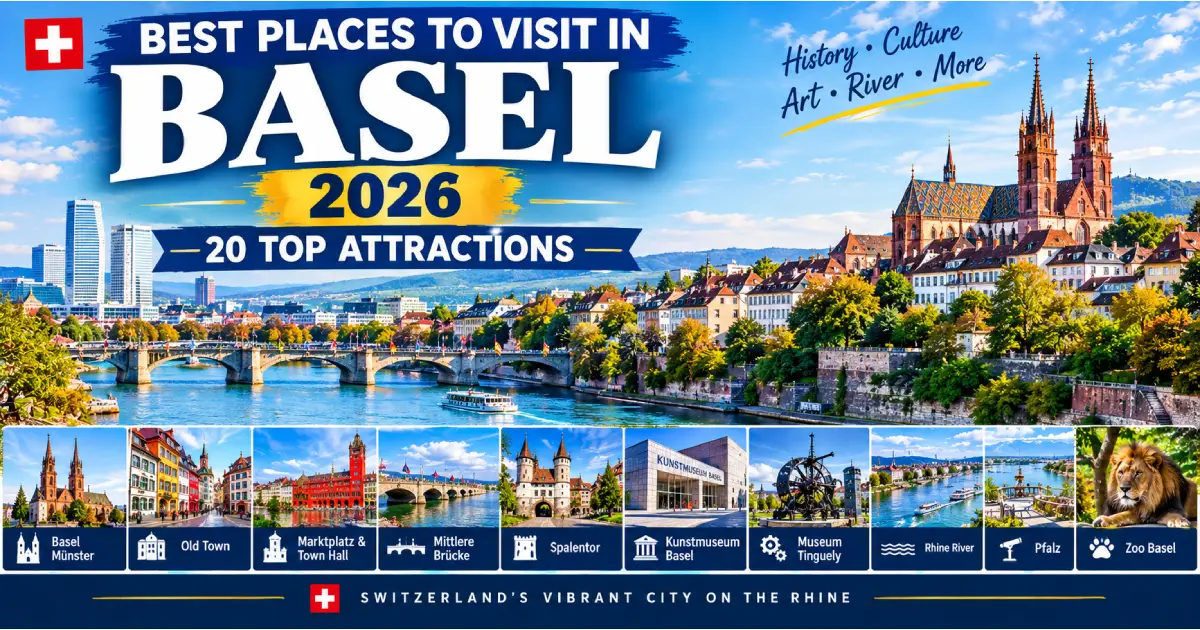
By Travel Tourister | Updated Sep 2026
Basel is Switzerland’s most intellectually serious city — a Rhine-side city of approximately 180,000 permanent residents that functions simultaneously as Switzerland’s most important art city (hosting Art Basel, the world’s most significant contemporary art fair, every June; maintaining 40+ museums per square kilometer, the highest museum density of any city on Earth; and housing several of the world’s finest individual art museums, including the Kunstmuseum Basel, the Fondation Beyeler, and the Museum Tinguely), as a major pharmaceutical and chemical industry center (Novartis, Roche, and Syngenta all headquartered in the city, the so-called “Pharmadreieck” providing the economic foundation that funds Basel’s extraordinary cultural infrastructure), and as Switzerland’s only genuinely tricultural city — Basel sits precisely at the point where Switzerland, Germany, and France meet (the Dreiländereck — the Three-Country Corner — where the Rhine marks the actual border junction), the city drawing daily commuters and cultural audiences from three national contexts.
The best places to visit in Basel in 2026 reflect this specific cultural density: the Kunstmuseum Basel (the oldest public art museum in the world, in continuous operation since 1661, with a collection spanning Holbein the Younger’s most significant works through Picasso, Klee, and contemporary art of exceptional quality), the Fondation Beyeler (the single finest private art collection open to the public in Switzerland, in a Renzo Piano building in Riehen that provides the world’s finest single museum experience for Impressionist and modern art), the Basel Old Town (the most architecturally complete Romanesque-to-Gothic-to-Renaissance city center in Switzerland, the Münster cathedral overlooking the Rhine from its terrace position), and the Rhine itself (the river that defines Basel’s specific urban character — the summer swimming tradition of floating downstream in the Rhine’s current, one of Switzerland’s most distinctive urban outdoor pleasures). This guide covers the 20 best places to visit in Basel with the depth and practical detail that makes each genuinely rewarding.
For related guides, see our Switzerland Travel Guide 2026, Best Places to Visit in Switzerland 2026, Things to Do in Zurich 2026, and Swiss Travel Pass Guide 2026.
| Place | Type | Cost | Best For | Duration |
|---|---|---|---|---|
| Kunstmuseum Basel | Museum | CHF 26 | Old Masters to contemporary, Holbein | 3–4 hrs |
| Fondation Beyeler | Museum | CHF 30 | Impressionist and modern art, Renzo Piano | 2–3 hrs |
| Basel Münster | Cathedral | Free (crypt CHF 2) | Romanesque cathedral, Rhine terrace | 1–1.5 hrs |
| Basel Old Town (Altstadt) | Historic Quarter | Free | Medieval architecture, fountains | 2 hrs |
| Museum Tinguely | Museum | CHF 18 | Kinetic art, Jean Tinguely machines | 1.5–2 hrs |
| Dreiländereck (Three-Country Corner) | Landmark | Free | Switzerland/Germany/France junction | 30 min |
| Rhine Swimming (Rheinschwimmen) | Swimming | Free | Floating downstream in summer | 2 hrs |
| Museum der Kulturen Basel | Museum | CHF 12 | World cultures, ethnography | 1.5–2 hrs |
| Marktplatz and Red Town Hall | Architecture | Free | Most picturesque city square in CH | 30 min |
| Art Basel (June Fair) | Art Fair | CHF 68+ | World’s most important contemporary art | Full day |
| Vitra Design Campus | Architecture | CHF 14–20 | Hadid, Gehry, Ando, Siza campus | 2–3 hrs |
| Historisches Museum Basel | Museum | CHF 12 | Basel history from medieval | 1.5–2 hrs |
| Kleinbasel (Klein Basel) | Neighborhood | Free | Rhine bank, alternative culture | 1–2 hrs |
| Spalentor Gate | Architecture | Free | Best-preserved medieval city gate CH | 20 min |
| Basel Paper Museum | Museum | CHF 15 | Interactive medieval paper production | 1.5 hrs |
| Museum für Gegenwartskunst | Museum | Included with Kunstmuseum | Contemporary art, Rhine bank | 1 hr |
| Riehen Village and Beyeler | Village | Free (village) | Fondation Beyeler approach, village walk | Half day |
| Basel Carnival (Fasnacht) | Festival | Free | World’s largest carnival 72 hours | 3 days (early March) |
| Anti-museum (Haus für elektronische Künste) | Museum | CHF 8 | Electronic and media art | 1 hr |
| Zoo Basel (Zoologischer Garten) | Zoo | CHF 22 | Oldest and finest zoo in Switzerland | 3 hrs |
Cost: CHF 26 (day ticket covering main building + Gegenwart annex); free first Sunday of month | Location: St. Alban-Graben 16, Basel | Hours: Tuesday–Sunday 10 AM–6 PM (Wednesday until 8 PM) | Duration: 3–4 hours | Access: Tram 2 or 15 to Kunstmuseum | Book: No reservation required except for special exhibitions
The Kunstmuseum Basel (opened to the public in 1661, making it the world’s oldest public art museum — preceding the Uffizi’s public accessibility by more than a century) maintains a collection of exceptional range and quality: the world’s most significant collection of works by Hans Holbein the Younger (16 major paintings including the portrait series of Erasmus, the “Dead Christ in the Tomb” — whose specific horizontal format and unflinching anatomical realism influenced Dostoevsky so profoundly that he described it in “The Idiot”), the finest collection of Upper Rhine painting from 1400–1600 anywhere in the world, and a modern collection (Paul Klee, Pablo Picasso, Alberto Giacometti, Oskar Kokoschka) that reflects Basel’s specific 20th-century cultural position at the intersection of German, French, and Swiss modernism.
The Holbein collection: The Kunstmuseum’s most internationally irreplaceable holding — Hans Holbein the Younger worked in Basel from 1515 to 1526 and again from 1528 to 1532, producing the majority of his definitive works here before his permanent move to London as Henry VIII’s court painter. The Basel collection (assembled partly by purchase and partly by the 1661 Amerbach Cabinet acquisition — the private collection of the Basel humanist Bonifacius Amerbach that formed the museum’s founding core) includes Holbein portraits of unprecedented psychological penetration and technical accomplishment. The “Dead Christ” (the horizontal entombment painting, the figure of Christ in an entirely realistic rather than idealized state of post-mortem rigor, the specific horizontal format implying the closed sarcophagus lid and the body’s confinement) is the single most discussed individual work in the museum.
The Lucas Cranach collection: The museum’s other exceptional historical holding — works by Lucas Cranach the Elder (the Wittenberg Reformation painter, whose collaboration with Luther and whose extraordinary productivity created the visual iconography of the German Reformation) of a quality and number exceeding any collection outside Germany, reflecting Basel’s specific position as a Reformation city where the cultural connections with the Lutheran German states were maintained.
The modern collection: The museum’s 20th-century holdings (arranged in the connected Gegenwart annex on the Rhine bank) include specific Paul Klee works of the highest quality (the Basel Klee collection second in significance only to Bern’s Zentrum Paul Klee), Picasso works spanning his full career, and a selection of post-war European and American art of genuine depth.
Insider tips: The free first Sunday of each month (when the permanent collection is accessible without entry fee) is the museum’s most visited single day — arriving at opening time (10 AM) on the first Sunday provides access before the crowds intensify at mid-morning. The Wednesday evening extension (open until 8 PM) provides the week’s most specifically atmospheric visiting window — the reduced afternoon crowd and the gallery lighting’s evening quality creating a more contemplative museum environment than the weekend peak.
Cost: CHF 30 | Location: Baselstrasse 101, Riehen | Hours: Daily 10 AM–6 PM (Wednesday until 8 PM) | Duration: 2–3 hours | Access: Tram 6 from Basel center to Riehen/Fondation Beyeler (30 min, covered by Swiss Travel Pass) | Book: No reservation usually required; advance purchase recommended for major temporary exhibitions
The Fondation Beyeler (the foundation established by Basel art dealer Ernst Beyeler and his wife Hildy, opened in 1997 in a purpose-built Renzo Piano building in the Basel suburb of Riehen — a building of exceptional quality, the Piano-designed single-story pavilion with its natural-light-filtering roof providing the most perfectly calibrated museum light in Switzerland and among the finest in Europe) houses what is consistently described as the finest private art collection open to the public in Switzerland and one of the 10 finest in the world: approximately 200 masterworks of Impressionism, Post-Impressionism, Classical Modernism, and select contemporary art, selected by Beyeler across a 50-year art-dealer career with a connoisseur’s eye rather than an institutional committee’s consensus.
The collection’s character: The Fondation Beyeler’s specific genius is the collection’s coherence — every work was selected by a single extraordinary eye, creating a consistency of quality and a specific sensibility (Beyeler’s preference for works of emotional directness and technical achievement rather than conceptual novelty) that institutional collections assembled by committee and bequest cannot match. The Monet “Waterlilies” (the late series, four paintings in the Fondation representing the culmination of Monet’s visual investigation of his Giverny pond surface in aging, failing eyesight), the specific Cézanne still lifes (the apples and tablecloth paintings that Cézanne produced at the peak of his analytical power), and the Picasso selection (spanning Cubism through the monumental sculptures of the 1930s-40s) provide the most specifically “museum-visit emotion” intensity per square meter of any Swiss museum.
The building: Renzo Piano’s pavilion (natural stone walls, the signature Piano translucent roof panels diffusing daylight into the galleries at the specific intensity that Impressionist and Post-Impressionist painting requires, the garden surroundings creating an immediate relationship between the landscape paintings inside and the garden visible through the glass-walled ends) is as compelling as the collection — one of the world’s finest examples of museum architecture specifically designed around the needs of a specific collection.
Insider tips: The Fondation Beyeler’s temporary exhibition program (typically 3–4 major exhibitions per year, each drawing from international collections for the most ambitious European temporary shows outside London and Paris) provides the most consistently high-quality temporary exhibition program in Switzerland. Checking fondationbeyeler.ch for the current 2026 exhibition calendar and timing a Basel visit to coincide with a specific major show provides the most specifically exceptional single museum visit available in Switzerland.
Cost: CHF 18 | Location: Paul Sacher-Anlage 2, Basel | Hours: Tuesday–Sunday 11 AM–6 PM | Duration: 1.5–2 hours | Access: Tram 8 to Museum Tinguely
The Museum Tinguely (on the Rhine bank in a purpose-built Mario Botta building, dedicated to the work of the Basel-born Jean Tinguely — 1925–1991, the kinetic sculptor and meta-mechanical artist whose machines embody the most specifically entertaining serious art available in any Swiss museum) provides the most specifically joyful art museum experience in Basel. Tinguely’s machines — large-scale assemblages of scavenged industrial components (motors, gears, wheels, bicycle parts, fan blades, and various found objects) assembled into self-propelling kinetic sculptures that rattle, whir, clatter, and occasionally collapse in specifically deliberate semi-chaos — are activated at specific times during the museum visit, transforming the gallery from a standard silent museum environment into an animated, noisy, genuinely amusing space whose seriousness of artistic purpose is entirely compatible with the laughter that the machines reliably produce.
The “Baluba” series: Tinguely’s signature dangling assemblages (the Baluba works — wire armatures hung with found objects that move in air currents created by the gallery environment, producing specific sound-and-motion events that Tinguely specifically designed to be unpredictable within controlled parameters) are the museum’s most characteristic work type, representing the core of Tinguely’s mature artistic vision: machines that comment on machines, kinetic art that parodies industrialism, chaos that reveals the concealed disorder in apparent order.
“Homage to New York” documentary: The museum’s documentation of Tinguely’s 1960 “Homage to New York” (the self-destroying machine that Tinguely constructed in MoMA’s sculpture garden specifically to destroy itself in front of the art world — the machine’s planned self-immolation on March 17, 1960 having partially succeeded, partially failed, and partially alarmed the fire department in a specifically Tinguely fashion) provides the most concentrated single encounter with the artist’s fundamental conceptual approach.
Insider tips: The Museum Tinguely’s machine activation schedule (certain works activated at specific hours on weekends and holidays — check the current schedule at tinguely.ch) transforms the museum’s character when the machines are running versus when they’re at rest. Planning the visit to coincide with an activation period (typically midday on weekends) provides the most specifically Tinguely-intended experience.
Cost: CHF 12 | Location: Münsterplatz 20, Old Town | Hours: Tuesday–Sunday 10 AM–5 PM | Duration: 1.5–2 hours | Special: The expanded roof structure by Herzog & de Meuron
The Museum der Kulturen Basel (the Museum of Cultures — the ethnographic museum in the Old Town’s Augustinerhof, immediately adjacent to the Münster cathedral, expanded and transformed by the Basel-born Herzog & de Meuron architectural practice [the winners of the Pritzker Prize who also designed the Tate Modern, the “Bird’s Nest” Beijing Olympic Stadium, and dozens of other internationally significant projects] with a specific roof structure [2011] that transformed the historic museum building into one of Basel’s most architecturally distinctive spaces) holds the most significant ethnographic collection in Switzerland — objects from Oceania, Africa, the Americas, and Asia accumulated through Basel’s specific 19th-century missionary and mercantile connections.
The Oceania collection: The museum’s most internationally significant single holding — the Oceania collection (assembled partly through the Basel Mission’s Pacific activity and partly through the specifically extraordinary curiosity of individual Basel collectors in the 19th century) contains works of quality and importance comparable to those in Berlin’s Humboldt Forum and the British Museum’s Pacific collections.
The Herzog & de Meuron roof: The expanded roof structure (a tilted, asymmetric ceramic-tile roof that creates a new public roof terrace while simultaneously transforming the building’s silhouette in the Münsterplatz) provides one of Basel’s most specifically architectural experiences — the terrace accessible during museum hours providing a specific view of the Münster’s north face and the Old Town roofscape unavailable from any other accessible elevated position in the area.
Cost: CHF 12 | Location: Barfüsserplatz, Basel | Hours: Tuesday–Sunday 10 AM–5 PM | Duration: 1.5–2 hours
The Historisches Museum Basel (housed in the 14th-century Barfüsserkirche — the former Franciscan church whose nave and choir provide among the most atmospheric museum spaces in Switzerland, the high Gothic stone interior converted to display Basel’s historical collections without destroying the architectural character) contains the most significant single object in all of Switzerland for specific historical drama: the original Basel Danse Macabre fresco fragments (the “Totentanz” — the Dance of Death, the medieval Basel fresco cycle that was the most celebrated single visualization of death’s democratic equality in European art, the complete fresco destroyed in the 19th century but surviving in the specific fragments now in the museum alongside the 17th-century prints by Matthäus Merian that recorded it before destruction).
The cathedral treasury: The museum’s second exceptional holding — the Basel Cathedral Treasury (the medieval church vessels, reliquaries, and sacred objects from the Münster, one of the finest cathedral treasuries in the German-speaking world, whose survival through the Reformation iconoclasm in Basel is historically significant given the city’s specific Reformed Protestant character from 1529).
Cost: Free (cathedral); CHF 2 (crypt) | Location: Münsterplatz, Basel Old Town | Hours: Monday–Saturday 10 AM–5 PM; Sunday from noon | Duration: 1–1.5 hours
The Basel Münster (the cathedral complex on the elevated Rhine bank whose terrace — the Pfalz — is Basel’s finest single public viewpoint: the Rhine below, the Black Forest on the German bank visible across the water, and the German city of Freiburg im Breisgau’s Münster tower visible on clear days 30 kilometers to the northeast) is simultaneously Basel’s finest Romanesque-to-Gothic cathedral (built 1019–1500 in successive campaigns that added Gothic elements to the original Romanesque structure, the specific combination visible in the nave’s Romanesque proportions carrying a Gothic clerestory of later insertion) and its most specific public space — the Pfalz terrace behind the cathedral used daily by Basel residents for the city’s most celebrated informal public sitting space.
The St. George portal: The most specifically significant single medieval portal in Basel — the southern doorway’s specific Romanesque carving (the tympanum composition of Christ in Majesty with the Four Evangelists’ symbols, the door jamb figures of prophets and apostles, and the specific stone carving technique of 11th–12th century Rhenish workshop practice) represents the most important Romanesque sculpture surviving in Basel.
The Erasmus tomb: Desiderius Erasmus (the most significant humanist scholar of the early 16th century, the Rotterdam-born philosopher who made Basel his final residence) is buried in the Basel Münster — the tomb slab (a simple red sandstone marker in the north aisle, the inscription noting his accomplishments without elaboration in a characteristically humanist restraint) providing the most specific single connection between the physical cathedral and Basel’s extraordinary role in the Erasmian humanist tradition.
The Pfalz terrace: The open terrace behind the Münster’s east end (the Pfalz — accessible through the cathedral or via the external staircase from the Münsterberg side) provides Basel’s finest specific urban viewpoint: the Rhine in its full Basel width visible below (approximately 270 meters at this point), the German bank (Kleinbasel — the smaller part of Basel on the Rhine’s north bank, traditionally the city’s working-class quarter) visible directly across, and the Black Forest hills providing the specific green backdrop that makes the Rhine here genuinely beautiful rather than merely useful.
Cost: Free | Location: Marktplatz, Basel Old Town center | Best Time: Tuesday and Saturday mornings (market); year-round | Duration: 30 minutes
The Basel Marktplatz (the central market square, Basel’s most photographed single urban composition) provides the most pictorially concentrated view of Basel’s architectural character: the 16th-century Rathaus (Town Hall) with its specific deep red-orange painted facade (the Basel red, a specific pigment derived from iron oxide that has identified the Rathaus since its 1504–1521 construction, maintained in successive repaints across 500 years as the city’s symbolic color) covering the entire north side of the square, the medieval and Renaissance building facades of the surrounding market area, and the weekly Tuesday and Saturday fruit-and-vegetable market (one of Switzerland’s finest city-center fresh markets, operated on the Marktplatz since the medieval period) providing the most complete single-viewpoint expression of Basel’s urban identity.
The Rathaus courtyard: The Rathaus’s internal courtyard (accessible through the main portal on the Marktplatz — no entry restriction during normal business hours) contains the most significant single collection of Basel heraldic painting: the courtyard walls covered in painted shields, historical scenes, and civic emblems spanning from the original 16th-century painting through successive restoration campaigns that have maintained the courtyard decoration as a continuously updated civic document.
Insider tips: The Basel Marktplatz in the Tuesday morning market peak (approximately 9–11 AM) provides the most socially complete version of the square — the market stalls across the full square width, the café terraces of the surrounding buildings active, and the Rathaus facade in full morning light creating the most photographically complete Basel composition. The specific combination of the deep red Rathaus facade, the market stall color, and the morning light on the medieval surrounding buildings is the most specifically Basel image available at any accessible public space.
Cost: Free | Location: Spalenvorstadt, western Old Town | Year-round | Duration: 20 minutes
The Spalentor (the surviving main western gate of Basel’s medieval city walls, completed 1370, the most architecturally accomplished medieval city gate in Switzerland — its specific combination of the central tower, flanking turrets, decorative tracery on the gatehouse arch, and the specific medieval heraldic sculptural program on the gate’s exterior face representing the high point of 14th-century Swiss civic fortification architecture) provides the most dramatically photogenic single medieval structure in Basel. The gate’s specific composition (the three-tower silhouette, the heraldic decoration at the arch level, and the gatehouse passage through which pedestrians still walk daily) creates the city’s most historically atmospheric single built element.
The Spalentor’s specific historical significance: it is one of only three surviving gates from Basel’s original six medieval city gates (the others demolished in the 19th century urban expansion), preserved when the city walls were demolished by a civic vote that specifically excluded the three most architecturally significant gate towers. The vote’s outcome (the Spalentor, the St. Alban Tor, and the Aeschentor preserved while the functionally equivalent but architecturally plainer gates were demolished) represents one of Switzerland’s earliest examples of civic architectural conservation consciousness.
Cost: Free | Location: Multiple entry points (Rheinbad St. Johann, Rheinbad Breite) | Season: June–September (water temperature 18–22°C at peak) | Best Time: Late afternoon (warmest water) | Duration: 2 hours
The Rheinschwimmen (Rhine swimming) tradition in Basel — residents entering the Rhine at specific upstream points, floating downstream with the current (approximately 5 km/h in the Basel section — carrying swimmers at a speed that provides gentle motion without requiring active swimming effort), and exiting at downstream ladders and ramps — is Basel’s most specifically urban outdoor summer pleasure. The floating-downstream character (the current doing the work while the swimmer observes the city from the water surface) creates a uniquely riverine urban experience: the Old Town’s riverbank architecture visible from the water level, the Rhine’s specific green-grey color and the warmth accumulated across the summer, and the social dimension of hundreds of Basel residents simultaneously in the river on warm summer afternoons.
The Wickelfisch: The distinctive dry-bag in the shape of a fish (the “Wickelfisch” — a design specifically associated with Basel’s Rhine swimming tradition, a waterproof bag for clothing and valuables that swimmers tow behind them on a cord during the float) has become both a practical necessity and a specifically Basel cultural object — purchased at various Basel shops as a Basel souvenir even by visitors who don’t swim, the Wickelfisch is Basel’s most specifically urban-culture product.
The Rhine baths (Rheinbäder): The two official Rhine bathing areas (Rheinbad St. Johann on the Grossbasel bank and Rheinbad Breite on the Kleinbasel bank — both with changing rooms, showers, and specific Rhine entry infrastructure) provide the most organized version of the Rhine swimming tradition, with the associated social infrastructure (the kiosk, the sunbathing areas on the wooden platforms above the river, and the specific evening atmosphere of the Rheinbad St. Johann whose terrace extends over the river water) creating a specific Basel summer institution.
Insider tips: The Rheinbad St. Johann’s evening atmosphere (the facility open until 10 PM in peak summer, the specific warm evening light on the Rhine, and the social gathering that the terrace above the water creates after the working day ends) is one of Basel’s most specifically local experiences — the resident population’s evening Rhine ritual providing the most authentically urban-Swiss summer pleasure available to visitors who integrate into it rather than observing from the shore.
Cost: Free | Location: Rhine bank at the Basel port area (Hafen), 3 km west of the Old Town | Access: Tram 8 to Dreiländereck | Duration: 30 minutes | Character: The physical point where Switzerland, Germany, and France meet
The Dreiländereck (the Three-Country Corner — the specific geographical point where the borders of Switzerland, Germany, and France converge, marked by an obelisk monument at the Rhine bank in the Basel port area) provides the most literally concrete expression of Basel’s tricultural position: standing at the monument, the Rhine separates Swiss territory from German territory to the right (the German bank — the Weil am Rhein side, where the Vitra Campus is located) while the French border runs along the specific fence line behind the visitor to the left (the Huningue/Saint-Louis side of the French Alsace).
The Dreiländereck’s specific functional interest — the simultaneous presence of three national jurisdictions (Swiss, German, and French law applicable within meters of each other), three currencies (Swiss franc, Euro, and Euro again — but a different national Euro), three languages (Swiss German, German, and French), and three national railway systems (SBB, DB, and SNCF each operating within the Basel metropolitan area) creates the most specifically European of any Swiss location’s international character.
The boat tour to the Dreiländereck (Rhine riverboats from the Mittlere Brücke or the Kleinbasel bank operating day-tour circuits that include passing the Dreiländereck point from the water) provides the most specifically scenic engagement with the Three-Country Corner — the specific perspective of the monument from the water (the three national contexts visible in the three directions simultaneously) being unavailable from the land position.
Cost: CHF 14–20 (various tour options) | Location: Charles-Eames-Strasse 2, Weil am Rhein, Germany (across the Rhine from Basel) | Access: Tram 8 to Vitra/Schaulager (Germany — Swiss Travel Pass covers to German border; German tram or walking required across) | Duration: 2–3 hours | Book: Online booking required for specific tours at shop.vitra.com
The Vitra Campus (in Weil am Rhein, directly across the Rhine from Basel in Germany — accessible by tram from Basel center) is the world’s most concentrated collection of significant contemporary architecture on a single site: the furniture manufacturer Vitra’s production campus whose destruction by fire in 1981 led to a systematic reconstruction using internationally significant architects for each successive building, creating a campus that now includes structures by Frank Gehry (the Vitra Design Museum — the architect’s first European building, 1989, the specific deconstructivist geometry that Gehry would subsequently apply at larger scale in Bilbao), Zaha Hadid (the Vitra Fire Station — Hadid’s first completed building, 1993, its angular form creating the most physically palpable experience of Deconstructivism available in any public building), Tadao Ando (the conference pavilion — Ando’s specific exposed-concrete precision in a minimal building that demonstrates Japanese architectural philosophy more completely than most European examples), Álvaro Siza (the production hall), Nicholas Grimshaw (the factory), SANAA (the Vitra Schaulager/warehouse), Herzog & de Meuron (the Schaulager Basel adjacent), and Buckminster Fuller (the original dome structure, relocated from the 1954 Detroit Auto Show).
The Zaha Hadid Fire Station: The most specifically extraordinary building on the campus — Hadid’s 1993 Fire Station (now converted to a temporary exhibition space after the fire brigade moved to a functional facility) represents the single most significant early Deconstructivist building accessible to the public in Europe. The building’s specific angular geometry (the diagonal plans, the walls that lean and tilt without reference to gravity’s vertical axis, the acute angles of the structural elements) creates a physical experience of spatial disorientation that photographs and architectural drawings cannot prepare visitors for — the interior of the building working fundamentally differently from any normatively structured architectural space.
Insider tips: The Vitra Campus Architecture Tour (the most comprehensive guided visit — approximately 2 hours, covering the outdoor campus with a guide who contextualizes each building in the broader Vitra and architectural history, currently CHF 20 per person — book at shop.vitra.com well in advance for weekend and peak-season slots) provides the most structured and most informative engagement with the campus. Self-guided exploration is available but significantly less informative without the contextual guidance.
Dates: Mid-June annually (approximately 4–5 days — check artbasel.com for current 2026 dates) | Location: Messe Basel (Basel Exhibition Center), Messeplatz | Tickets: CHF 68 (single day); CHF 88 (2-day); CHF 108 (full fair) | Book: Online at artbasel.com; advance purchase essential | Accommodation: Book 6+ months ahead for Art Basel week
Art Basel (the annual contemporary art fair held in Basel every June since 1970, now expanded to sister fairs in Miami Beach [December] and Hong Kong [March] — the original Basel fair remaining the most prestigious and most commercially significant of the three) is the world’s most important single art market event: approximately 93 international galleries presenting approximately 4,000 artworks across the Messe Basel’s two halls, the works spanning the price range from CHF 5,000 works by emerging artists to USD 100,000,000+ single-work transactions for museum-quality masterpieces.
The practical Art Basel experience: The fair’s specific character — the simultaneous presence of the world’s most significant contemporary art (works typically shown publicly for the first time at Art Basel, the global premiere-reveal platform that gallery directors specifically choose for their most significant new work) and the world’s most concentrated single gathering of museum directors, collectors, curators, critics, and artists (the art world’s annual assembly point) creates an atmosphere without exact parallel at any other annual event in any field. Attending Art Basel without purchasing anything (the majority of the fair’s approximately 93,000 annual visitors are not purchasers but observers) provides access to more significant new contemporary art in a single day than any museum visit provides.
The surrounding fair ecosystem: Art Basel generates an ecosystem of concurrent events — the Liste Art Fair (the emerging-artist satellite fair specifically for younger galleries, held simultaneously at the Dreispitz area), Scope, Volta, and various other satellite fairs provide more accessible alternatives for visitors whose interests run toward emerging rather than established contemporary art.
Dates: The three days starting the Monday after Ash Wednesday (early March — check fasnacht.ch for 2026 exact dates) | Cost: Free (public event) | Access: Basel is accessible by SBB from all Swiss cities; accommodation books out months ahead
The Basel Fasnacht (the three-day Basel Carnival, beginning at precisely 4 AM on the Monday after Ash Wednesday with the Morgenstraich — the synchronized extinguishing of all public lights in the Old Town center, followed by the simultaneous appearance of thousands of masked revelers with illuminated lanterns in the complete darkness) is Switzerland’s most culturally significant single annual event and one of Europe’s most genuinely extraordinary carnival traditions. The specific Basel Fasnacht character — three 72-hour days (Monday, Wednesday, Friday) of continuous masked procession, the Cliques (the organized Fasnacht groups, each with their own specific costume design, musical instruments, and satirical targets for the year’s political commentary) marching through the city playing the specific piccolo-and-drum combination that defines the Fasnacht sound — makes Basel in early March one of the most specifically extraordinary annual destinations in Switzerland.
The Morgenstraich: The most dramatic single moment — 4 AM on Fasnacht Monday, the city’s public lighting switched off simultaneously, the illuminated lanterns of the thousands of masked participants appearing as the only light source in the complete darkness of the early morning streets, the specific piccolo-and-drum music beginning as the lanterns move through the black streets. The Morgenstraich’s specific atmosphere (the cold March air, the complete darkness, the emerging lights, and the piercing sound of the Fasnacht music from thousands of players) is described by first-time participants as unlike any other single experience in Switzerland.
Practical Fasnacht visit: Basel accommodation during Fasnacht (typically 3–5 nights required to cover the three-day event comfortably) books out 4–6 months ahead — the accommodation booking is the single most practically important action for Fasnacht visitors. Lausanne and Zurich (both approximately 1 hour by train) provide alternative bases for visitors who can’t secure Basel accommodation, the trains running through the night during Fasnacht.
Cost: Free to explore | Access: Mittlere Brücke from the Old Town, or Tram 8 across the Rhine | Duration: 1–2 hours | Character: More relaxed, more multicultural, excellent Rhine bank bars
Kleinbasel (the “Small Basel” — the smaller part of the city on the Rhine’s northern German bank, historically the working-class and immigrant quarter of the city, now the most culturally diverse and most specifically contemporary-nightlife district in Basel) provides the most specifically non-historic Basel experience: the Rhine Promenade on the Kleinbasel bank (the riverside walkway with the Old Town’s historic skyline visible across the water), the Claraplatz and its multicultural market (Tuesday and Saturday, the most ethnically diverse market in Basel, reflecting the Kleinbasel quarter’s specific multicultural demographic), and the Rhine bank bars (the specific summer outdoor bar culture concentrated on the Kleinbasel bank, the tables positioned to face the Old Town across the water in a composition that makes drinking while watching the Rhine’s most aesthetically rewarding urban stretch an entirely natural evening activity).
About Travel Tourister Travel Tourister’s destination specialists have explored Basel across all seasons — from Kunstmuseum first-Sunday free visits and Fondation Beyeler morning Monet encounters through Rhine swimming Wickelfisch evening floats and Marktplatz Saturday market mornings to Fasnacht Morgenstraich 4 AM experiences, Vitra Campus Zaha Hadid Fire Station tours, and Münster Pfalz terrace Rhine sunset views — to deliver the most practical and honest guide to the best places to visit in Basel for every type of 2026 visitor.
Posted By : Vinay
Latest Article
2nd Floor, 39, Above Kirti Club, DLF Industrial Area, Kirti Nagar, New Delhi, Delhi 110015



Travel Tourister is a leading Travel portal where we introduce travellers to trusted travel agents to make their journey hasselfree, memorable And happy. Travel Tourister is a platform where travellers get Tour packages ,Hotel packages deals through trusted travel companies And hoteliers who are working with us across the world. We always try to find new and more travel agents and hoteliers from every nook and corners across the world so that you could compare the deals with different travel agents and hoteliers and book your tour or hotel with the one you have chosen according to your taste and budget.
Copyright © Travel Tourister, India. All Rights Reserved

 Call
Call Enquiry