Published on : 18 Sep 2026
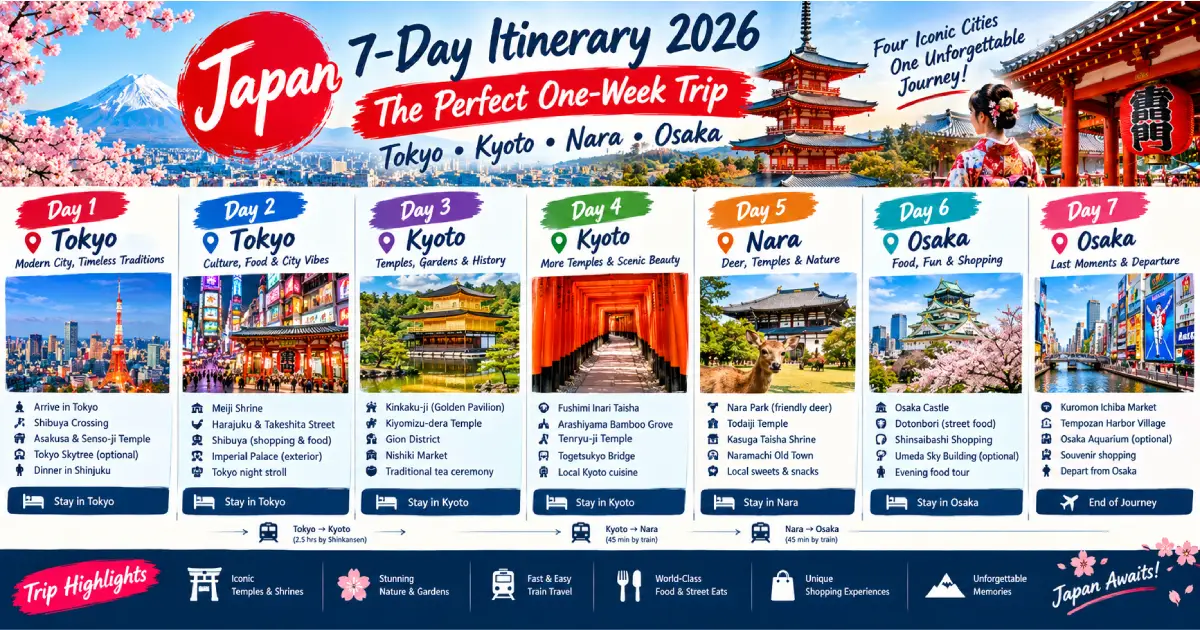
Seven days in Japan is exactly enough time to experience the country’s two defining halves — Tokyo’s hyper-dense, endlessly layered modernity, and the Kansai region’s concentration of temples, shrines, and preserved historic streetscapes around Kyoto, Nara, and Osaka — connected by the single fastest, most reliable high-speed rail journey in the world, the Tokaido Shinkansen, which turns what would be a full day’s travel almost anywhere else into a 2 hour 15 minute transfer. The specific challenge of a 7-day Japan itinerary for a first-time tier-1 visitor is not filling the days — Tokyo alone could absorb two full weeks without repetition — but resisting the urge to over-schedule: Japan’s cities reward slower, more deliberate movement (one neighborhood explored properly rather than four skimmed) more than almost any other tier-1 travel destination, because the density of specific, small-scale detail (a single narrow alley, a particular shrine gate, a single counter restaurant) is where the country’s character actually lives.
This 7-day Japan itinerary is built around three specific planning principles: the Tokyo section is front-loaded with the highest-energy, most overwhelming-for-jet-lag districts (Shinjuku, Shibuya) saved for Day 2 once the first night’s sleep has taken effect, rather than Day 1; the Kansai section is based in Kyoto for three nights with Nara and Osaka run as day trips, avoiding the time and luggage cost of changing hotels every single night; and the Shinkansen transfer between Tokyo and Kyoto is scheduled for a single travel day rather than squeezed into the end of a sightseeing day, because Japan’s train punctuality rewards a itinerary that isn’t racing the clock. The result is a circuit (Tokyo → Kyoto, with Nara and Osaka as Kyoto-based day trips) that covers Japan’s essential first-time experiences without the exhausting over-scheduling that the least-considered Japan itineraries produce.
For specific destination planning, see our Tokyo Travel Guide 2026 (publishing soon), Kyoto Travel Guide 2026 (publishing soon), Japan Travel Guide 2026 (publishing soon), and Best Restaurants in Japan 2026.
| Day | Base | Primary Experience | Travel | Approx. Cost Beyond JR Pass |
|---|---|---|---|---|
| Day 1 | Tokyo | Arrival, Shinjuku, easy orientation | Narita/Haneda → Tokyo | ¥3,000–¥5,000 |
| Day 2 | Tokyo | Asakusa, Ueno, Akihabara | Tokyo Metro | ¥1,500–¥3,000 |
| Day 3 | Tokyo | Shibuya, Harajuku, Meiji Shrine, evening Shinkansen to Kyoto | Tokyo → Kyoto (2h15m, JR Pass) | ¥3,000–¥5,000 |
| Day 4 | Kyoto | Fushimi Inari, Kiyomizu-dera, Gion | Kyoto City Bus | ¥1,000–¥2,000 |
| Day 5 | Kyoto/Nara | Arashiyama bamboo grove, Kinkaku-ji; OR day trip to Nara | Local trains (JR Pass) | ¥1,500–¥3,000 |
| Day 6 | Osaka (day trip from Kyoto) | Dotonbori, Osaka Castle, Kuromon Market | Kyoto → Osaka (JR Pass, 30 min) | ¥3,000–¥6,000 |
| Day 7 | Kyoto/Osaka | Nishiki Market, departure via Kansai Airport | Kyoto → KIX (JR Pass) | ¥2,000–¥4,000 |
7-Day Japan Rail Pass (2026 pricing): Approximately ¥50,000 (confirm current pricing at jrpass.com — note the JR Pass price increased substantially in 2023, so calculate against point-to-point ticket costs before purchasing) Point-to-point equivalent for this exact itinerary: Approximately ¥45,000–¥52,000 (Narita Express + Tokyo–Kyoto Shinkansen return + Kyoto–Osaka–Nara local trains + Kyoto–Kansai Airport) Verdict: Close to break-even for this specific 7-day circuit — the Pass wins mainly on flexibility and no per-ticket queueing, not on hard savings.
The 7-day Japan Rail Pass — once an automatic recommendation for any first-time visitor — became a genuinely close calculation after the October 2023 price increase (roughly a 70% jump from its previous price), and for this specific 7-day Tokyo-Kyoto-Osaka-Nara itinerary, a first-time visitor should run the numbers rather than assume the Pass is the default best option.
Buy the JR Pass if: your itinerary includes a Tokyo–Kyoto or Tokyo–Osaka Shinkansen round trip (the single most expensive component point-to-point, at roughly ¥27,000–¥29,000 return), plus multiple local JR trains for day trips (Nara, Osaka) — the Pass covers the ordinary (non-Nozomi) Shinkansen services, all standard JR local and rapid trains, and the JR train to and from Narita Airport (Narita Express).
Skip the JR Pass if: your trip is Tokyo-only, or if your Kansai day trips can be covered by the cheaper Kansai-specific regional passes (the ICOCA & Haruka combo ticket, or the Kansai Thru Pass) which cost meaningfully less than the national JR Pass for a Kyoto-based week.
Practical booking note: As of 2023, the JR Pass can be purchased inside Japan as well as before arrival, but pre-booking online (with exchange at a JR office on arrival) remains the more reliable route for guaranteed Shinkansen reserved seats during peak seasons (cherry blossom season in late March–early April, and autumn foliage in November).
Base: Tokyo | Type: Arrival day, low-intensity | Primary experiences: Hotel check-in, Shinjuku evening walk, Omoide Yokocho | Best accommodation area: Shinjuku, Shibuya, or Tokyo Station area
Most international flights land at Narita (NRT, roughly 60 km from central Tokyo, 60–90 minutes by Narita Express or Skyliner) or Haneda (HND, roughly 20 km from central Tokyo, 30–45 minutes by monorail or train, and generally the more convenient airport for a Day 1 arrival). The Narita Express (N’EX, covered by the JR Pass) is the most comfortable direct route from Narita into central Tokyo, running to Tokyo, Shinjuku, and Shibuya stations without a transfer.
Afternoon (after check-in):
Keep the first afternoon deliberately light — jet lag from most tier-1 departure points (the US West Coast is roughly 16–17 hours flight time; the UK and Europe roughly 12–14 hours) makes ambitious sightseeing on Day 1 counterproductive. A short walk near the hotel, a convenience store run (the Japanese konbini — 7-Eleven, Lawson, FamilyMart — is a genuine first-day attraction in itself, stocked with a quality and variety of prepared food that has no real Western equivalent), and an early dinner set up a better Day 2.
Evening: Omoide Yokocho (“Memory Lane,” also nicknamed Piss Alley by older expats for its pre-renovation state) — a narrow, lantern-lit alley of tiny yakitori and ramen stalls tucked beside Shinjuku Station’s west exit, seating a handful of diners each, smoke and grilled-chicken smell filling the lane. It’s the single most atmospheric, jet-lag-friendly first dinner in Tokyo: no reservation needed, no language barrier (point at what looks good), and a 20-minute meal is entirely normal.
Accommodation: Shinjuku (transit-central, walkable to Omoide Yokocho and Kabukicho) or Shibuya (younger, closer to Harajuku for Day 3) both work well as a single Tokyo base for three nights. Hotel rates: ¥12,000–¥25,000/night (mid-range double); ¥30,000+ (upper-end).
Base: Tokyo | Primary experiences: Senso-ji Temple, Ueno Park, Akihabara electronics and anime district | Transport: Tokyo Metro (covered by a Tokyo Subway 24/72-hour ticket, ¥800–¥1,500, not covered by JR Pass)
9:00 AM — Tokyo Metro to Asakusa station. Senso-ji, Tokyo’s oldest and most visited temple (founded 645 AD), is approached through the Kaminarimon (“Thunder Gate,” the giant red lantern instantly recognizable from Tokyo tourism photography) and the Nakamise-dori shopping street — roughly 200 meters of stalls selling traditional snacks, yukata, and souvenirs, busy from opening. Arriving before 9:30 AM meaningfully thins the crowd for photographs at the main hall and the five-story pagoda.
10:30 AM — Walk the quieter backstreets east of Senso-ji (the Denboin-dori and the Asakusa Shrine grounds immediately behind the main temple) for a less crowded sense of the neighborhood, then the Sumida River waterfront for a view across to the Tokyo Skytree (634m, the world’s tallest tower — worth the photograph from the ground rather than necessarily the ticketed ascent, given the itinerary’s time constraints).
12:30 PM — Lunch in Asakusa (tempura or unagi are the neighborhood’s specialties) before heading to Ueno.
1:30 PM — Ueno Park: Tokyo’s largest public park, home to the Tokyo National Museum (Japan’s oldest and largest museum, an essential stop for anyone with an interest in samurai armor, ukiyo-e woodblock prints, and Buddhist sculpture — budget 90 minutes minimum) and, in late March–early April, some of Tokyo’s most crowded and celebrated cherry blossom viewing.
3:30 PM — Akihabara (“Akiba”), a 15-minute train ride from Ueno: Tokyo’s electronics-and-otaku-culture district, a dense grid of multi-floor electronics stores, retro and modern video game shops, anime and manga specialty stores, and maid cafes. Even for a visitor with no specific interest in anime culture, the sheer density and neon visual overload of the main strip (particularly after dark) is a genuinely worthwhile Tokyo experience distinct from anywhere else in the city.
Evening: Dinner in Akihabara or back toward the hotel — a conveyor belt sushi chain (Genki Sushi or similar) makes a good, unintimidating second-night dinner.
Base: Tokyo → Kyoto (overnight) | Primary experiences: Meiji Shrine, Takeshita Street, Shibuya Crossing | Travel: Tokyo → Kyoto Shinkansen (2h15m, JR Pass covered on Hikari/Kodama; Nozomi requires separate ticket)
9:00 AM — Meiji Jingu, Tokyo’s most significant Shinto shrine, set inside a 170-acre forest donated and planted by citizens nationwide after Emperor Meiji’s death in 1912 — the walk from the Harajuku entrance along the gravel approach, beneath a series of towering wooden torii gates, is a genuinely calming contrast to Tokyo’s density elsewhere, and a useful first proper introduction to Shinto shrine etiquette (bow at the torii before passing through; purify hands and mouth at the temizuya water basin before approaching the main hall).
10:30 AM — Takeshita Street, immediately outside Harajuku Station: Tokyo’s most concentrated teen fashion and street-food strip, loud, crowded, and a useful contrast to the shrine’s calm 20 minutes earlier — crepe stands, cheap accessory shops, and youth fashion culture in its most commercially concentrated form.
12:30 PM — Lunch in the Shibuya/Harajuku area, then walk (or take the train one stop) to Shibuya.
1:30 PM — Shibuya Crossing, the world’s busiest pedestrian intersection (up to 3,000 people crossing per light cycle at peak times) — cross it once for the experience, then view it from above (the Shibuya Sky observation deck, or the more budget-friendly Starbucks inside the Tsutaya building overlooking the crossing) for the full scale to register.
2:30 PM — Final Tokyo shopping or a last specific stop (Shibuya’s Hachiko statue, the loyal-dog memorial that’s become the district’s default meeting point, is worth the two-minute photo).
4:00 PM — Return to hotel, collect luggage, head to Tokyo Station.
5:00 PM–6:00 PM — Board the Tokaido Shinkansen at Tokyo Station (Hikari or Kodama services are JR Pass-covered; the fastest Nozomi service requires a separate paid ticket and is not covered by the Pass — build in the extra 15–25 minutes the Hikari takes rather than paying for Nozomi). The journey (2 hours 15 minutes on Hikari) passes Mount Fuji on the right-hand side of the train roughly 45–50 minutes in on a clear day — sit on the right (facing forward) for the view, and check the weather forecast in advance since Fuji is visible only on clear days.
8:00 PM — Arrive Kyoto Station. Check in, then a light dinner near the station or hotel — Kyoto’s pace is deliberately gentler than Tokyo’s, and the first evening is a good moment to let that register.
Accommodation: Central Kyoto (near Kyoto Station, or the Gion/Higashiyama area for atmosphere) for three nights. Hotel rates: ¥10,000–¥22,000/night (mid-range double); ¥28,000+ (upper-end, including traditional ryokan).
Base: Kyoto | Primary experiences: Fushimi Inari Shrine’s thousand torii gates, Kiyomizu-dera, Gion geisha district | Transport: Kyoto City Bus day pass (¥700) or JR local trains (JR Pass covers Fushimi Inari’s JR Nara Line stop)
7:30 AM — Arrive early (the single most important timing decision of the day) at Fushimi Inari, Kyoto’s most photographed site: thousands of vermilion torii gates climbing the wooded slopes of Mount Inari over a 2–3 hour round-trip hiking trail. Arriving by 8 AM avoids the worst of the tour-bus crowds that make the lower gates (the most photographed section, the Senbon Torii “thousand gates” tunnel) nearly impassable for photography by mid-morning. A full summit hike isn’t necessary — the first 30–40 minutes of gates, up to the Yotsutsuji intersection with its city view, capture the experience for most visitors’ time budgets.
11:00 AM — Train back toward central Kyoto, then bus or taxi to the Higashiyama district for Kiyomizu-dera, a UNESCO World Heritage wooden temple famous for its massive wooden stage built without a single nail, extending out over the hillside on wooden pillars, with panoramic views across the city and (in autumn) a hillside blazing with maple color.
12:30 PM — Lunch in the Higashiyama preserved streets (Sannenzaka and Ninenzaka, two cobblestone lanes lined with traditional wooden shops selling pottery, sweets, and crafts, connecting Kiyomizu-dera toward Gion) — this is Kyoto’s most photogenic walking district, and slowing down here rather than rushing through is the specific point of the afternoon.
3:30 PM — Gion, Kyoto’s most famous geisha (geiko, in the local dialect) district: the Hanami-koji street’s wooden machiya townhouses, and — with respectful distance and no photographing without permission, a specific etiquette point tier-1 visitors are frequently unaware of — the possibility of spotting a geiko or maiko (apprentice) moving between appointments in the early evening.
5:00 PM — Yasaka Shrine, at the eastern end of Gion, lit with lanterns as evening approaches.
6:30 PM — Dinner in Gion or Pontocho (a narrow, atmospheric dining alley running parallel to the Kamo River, a short walk from Gion, lined with restaurants ranging from affordable yakitori to high-end kaiseki).
Base: Kyoto | Primary experiences: Arashiyama Bamboo Grove, Kinkaku-ji (Golden Pavilion) | Alternative: Full-day trip to Nara | Transport: JR Sagano Line (JR Pass covered) or Kyoto City Bus
8:30 AM — JR Sagano Line to Saga-Arashiyama Station (JR Pass covered, 15 minutes from Kyoto Station). The Arashiyama Bamboo Grove — a few hundred meters of towering bamboo stalks arching over a narrow path, the sound of the stalks creaking in the wind officially recognized as one of Japan’s “100 Soundscapes to Preserve” — is at its calmest and most photogenic before 9 AM, when the day-trip crowds from central Kyoto haven’t yet arrived.
10:00 AM — Tenryu-ji Temple (adjacent to the bamboo grove, a UNESCO World Heritage Zen temple with one of Japan’s finest traditional gardens, using the Arashiyama mountains as “borrowed scenery” beyond the garden’s own pond) and, if time allows, the Togetsukyo Bridge over the Katsura River.
12:00 PM — Lunch in Arashiyama (yudofu, simmered tofu, is a specific Kyoto specialty worth trying here).
1:30 PM — Bus or taxi to Kinkaku-ji, the Golden Pavilion — a Zen temple whose top two floors are covered entirely in gold leaf, reflected in the still pond in front of it (Kyoko-chi, the “Mirror Pond”) — the single most photographed building in Japan, and worth the specific 30–40 minute visit despite the crowds, which move through relatively efficiently given the temple’s one-directional walking path.
8:00 AM — JR Nara Line direct from Kyoto Station (JR Pass covered, 45 minutes) or the slightly faster private Kintetsu line (not JR Pass covered).
9:00 AM — Nara Park: home to over 1,000 free-roaming sika deer, considered messengers of the gods in Shinto belief, that approach and bow for “shika senbei” deer crackers sold throughout the park (¥200 per pack) — a genuinely unique, family-friendly experience with no real equivalent elsewhere in Japan.
10:30 AM — Todai-ji Temple, housing the Daibutsu — a 15-meter bronze Great Buddha statue, one of the largest bronze Buddha statues in the world, inside what remains the largest wooden building on Earth despite being rebuilt at two-thirds its original size.
1:00 PM — Lunch in Nara, then Kasuga Taisha (the vermilion shrine famous for its thousands of stone and bronze lanterns lining the forested approach path) before returning to Kyoto by early evening.
Note: Nara can realistically be combined with Osaka as Day 6 for a faster-paced but more comprehensive Kansai circuit if Arashiyama/Kinkaku-ji are prioritized on Day 5 instead — see the “Variations” section below.
Base: Kyoto (day trip) | Primary experiences: Dotonbori canal district, Osaka Castle, Kuromon Ichiba Market | Transport: JR Special Rapid Service, Kyoto → Osaka (JR Pass covered, 30 minutes)
8:30 AM — JR from Kyoto Station to Osaka Station (30 minutes, JR Pass covered), then a short transfer toward Osaka Castle.
9:30 AM — Osaka Castle, one of Japan’s most iconic castles (the current structure is a 1931 concrete reconstruction with a museum inside, the original 16th-century castle having been destroyed and rebuilt multiple times through Japanese history) — the surrounding park, particularly under cherry blossoms in late March/early April, is one of Osaka’s most photographed public spaces regardless of whether the museum interior is visited.
11:30 AM — Kuromon Ichiba Market (“Osaka’s Kitchen”), a 190-year-old covered market street for grazing rather than a sit-down meal — grilled scallops, wagyu skewers, fresh oysters, and uni sampled stall-by-stall standing at the counters. Budget ¥2,000–¥3,000 for a full grazing lunch here.
1:30 PM — Dotonbori, Osaka’s most famous entertainment and dining district, centered on the Dotonbori canal: the giant illuminated Glico Running Man sign (Osaka’s most photographed single landmark), the mechanical crab sign above Kani Doraku, and the specific density of neon signage that makes Dotonbori Japan’s most visually overwhelming single street after dark.
3:00 PM — Takoyaki tasting — Dotonbori’s competing takoyaki stalls (octopus-filled batter balls) each claim the definitive recipe; trying two or three different stalls for comparison is a standard and expected Dotonbori activity.
5:00 PM — Return train to Kyoto (JR Pass covered, 30 minutes) for a final Kyoto evening, or extend into an Osaka dinner (Dotonbori’s restaurants stay lively well into the night) before the last train back.
Base: Kyoto (departure day) | Primary experiences: Nishiki Market, final souvenir shopping | Transport: Kyoto → Kansai Airport (Haruka Express, JR Pass covered, 75 minutes) OR Kyoto → Tokyo → Narita/Haneda if departing from Tokyo
9:00 AM — Nishiki Market, “Kyoto’s Kitchen,” a five-century-old covered shopping street a short walk from downtown Kyoto: yuba (tofu skin), tsukemono (Kyoto-style pickles), matcha sweets, and skewered baby octopus stuffed with a whole quail egg — a walkable final taste of Kyoto food culture and a good source of packaged souvenirs (matcha, senbei crackers, and Japanese knives are all commonly purchased here).
11:00 AM — Final souvenir shopping — Kyoto’s Teramachi and Shinkyogoku covered shopping arcades, a short walk from Nishiki Market, cover most remaining gift needs (traditional crafts, stationery, and Japanese sweets) under one roof.
Early Afternoon — Depending on flight timing: the Haruka Limited Express (JR Pass covered) runs directly from Kyoto Station to Kansai International Airport (KIX) in approximately 75 minutes, making a same-day Kyoto departure straightforward for afternoon or evening flights.
Note for Tokyo departures: If your international flight departs from Narita or Haneda rather than Kansai, budget a final Shinkansen back to Tokyo (2h15m, JR Pass covered) with at least 3 hours of buffer before an international check-in — this itinerary’s structure works equally well run in reverse (Kyoto-first, Tokyo-last) if your flights favor that direction.
| City | Budget Double (¥/night) | Mid-Range (¥/night) | Luxury (¥/night) |
|---|---|---|---|
| Tokyo | 8,000–14,000 | 15,000–28,000 | 30,000–60,000+ |
| Kyoto | 7,000–13,000 | 14,000–25,000 | 28,000–55,000+ |
Booking timing for peak season (cherry blossom late March–early April; autumn foliage mid-November): 4–6 months ahead for mid-range Kyoto hotels and any Kyoto ryokan; 2–3 months for Tokyo. Kyoto’s limited hotel supply relative to demand during these two windows makes it the tightest single booking constraint in this entire itinerary — book Kyoto accommodation before Tokyo if traveling in either peak window.
For this specific route, the 7-day Japan Rail Pass covers:
✅ Narita Express (Narita Airport → Tokyo/Shinjuku/Shibuya) ✅ Tokaido Shinkansen, Tokyo → Kyoto (Hikari and Kodama services only — NOT Nozomi) ✅ JR Sagano Line (Kyoto → Arashiyama) ✅ JR Nara Line (Kyoto → Nara) ✅ JR Special Rapid Service (Kyoto → Osaka) ✅ Haruka Express (Kyoto → Kansai Airport)
Not covered: Tokyo Metro and Toei Subway lines (Days 2–3 in Tokyo — budget a separate 72-hour Tokyo Subway ticket, ¥1,500), Kyoto City Buses (a separate ¥700 day pass is more economical than individual fares for a full sightseeing day), and the Nozomi/Mizuho Shinkansen services (the fastest but Pass-excluded trains).
A Suica or Pasmo IC card (tap-to-pay, purchasable and rechargeable at any station machine or via the mobile Suica app on a compatible smartphone) covers Tokyo Metro, buses, konbini purchases, and most transport not included in the JR Pass — the single most useful piece of practical infrastructure for this trip, IC Pass or not.
Despite Japan’s high-tech reputation, a meaningful share of small restaurants, temples, and local shops remain cash-only. 7-Eleven ATMs reliably accept foreign cards for withdrawals — the most reliable cash source for tier-1 visitors throughout this itinerary.
JR Pass holders can reserve Shinkansen seats at no extra cost at any JR ticket office — during cherry blossom season and Golden Week (late April–early May, Japan’s own peak domestic travel period, worth avoiding for a first-time itinerary if possible), reserving the Tokyo–Kyoto Shinkansen a few days ahead prevents standing in the non-reserved cars.
Japan’s same-day and next-day luggage forwarding service (Yamato Transport’s “TA-Q-BIN,” available at hotel front desks and convenience stores, roughly ¥2,000–¥3,000 per large suitcase) allows sending bags directly from a Tokyo hotel to a Kyoto hotel — a genuinely useful option for the Day 3 Shinkansen transfer if traveling with more than carry-on luggage, since Shinkansen cars have limited large-luggage storage space and some routes require advance reservation for oversized bags.
Google Maps handles Japan’s train system (including platform numbers and car-door positions) more reliably than almost anywhere else in the world; Japan Official Travel App (by JNTO) provides offline maps and emergency information; and the JR East/West apps provide Shinkansen reservation management for Pass holders.
Visitors who prioritize depth over breadth can combine Nara (morning) and Osaka (afternoon/evening) into a single Day 6, using the freed-up Day 5 for a slower, more complete Arashiyama and Kinkaku-ji day without the Option A/B choice — this suits first-time visitors who find Japan’s pace more tiring than expected by Day 5.
Inserting a Hakone day trip (from Tokyo, via the Odakyu Romancecar — not JR Pass covered, so factor in a separate ¥2,470 one-way ticket) between Day 2 and Day 3 adds a full day (making this an 8-day itinerary) for the Hakone Open-Air Museum, an Owakudani volcanic valley cable car, and a Lake Ashi cruise with Mount Fuji views on clear days — the single best non-Kyoto addition for a longer first Japan trip.
Rather than a single-day Osaka trip from Kyoto, moving one Kyoto night to Osaka (staying overnight in Namba or Umeda) allows a full evening and following morning in Osaka’s food culture — Shinsekai’s kushikatsu (skewered, breaded, deep-fried food) district and a proper depachika department-store food hall visit — for visitors whose primary trip interest is food.
Skipping the JR Pass entirely and buying individual tickets (the ICOCA & Haruka combo for Kansai transport, individual reserved Shinkansen tickets for the one Tokyo–Kyoto journey) can reduce total transport costs by ¥3,000–¥8,000 versus the 2026-priced JR Pass for this specific 7-day itinerary — run the exact calculation for your dates at jrpass.com and hyperdia.com before committing either way.
About Travel Tourister Travel Tourister’s destination specialists have run this exact 7-day circuit across multiple seasons — from Shinjuku’s Omoide Yokocho first-night ramen and pre-dawn Fushimi Inari torii-gate photography through Arashiyama’s early-morning bamboo grove calm and Kiyomizu-dera’s autumn maple stage views, to Dotonbori’s neon-lit takoyaki crawls and Nara’s deer-bowing rituals — to deliver the most practical and enjoyable one-week Japan itinerary for 2026 first-time visitors.
Posted By : Vinay
Latest Article
2nd Floor, 39, Above Kirti Club, DLF Industrial Area, Kirti Nagar, New Delhi, Delhi 110015



Travel Tourister is a leading Travel portal where we introduce travellers to trusted travel agents to make their journey hasselfree, memorable And happy. Travel Tourister is a platform where travellers get Tour packages ,Hotel packages deals through trusted travel companies And hoteliers who are working with us across the world. We always try to find new and more travel agents and hoteliers from every nook and corners across the world so that you could compare the deals with different travel agents and hoteliers and book your tour or hotel with the one you have chosen according to your taste and budget.
Copyright © Travel Tourister, India. All Rights Reserved

 Call
Call Enquiry