Published on : 30 Sep 2026
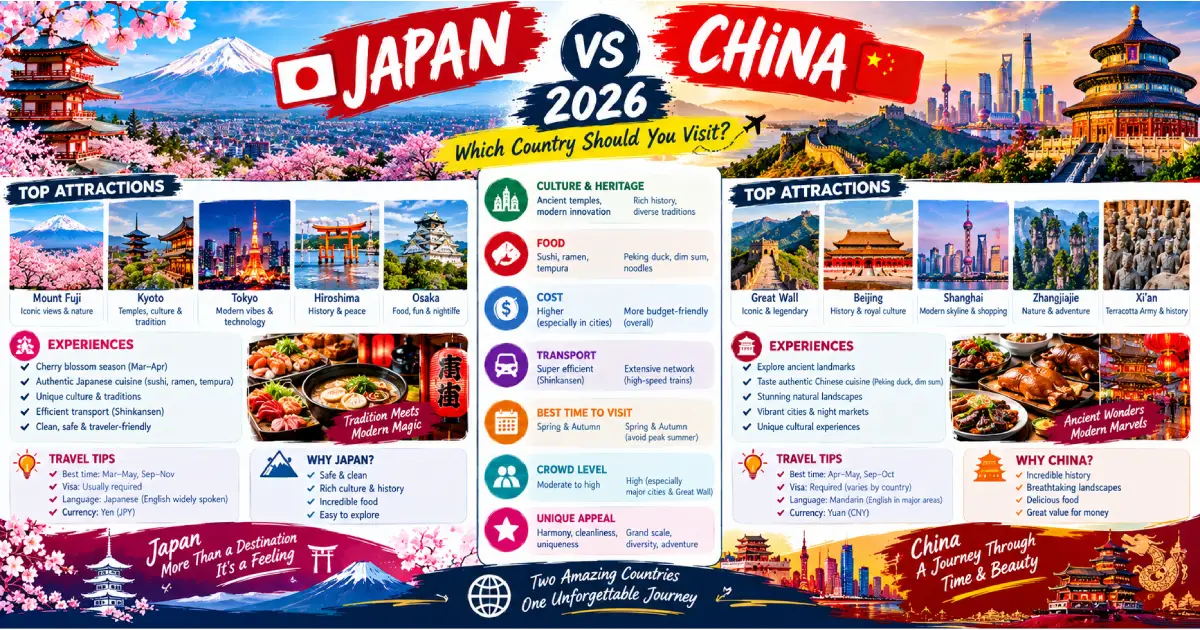
Japan and China represent two genuinely different scales of East Asian travel experience: Japan is a compact, tourist-refined country where nearly every logistical detail (transport, signage, payment) has been smoothed for the visitor over decades of inbound tourism investment, while China is a continental-scale country where the single biggest attractions — the Great Wall, the Terracotta Army, the Forbidden City, Zhangjiajie’s pillar mountains — operate on a sheer scale and historical depth that no single country in the region matches, layered over a travel experience that’s noticeably more logistically demanding for a first-time tier-1 visitor, from the visa process itself through the Great Firewall’s restriction of Google, WhatsApp, and most Western apps. Neither country is a clear across-the-board winner; the right choice depends heavily on how much travel friction a visitor is willing to accept in exchange for what China’s scale and history uniquely deliver.
Japan is best for travelers who want a smooth, tourist-refined trip with minimal logistical friction — reliable English signage, a JR Pass built for tourists, functioning Western apps, and a level of infrastructure polish built over decades of inbound tourism investment.
China is best for travelers who want scale and historical depth that no other Asian country matches — the Great Wall, the Terracotta Army, the Forbidden City, and landscapes (Zhangjiajie, Guilin) that look genuinely otherworldly — and who are prepared to navigate a more logistically demanding trip in exchange.
| Category | Winner | Why |
|---|---|---|
| 🛂 Visa & Entry Ease | Japan | Visa-free for all four tier-1 nationalities; China varies by passport |
| 💰 Cost | China | Meaningfully cheaper across hotels, food, and domestic transport |
| 🍜 Food Scene | Tie | Both world-class; vastly different culinary traditions |
| ⛩️ Culture & History | China | Millennia-deeper history and larger-scale monuments |
| 📱 Tech & Connectivity | Japan | No app restrictions; VPN not required |
| 🚄 Ease of Travel | Japan | More English signage, more first-timer-friendly systems |
| 🏞️ Nature & Landscapes | China | Vastly larger and more geographically varied |
| 🌃 Nightlife | Tie | Tokyo/Osaka vs Shanghai/Beijing — both strong, different styles |
| 👨👩👧 Family-Friendly | Japan | More visitor infrastructure specifically built around families |
Overall: Japan wins on ease, polish, and predictability; China wins on scale, history, and value. This is less a “which is better” comparison than a “how much friction will you accept” one.
This is the single most decision-relevant category for tier-1 travelers, and it depends heavily on which passport you hold. Japan grants visa-free entry for tourism to US, UK, Canadian, and Australian passport holders for stays of up to 90 days — no advance application required. China’s visa-free policy has expanded significantly through 2026: UK, Canadian, and Australian passport holders can now enter China visa-free for up to 30 days (the UK and Canada were added in February 2026, joining Australia and dozens of other countries under China’s expanding unilateral visa-free scheme), but US passport holders are notably excluded from this scheme — American travelers still need to apply for a standard Chinese tourist visa in advance, or are limited to a 10-day visa-free transit if their itinerary continues on to a third country rather than returning directly to the US. UK, Canadian, and Australian travelers should confirm current terms before booking, since China’s policy is reviewed and re-extended periodically (currently valid through December 31, 2026).
China is consistently cheaper than Japan across nearly every travel expense category — domestic high-speed rail, hotels outside of Beijing and Shanghai’s premium districts, and food in particular, where a full, excellent meal at a local restaurant routinely costs $5–$10 outside major tourist zones. Japan’s budget end is cheaper than its reputation suggests (see Is Japan Expensive in 2026?), but China’s overall cost floor sits meaningfully lower, particularly outside its most internationally visited cities.
China’s recorded history spans over 3,000 years and its monuments operate at a scale unmatched anywhere in East Asia — the Great Wall stretches over 21,000 km in total across all its sections, Xi’an’s Terracotta Army guards an emperor’s tomb complex still only partially excavated, and the Forbidden City comprises nearly 1,000 surviving buildings across 180 acres. Japan’s own historical density (particularly Kyoto’s roughly 1,600 temples) is genuinely impressive and, unlike much of China’s, largely intact rather than reconstructed, but simply doesn’t operate at China’s continental scale.
Japan poses no connectivity friction for a Western visitor: Google Maps, WhatsApp, Instagram, and every standard Western app function normally, and pocket WiFi/eSIM options are widespread and simple to arrange. China’s Great Firewall blocks Google (including Maps and Gmail), WhatsApp, Instagram, and Facebook entirely — a VPN (ideally installed and tested before arrival, since VPN provider websites are themselves often blocked once inside China) is close to essential for a Western visitor who wants normal access to maps, messaging, and email, and even with a VPN, navigation and translation apps require more specific pre-trip preparation (Baidu Maps or Amap instead of Google Maps, WeChat as the dominant payment and messaging platform) than Japan ever demands.
Japan’s decades of dedicated inbound tourism infrastructure — English signage throughout the rail network, the JR Pass built specifically for tourists, near-universal card and increasingly cash-free payment options — gives it a clear edge for a first-time, no-Mandarin-language visitor. China’s high-speed rail network is, on pure engineering terms, comparable or even superior to Japan’s Shinkansen (China operates the world’s largest high-speed rail network by total track length), but English signage and service is noticeably less consistent outside Beijing, Shanghai, and the most internationally visited cities, and China’s own payment ecosystem (dominated by Alipay and WeChat Pay, both requiring setup that can be genuinely difficult for a short-term foreign visitor without a Chinese bank account) adds a layer of friction Japan’s more card-and-cash-friendly system avoids.
China’s sheer geographic scale — a country larger than the entire European Union — delivers landscape variety Japan’s more compact geography can’t match: Zhangjiajie’s otherworldly sandstone pillar forests, Guilin’s karst mountains and Li River, Tibet’s high-altitude plateau, and the Gobi Desert all exist within a single country’s borders. Japan’s own nature (the Japan Alps, volcanic terrain, four distinct seasons) is genuinely beautiful but operates at a smaller, more contained scale throughout.
| Expense | Japan (Tokyo/Kyoto) | China (Beijing/Shanghai) |
|---|---|---|
| 3-star hotel, per night | $80–$150 | $45–$90 |
| Mid-range dinner for one | $25–$45 | $10–$25 |
| High-speed rail, 2-hour journey | $90–$110 | $50–$70 |
| 7-day trip, mid-range budget (excl. flights) | $900–$1,400 | $550–$950 |
Choose Japan first if: this is your first trip to East Asia, you want minimal logistical friction, your passport is American (given the current visa gap), or you’re prioritizing food, modern culture, and a highly refined tourist experience over historical scale.
Choose China first if: you hold a UK, Canadian, or Australian passport (visa-free entry meaningfully lowers the planning barrier), you’re specifically drawn to ancient history and monumental scale (the Great Wall, Terracotta Army), budget is a significant factor, and you’re comfortable installing a VPN and doing more upfront research than a Japan trip requires.
Consider both if: your total travel window is 3+ weeks — Beijing/Shanghai to Tokyo is a roughly 3-hour direct flight, and combining China’s historical scale with Japan’s polish gives a genuinely complementary two-country trip, though American travelers should factor China’s visa application timeline (typically several weeks) into the planning process well in advance.
About Travel Tourister Travel Tourister’s destination specialists have run both circuits — from Kyoto’s temple density and Tokyo’s seamless transit to the Great Wall’s scale and Xi’an’s Terracotta Army — to give tier-1 travelers an honest, passport-aware comparison for deciding between Japan and China in 2026.
Posted By : Vinay
Latest Article
2nd Floor, 39, Above Kirti Club, DLF Industrial Area, Kirti Nagar, New Delhi, Delhi 110015



Travel Tourister is a leading Travel portal where we introduce travellers to trusted travel agents to make their journey hasselfree, memorable And happy. Travel Tourister is a platform where travellers get Tour packages ,Hotel packages deals through trusted travel companies And hoteliers who are working with us across the world. We always try to find new and more travel agents and hoteliers from every nook and corners across the world so that you could compare the deals with different travel agents and hoteliers and book your tour or hotel with the one you have chosen according to your taste and budget.
Copyright © Travel Tourister, India. All Rights Reserved

 Call
Call Enquiry