Published on : 01 Oct 2026
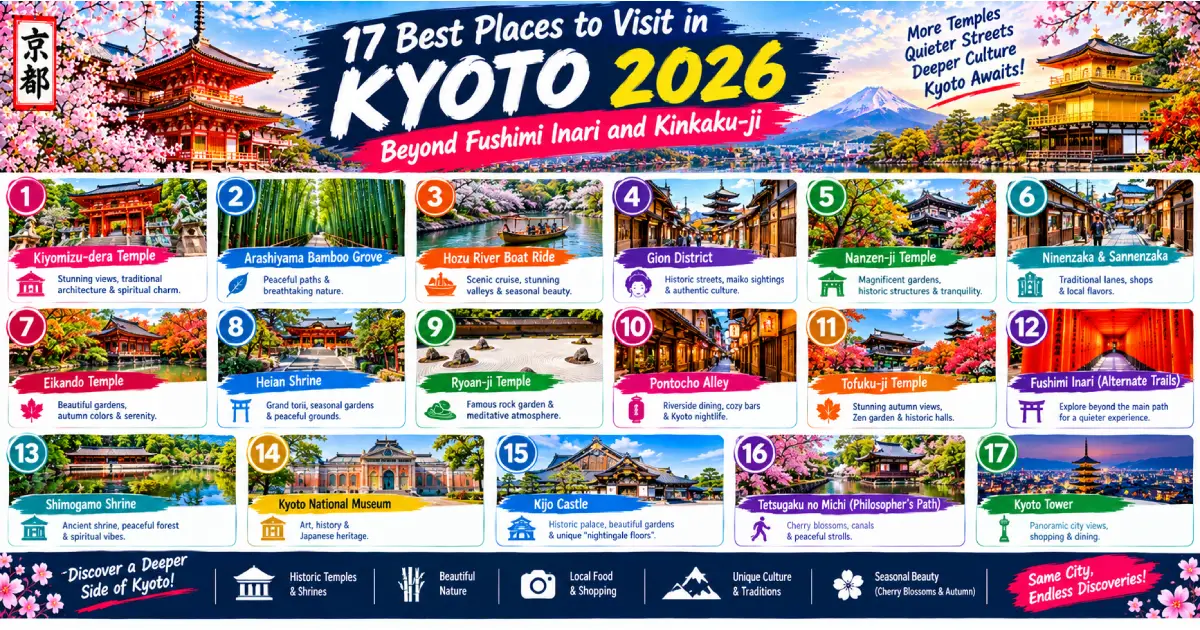
Our 24 Best Things to Do in Kyoto guide already covers the city’s essential sites — Fushimi Inari, Kinkaku-ji, Kiyomizu-dera, Arashiyama’s bamboo grove — the places that earn their reputation and belong on any first-time itinerary. This guide goes further: 17 additional places, many receiving only a fraction of those headline sites’ foreign-visitor traffic despite being, by the assessment of Kyoto’s own residents and repeat visitors, every bit as worthwhile. A philosopher-named canal path leads to a brick Roman-style aqueduct built during the Meiji era; a half-day countryside escape reaches a moss garden temple most visitors never discover exists; and one of Kyoto’s largest, most significant shrines sits almost entirely unvisited by foreign tourists despite a five-minute walk from a major train station.
| # | Place | Category | Best For | Best Time |
|---|---|---|---|---|
| 1 | Nanzen-ji Temple | Temple complex | Brick aqueduct, sub-temples | Morning |
| 2 | Daitoku-ji Temple Complex | Zen temple complex | Quiet Zen gardens, fewer crowds | Any time |
| 3 | Honen-in Temple | Temple | Mossy thatched gate, autumn | Autumn |
| 4 | Toji Temple | Temple | Japan’s tallest wooden pagoda | Any time |
| 5 | Yasaka Shrine | Shrine | Gion’s anchor shrine, lanterns | Evening |
| 6 | Shimogamo Shrine | Shrine | Ancient forest setting | Any time |
| 7 | Kamigamo Shrine | Shrine | Kyoto’s oldest shrine | Any time |
| 8 | Murin-an Garden | Garden | Meiji-era landscape design | Spring, autumn |
| 9 | Kyoto Botanical Garden | Garden | Seasonal flowers, conservatory | Spring |
| 10 | Maruyama Park | Park | Kyoto’s famous hanami gathering spot | Cherry blossom season |
| 11 | Ohara Village & Sanzen-in | Countryside temple | Moss gardens, rural escape | Autumn |
| 12 | Kurama-dera Temple | Mountain temple | Hiking, forest setting | Spring, autumn |
| 13 | Kibune Shrine | Shrine | Red lantern stairway | Summer evening |
| 14 | Higashi & Nishi Honganji | Temple complexes | Massive wooden halls | Any time |
| 15 | Kyoto Tower | Landmark | Station-area skyline view | Evening |
| 16 | Shirakawa Canal | Canal walk | Quiet Gion alternative | Evening |
| 17 | Uji | Town/temple | Byodo-in Temple, matcha culture | Any time |
Location: Northern Higashiyama, at the Philosopher’s Path’s southern end | Best For: A genuinely surprising Meiji-era brick aqueduct within the temple grounds | Best Time: Morning
Nanzen-ji’s main gate and Zen gardens are impressive in their own right, but the temple’s specific standout feature is Suirokaku — a red-brick, Roman-aqueduct-style water channel built in 1888 that cuts directly through the temple grounds, an architectural style so unexpected within a centuries-old Buddhist temple complex that it’s become one of Kyoto’s most distinctive and most-photographed unexpected details.
Location: Northern Kyoto | Best For: A sprawling Zen complex with far fewer crowds than Kyoto’s headline temples | Best Time: Any time
Daitoku-ji isn’t a single temple but a walled complex of over 20 sub-temples, several with their own celebrated dry rock gardens rivaling Ryoan-ji’s fame without Ryoan-ji’s crowds — only a handful of the sub-temples are open to the public at any given time (Daisen-in and Ryogen-in among the most consistently accessible), making this one of Kyoto’s best options for genuinely quiet Zen garden contemplation.
Location: Northern Higashiyama, just off the Philosopher’s Path | Best For: A mossy thatched gate and a near-total absence of crowds | Best Time: Autumn, for the maple canopy over the entrance
A small, free-to-enter temple most visitors walk straight past on their way along the Philosopher’s Path, Honen-in’s thatched-roof gate, moss gardens, and two raked-sand mounds (changed seasonally to reflect different natural motifs) offer one of Kyoto’s most peaceful, least commercialized temple experiences.
Location: Near Kyoto Station | Best For: Japan’s tallest wooden pagoda (57 meters) | Best Time: Any time; particularly striking at night during seasonal illuminations
A UNESCO World Heritage site within easy walking distance of Kyoto Station, Toji’s five-story pagoda is the tallest wooden tower in Japan and has become one of the city’s most recognizable silhouettes — notably underutilized by visitors given its genuine convenience as a first or last Kyoto stop right by the station.
Location: Eastern edge of Gion | Best For: Gion’s own anchor shrine, lit by hundreds of lanterns at night | Best Time: Evening
Yasaka Shrine sits at the eastern end of Gion, directly connecting to Maruyama Park, and its rows of hanging lanterns make it one of Kyoto’s most atmospheric evening shrine visits — many visitors walk past on their way to Gion’s restaurants without realizing the shrine itself is worth a dedicated 20–30 minutes.
Location: Northern central Kyoto | Best For: An ancient primeval forest setting | Best Time: Any time
One of Kyoto’s oldest shrines, Shimogamo sits within Tadasu no Mori, a rare surviving fragment of primeval forest within the city — a genuinely different atmosphere from Kyoto’s more manicured temple gardens, and a UNESCO World Heritage Site that receives only a fraction of Fushimi Inari’s foreign-visitor numbers.
Location: Northern Kyoto | Best For: Kyoto’s oldest shrine, with a distinctly different architectural style | Best Time: Any time
Predating the city of Kyoto itself, Kamigamo Shrine’s wide gravel courtyard and two distinctive conical sand mounds (representing sacred mountains) give it an architectural character unlike anywhere else in this guide — worth combining with Shimogamo Shrine as a northern-Kyoto shrine pairing, given their shared historical connection.
Location: Near Nanzen-ji | Best For: Meiji-era landscape design, genuinely uncrowded | Best Time: Spring and autumn
A small, meticulously maintained garden built in 1896 for a Meiji-era statesman, Murin-an uses borrowed scenery from the nearby Higashiyama mountains and a specifically naturalistic (rather than formally stylized) design approach that influenced Japanese garden design for decades afterward — a genuine favorite among garden specialists, rarely crowded even during peak season.
Location: Northern Kyoto | Best For: Seasonal flower displays and a large conservatory | Best Time: Spring, for the garden’s own substantial cherry blossom collection
Japan’s oldest public botanical garden offers a different, more horticultural take on Kyoto’s seasonal beauty — its roughly 750 cherry trees make it a genuine, far-less-crowded cherry blossom alternative to the city’s more famous hanami spots.
Location: Adjacent to Yasaka Shrine, Gion | Best For: Kyoto’s most famous hanami gathering point | Best Time: Cherry blossom season
Home to a massive weeping cherry tree (shidarezakura), illuminated at night during peak bloom, Maruyama Park anchors Kyoto’s single most celebrated cherry blossom gathering spot — see our Japan in Spring guide for exact peak timing.
Location: Roughly 1 hour north of central Kyoto by bus | Best For: A genuine rural escape with moss-garden temples | Best Time: Autumn, for the valley’s foliage
A small mountain village roughly an hour from central Kyoto, Ohara is built around Sanzen-in Temple’s extraordinarily lush moss garden, dotted with small stone jizo statues peeking out from the moss — one of the most genuinely restorative half-day trips available from Kyoto, reached by a scenic bus ride through farmland most visitors never see.
Location: Northern Kyoto mountains | Best For: A forested mountain temple with genuine hiking | Best Time: Spring or autumn
Perched on a forested mountainside roughly 30 minutes from central Kyoto by train, Kurama-dera anchors the start of the Kurama-to-Kibune hiking trail — the temple itself, reached via a steep approach path (or a funicular for a less strenuous option), offers sweeping valley views uncommon elsewhere in this guide’s more urban entries.
Location: Northern Kyoto mountains, connected to Kurama via the hiking trail | Best For: A dramatic red lantern-lined stone stairway | Best Time: Summer evening, when the shrine is illuminated
Kibune Shrine’s main approach — a steep stone stairway flanked by rows of glowing red lanterns — is one of Kyoto’s most photogenic single images, and the surrounding village’s riverside kawadoko dining platforms (built directly over the river) make it a popular summer escape from Kyoto’s notoriously hot and humid lowland weather.
Location: Near Kyoto Station | Best For: Two of Japan’s largest wooden temple halls | Best Time: Any time
These two massive Jodo Shinshu Buddhist temple complexes, within walking distance of each other and of Kyoto Station, house some of the largest wooden structures in Japan — genuinely monumental in scale, and significantly less crowded than the city’s eastern temples despite their central, highly convenient location.
Location: Directly across from Kyoto Station | Best For: A station-area skyline view and orientation point | Best Time: Evening
Kyoto’s tallest structure, built in 1964, offers a straightforward observation deck view across the city’s low-rise skyline (Kyoto enforces strict building height limits to protect temple sightlines) — a useful first-evening orientation stop for visitors arriving by Shinkansen and staying near the station.
Location: Gion, parallel to the main Hanami-koji street | Best For: A quieter, less crowded alternative to Gion’s main tourist strip | Best Time: Evening
A small, willow-lined canal running through a quieter pocket of Gion, Shirakawa offers the same traditional machiya architecture and atmosphere as Hanami-koji with noticeably thinner crowds — a worthwhile detour for visitors who want Gion’s visual character without its busiest street’s foot traffic.
Location: 20 minutes south of Kyoto by JR train | Best For: Byodo-in Temple and Japan’s historic matcha tea culture | Best Time: Any time
Uji is Japan’s most historically significant matcha-producing region, and Byodo-in Temple’s Phoenix Hall — the building depicted on the Japanese ¥10 coin — anchors a town built almost entirely around traditional tea culture, with specialty matcha cafes and tea ceremony houses throughout; a worthwhile half-day addition for any visitor with a genuine interest in Japanese tea traditions beyond a single ceremony experience.
About Travel Tourister Travel Tourister’s destination specialists have wandered well beyond Kyoto’s headline temples — through Daitoku-ji’s quiet sub-temple gardens, Ohara’s moss-covered Sanzen-in, and Kibune’s lantern-lit stairway — to put together a genuinely differentiated list of places to visit in Kyoto for 2026 visitors who’ve already covered the basics.
Posted By : Vinay
Latest Article
2nd Floor, 39, Above Kirti Club, DLF Industrial Area, Kirti Nagar, New Delhi, Delhi 110015



Travel Tourister is a leading Travel portal where we introduce travellers to trusted travel agents to make their journey hasselfree, memorable And happy. Travel Tourister is a platform where travellers get Tour packages ,Hotel packages deals through trusted travel companies And hoteliers who are working with us across the world. We always try to find new and more travel agents and hoteliers from every nook and corners across the world so that you could compare the deals with different travel agents and hoteliers and book your tour or hotel with the one you have chosen according to your taste and budget.
Copyright © Travel Tourister, India. All Rights Reserved

 Call
Call Enquiry