Italy Digital Nomad Visa 2026: Complete Guide for Remote Workers
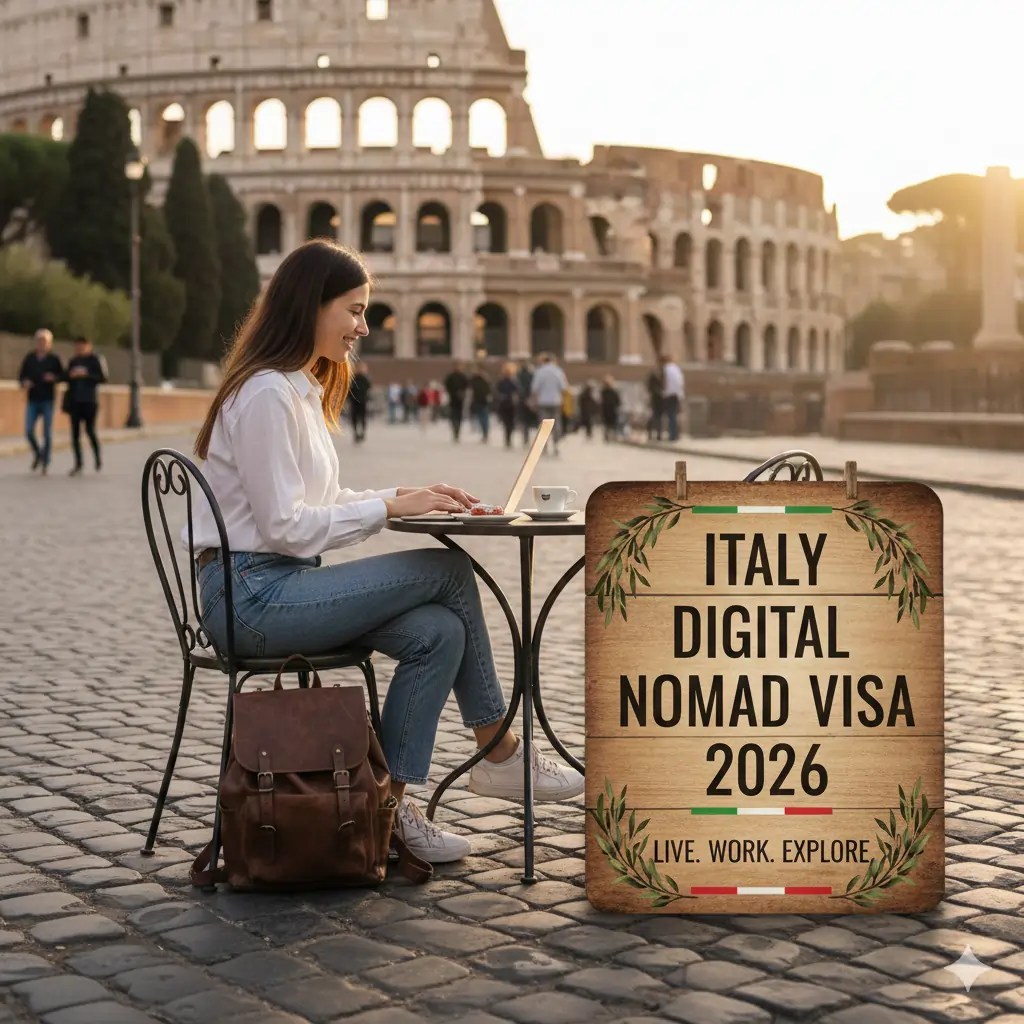
Imagine working from a sun-drenched terrace overlooking the Tuscan countryside, your espresso cooling beside your laptop as church bells echo across terracotta rooftops. Or perhaps you’re taking an afternoon break to explore the cobblestone streets of Rome before returning to your Airbnb for an evening video call. For digital nomads and remote workers from the US, UK, Canada, and Australia, Italy’s new Digital Nomad Visa makes this dream remarkably accessible.
Launched officially in April 2024, Italy’s Digital Nomad Visa (also called the Remote Worker Visa) represents Italy’s entry into the competitive European digital nomad market. While Spain and Portugal have been welcoming remote workers for years, Italy brings something unique to the table: lower income requirements (€28,000/year vs. €33,000-44,000 in neighboring countries), access to Italy’s unparalleled cultural heritage, and—perhaps most importantly—the opportunity to live la dolce vita while advancing your career.
Since the program’s launch, Italy has processed over 1,500 applications, with American digital nomads leading the way. The visa has proven particularly popular among tech professionals, consultants, designers, and content creators seeking a European base that offers both professional infrastructure and lifestyle quality.
This comprehensive 2026 guide covers everything you need to know about Italy’s Digital Nomad Visa: eligibility requirements (including the “highly skilled” qualification), income thresholds, step-by-step application process, required documents, tax implications, renewal procedures, and the best Italian cities for remote work.
Whether you’re a software developer in San Francisco, a marketing consultant in London, a graphic designer in Toronto, or a content creator in Sydney, this guide will show you exactly how to make Italy your new remote work base.
Quick Answer: Italy’s Digital Nomad Visa requires:
Minimum income: €28,000/year (~€2,333/month)
Qualification: University degree OR 3+ years professional experience OR 5+ years (without degree)
Initial validity: 1 year (renewable up to 2 more years)
Processing time: 30-60 days
Cost: €116 visa fee + €500-1,500 in documents/translations
What Makes Italy’s Digital Nomad Visa Different?
Italy entered the digital nomad visa market later than Spain and Portugal, but that’s not necessarily a disadvantage. Italy learned from its neighbors and created a program with some unique features that may actually make it MORE attractive for certain remote workers.
Key Differentiators
1. Lower Income Requirement
Country
Monthly Income
Annual Income
Italy
€2,333
€28,000
Spain
€2,760
€33,120
Portugal
€3,680
€44,160
Italy’s requirement is 16% lower than Spain’s and 39% lower than Portugal’s, making it the most accessible Southern European digital nomad visa.
2. “Highly Skilled” Requirement (But It’s Not Scary!)
Unlike Spain and Portugal which accept most remote workers, Italy specifically targets “highly qualified workers.” You must prove qualifications through ONE of these:
University degree (bachelor’s or higher)
Professional license/certification in your field
3+ years documented professional experience (with degree)
5+ years documented professional experience (without degree)
Reality check: Most digital nomads easily meet these requirements—if you’ve been working remotely successfully, you likely qualify.
3. No Annual Quota Restrictions
Unlike Italy’s Self-Employment Visa (which has limited annual spots under “Decreto Flussi”), the Digital Nomad Visa is NOT quota-limited. Applications are processed year-round on a rolling basis.
4. Two Categories: Digital Nomads vs. Remote Workers
Italy distinguishes between:
Digital Nomads: Freelancers, consultants, self-employed
Remote Workers: Employees of foreign companies
Both use the same visa, but documentation requirements differ slightly (we’ll cover this in detail).
5. Family-Friendly from Day One
Unlike some programs where you must establish residence first, Italy allows you to include your spouse and children under 18 in your initial application.
Eligibility Requirements: Do You Qualify?
To be eligible for Italy’s Digital Nomad Visa, you must meet ALL of these criteria:
Basic Requirements
1. Nationality
Must be non-EU/EEA/Swiss citizen
EU citizens don’t need this visa (you have freedom of movement)
Open to: US, UK, Canada, Australia, and 170+ other countries
2. Age
Must be 18 years or older
3. Professional Category (Choose One)
Option A: Digital Nomad (Self-Employed)
Freelancer, consultant, or independent contractor
Work for international clients
Can earn up to 20% from Italian clients (similar to Spain/Portugal)
Option B: Remote Worker (Employee)
Employed by company based outside Italy
Work entirely remotely using telecommunications technology
Company has no requirement to have Italian presence
Highly Skilled Qualification (Critical!)
This is where many applicants get confused. You must prove you’re “highly qualified” through ONE of the following:
Qualification Path #1: University Degree
Bachelor’s degree or higher
In any field (doesn’t have to match your current work)
From accredited university
Requires: Diploma + transcript + Italian translation
Best for: Authentic Italian experience, food culture, university town
Pros:
Most authentic, livable Italian city
Incredible food (birthplace of ragu, mortadella, tortellini)
Major university (40,000+ students)
More affordable than Rome/Milan/Florence
Porticos (covered walkways) everywhere
Central location (1hr to Florence, 2hrs to Venice)
Less touristy
Cons:
Smaller international community
Limited English speakers
Fewer coworking spaces
Can be rainy in winter
Costs:
1-bedroom apartment: €700-1,200/month
Coworking: €120-250/month
Meal at restaurant: €10-18
Monthly expenses: €1,400-2,400
Best neighborhoods:
Piazza Maggiore area: Central, historic
Universitaria: Student district, lively
Santo Stefano: Elegant, quiet, markets
Saragozza: Residential, local vibe
Coworking spaces: Kilowatt, CoderDojo, H-Farm
5. Turin (Torino)
Best for: Alpine access, automotive/tech industry, underrated gem
Pros:
Very underrated—beautiful city
More affordable than Milan
1 hour from Alps (skiing/hiking)
Growing tech scene (automotive capital)
Elegant architecture
Great coffee culture (birthplace of espresso machines)
Large city feel without crowds
Cons:
Smaller expat/digital nomad community
Limited English speakers
Cold winters
Less international than Milan
Costs:
1-bedroom apartment: €600-1,100/month
Coworking: €100-250/month
Meal at restaurant: €10-18
Monthly expenses: €1,300-2,300
Best neighborhoods:
Centro: Historic center, walkable
San Salvario: Multicultural, nightlife, young
Crocetta: Elegant, residential
Quadrilatero Romano: Historic, trendy
Coworking spaces: Toolbox Coworking, Superflat, Talent Garden Torino
6. Palermo (Sicily)
Best for: Budget, island life, authentic Sicily
Pros:
Most affordable major Italian city
Stunning architecture and history
Amazing food (Sicilian cuisine)
Beach access
Very authentic (less touristy than mainland)
Warm weather year-round
Cons:
Infrastructure challenges (internet can be spotty)
Limited coworking spaces
Very little English spoken
Slower pace (pro or con depending on preference)
More bureaucratic challenges
Costs:
1-bedroom apartment: €400-800/month
Coworking: €80-180/month
Meal at restaurant: €8-15
Monthly expenses: €1,000-1,800
Best neighborhoods:
Politeama: Central, elegant
Kalsa: Historic, artistic, nightlife
Libertà: Upscale, quieter
Vucciria: Historic market district
Coworking spaces: Impact Hub Palermo, Spazio 14
City Comparison Table
City
Cost
Weather
Expat Community
Coworking
Best For
Milan
€€€€
Cool
Large
Excellent
Business, fashion, design
Rome
€€€
Great
Very Large
Good
History, expat community
Florence
€€€
Good
Medium
Limited
Art, culture, tourism
Bologna
€€
Good
Small
Growing
Authentic, food, students
Turin
€€
Cool
Small
Good
Tech, Alps, underrated
Palermo
€
Excellent
Very Small
Limited
Budget, island, authentic
Tax Obligations in Italy
Understanding Italian tax obligations is crucial before moving.
Tax Residency
You become an Italian tax resident if:
You spend 183+ days in Italy in a calendar year, OR
You register your residence (</parameter> <parameter name=”new_str”>You become an Italian tax resident if:
You spend 183+ days in Italy in a calendar year, OR
You register your residence (anagrafe) in Italy, OR
Your “center of vital interests” is in Italy (family, economic ties)
As an Italian tax resident, you must:
File annual tax returns (by September 30)
Report worldwide income
Pay Italian taxes on Italy-sourced income
May owe Italian taxes on foreign income (depending on tax treaties)
Italian Tax Rates for Individuals
Italy uses progressive tax rates (IRPEF):
Income Bracket
Tax Rate
Up to €15,000
23%
€15,001 – €28,000
25%
€28,001 – €50,000
35%
€50,001 and above
43%
Plus:
Regional tax (add 1.23-3.33%)
Municipal tax (add 0-0.9%)
Effective rates: 24-47% depending on income and region
Possible Tax Incentives for Digital Nomads
Important: As of 2026, Italy is considering special tax incentives for Digital Nomad Visa holders, similar to Spain’s Beckham Law. Details are still being finalized.
Potential benefits being discussed:
Flat tax rate of 15-20% on foreign income
Valid for first 3-5 years
Would require special application after obtaining visa
Current status: Check with Italian tax advisor for latest information. Do NOT assume these benefits are automatic.
Social Security Contributions
As a Digital Nomad Visa holder:
Remote employees: Usually NOT required to pay Italian social security if:
Your employer continues paying social security in home country
A totalization agreement exists between Italy and your home country (US, Canada, UK, Australia all have agreements)
Self-employed/freelancers: Likely required to register with INPS (Italian social security) and pay contributions:
Approximately 24% of net income
Can be complex; consult Italian accountant
US Tax Obligations
For US citizens/green card holders:
US requires worldwide income reporting regardless of residence
Foreign Earned Income Exclusion (FEIE): Up to $126,500 (2024) tax-free
Foreign Tax Credit: Credit for Italian taxes paid
FBAR reporting: Required if foreign accounts exceed $10,000
Pay estimated taxes: March and November installments
Keep records: 5-10 years (Italy has long audit windows)
Recommended: Hire Italian commercialista (accountant) specializing in expat taxation. Cost: €500-1,500/year.
Renewal Process
Renewing Your Permesso di Soggiorno
Your initial residence permit is valid for 1 year. You can renew it twice for 1-year periods (3 years total on Digital Nomad Visa).
When to apply:
Submit renewal application 60-90 days before current permit expires
Never let it expire! Overstaying is illegal and can result in deportation ban
Where to apply:
Same Questura where you got original permit
Via post office “Kit” system or direct appointment
Documents needed:
Current Permesso di Soggiorno
Passport (valid 6+ months)
Proof of continued remote work:
Updated employment contract OR
Recent client contracts/invoices (6 months)
Bank statements (6 months showing continued income)
Current health insurance proof
Proof of accommodation
Tax returns (if filed in Italy)
4 passport photos
Application fee: ~€100-150
Processing time: 60-120 days
Result:
First renewal: 1 additional year
Second renewal: 1 additional year
Total time on Digital Nomad Visa: 3 years maximum
After 3 Years: What Are My Options?
Option 1: Switch to Different Visa Type
Self-employment visa (if establishing Italian business)
Employee visa (if hired by Italian company)
Family visa (if married to Italian/EU citizen)
Option 2: Leave Italy
Your Digital Nomad Visa cannot be extended beyond 3 years
Must leave for minimum 6 months before reapplying
Option 3: Apply for Long-Term EU Residence
Requires 5 years continuous legal residence
Digital Nomad Visa years MAY count (unclear; check current regulations)
More permanent status
Option 4: Citizenship
Requires 10 years continuous legal residence
Digital Nomad Visa years MAY count toward citizenship
Must pass Italian language test (B1 level)
Must demonstrate integration
Common Mistakes & How to Avoid Them
1. Not Meeting “Highly Skilled” Requirement
Mistake: Assuming any remote worker qualifies without proving qualifications.
Solution:
Carefully review which qualification path applies to you
Gather all supporting documents (degree, experience letters, etc.)
If uncertain, consult immigration lawyer before applying
Don’t hide or misrepresent qualifications—it will result in denial
2. Insufficient Income Documentation
Mistake: Showing barely meeting €28,000 threshold or irregular income.
Solution:
Show 10-20% buffer above minimum (€30,000-32,000)
Ensure income is consistent month-to-month
Provide more than required 6 months (offer 12 months)
For freelancers: Show diverse client base, not reliance on 1-2 clients
3. Starting Remote Work Too Recently
Mistake: Applying when you’ve only been working remotely for 2-3 months.
Solution:
Wait until you have minimum 6 months documented remote work
Employment contracts should be dated 6+ months ago
Freelancers: Show client relationships extending 6+ months
4. Wrong Health Insurance
Mistake: Buying cheap travel insurance or insurance with high deductibles.
Solution:
Must be long-term health insurance (not travel insurance)
Minimum €30,000 coverage
Comprehensive coverage (equivalent to Italian public healthcare)
Use recommended providers: Cigna Global, SafetyWing Remote Health, Now Health
5. Missing Translation/Apostille Requirements
Mistake: Submitting documents without certified Italian translations or Apostilles.
Solution:
ALL non-Italian documents must be translated by certified translator
Documents from non-EU countries need Apostille
Budget €30-60 per document for translations
Start translation process early (allow 2-3 weeks)
6. Applying to Wrong Consulate
Mistake: Applying to nearest consulate instead of consulate with jurisdiction over your legal residence.
Solution:
Verify which consulate has jurisdiction over your area
Contact them to confirm they accept Digital Nomad Visa applications
Some consulates have different procedures/requirements
7. Missing Post-Arrival Deadlines
Mistake: Not reporting presence within 8 days or not applying for Permesso within 60 days.
Solution:
Set calendar reminders immediately upon arrival
Report presence at Questura within 8 days (mandatory!)
Start Permesso application process within first 2 weeks
Don’t wait until day 59—appointments can be hard to get
8. Choosing Accommodation Poorly
Mistake: Providing short-term Airbnb or accommodation not in applicant’s name.
Solution:
Lease must be in applicant’s name
Minimum 12-month lease preferred
If using hotel/Airbnb: Get official letter from property confirming long-term booking
Consider securing Italian accommodation before applying
Frequently Asked Questions
1. Can I work for a US/UK/Canadian/Australian company with Italy’s Digital Nomad Visa?
Yes! That’s the whole point. You can work remotely for any company based outside Italy while living in Italy. Your employer doesn’t need any Italian presence.
2. Can I work for Italian clients as a freelancer?
Yes, but limited. Freelancers can earn up to 20% of total income from Italian clients. The other 80% must come from non-Italian sources.
3. What’s the minimum income requirement?
€28,000 per year (~€2,333/month) for a single applicant.
For families (estimated):
Spouse: Add ~€14,000/year
Each child: Add ~€7,000/year
4. Do I need a university degree?
Not necessarily. You can qualify through:
University degree (easiest path)
Professional license/certification
3+ years experience (WITH degree)
5+ years experience (WITHOUT degree)
Most remote workers qualify through one of these paths.
5. How long does the application take?
Timeline:
Application processing: 30-60 days
After approval: Type D visa in passport
After arrival: 60-120 days to receive Permesso di Soggiorno
Total: 3-6 months from application to residence card
Initial: 1 year Renewable: Twice (1 year each renewal) Total: Up to 3 years on Digital Nomad Visa
After 3 years, you must switch to different visa type or leave Italy for 6+ months before reapplying.
8. What’s the path to permanent residency?
After 5 years of continuous legal residence in Italy, you can apply for:
Long-term EU residence permit
Permanent resident status
Question: Do Digital Nomad Visa years count toward 5 years? This is currently unclear. Consult immigration lawyer for latest information.
9. Can I get Italian citizenship?
After 10 years of continuous legal residence:
Must pass Italian language test (B1 level)
Must demonstrate integration
Must pass citizenship exam
No criminal record
Question: Do Digital Nomad Visa years count? Currently unclear—consult immigration lawyer.
10. Do I need to speak Italian?
Not for the visa application. There’s no language requirement to apply for or receive the Digital Nomad Visa.
However: Basic Italian will make your life much easier, especially:
Dealing with bureaucracy
Finding accommodation
Daily life in smaller cities
Making friends with locals
11. What are the tax implications?
If you’re Italian tax resident (183+ days/year):
Must file Italian tax returns
Pay Italian taxes on Italy-sourced income
May owe Italian taxes on foreign income (depending on tax treaties)
Possible special tax incentives for Digital Nomad Visa holders (TBD)
Strongly recommend: Consult Italian tax advisor specializing in expats.
12. Can I travel to other Schengen countries?
Yes! Your Italian residence permit allows visa-free travel to all 26 Schengen countries for up to 90 days per 180-day period.
13. Can I apply while in Italy as a tourist?
No. You must apply from outside Italy through the Italian consulate in your country of legal residence.
Exception: EU citizens can apply from within Italy (but EU citizens don’t need this visa anyway).
14. How much does it cost in total?
DIY approach: €1,500-2,200 With some help: €2,500-3,500 Full legal service: €4,000-7,000
Main costs:
Visa fee: €116
Translations: €300-600
Health insurance: €720-2,160/year
Criminal records + Apostille: $50-250 USD
Permesso fee: €100-150
15. What’s the difference between Italy, Spain, and Portugal digital nomad visas?
Quick comparison:
Italy: Lowest income (€28,000), requires “highly skilled” qualification, 3-year max
Spain: Medium income (€33,120), best tax benefits (Beckham Law), 5-year renewable
Portugal: Highest income (€44,160), most established community, 5-year renewable
All three require 10 years for citizenship now.
16. Can I buy property in Italy?
Yes! Non-EU citizens can purchase Italian property. Owning property can:
Serve as proof of accommodation for visa
Provide long-term stability
Potentially support other visa types later
Note: Property ownership alone doesn’t grant residence rights. You still need a valid visa.
17. What happens if I’m denied?
If denied:
Receive letter explaining reason
Common reasons: Insufficient income, unclear qualifications, incomplete documents
Can reapply after addressing issues
No penalty for denial—try again
Pro tip: If denied, consult immigration lawyer before reapplying.
18. Can I work remotely from anywhere in Italy?
Yes! Your residence permit allows you to live and work from anywhere in Italy. You’re not restricted to one city or region.
Many digital nomads:
Spend summer in mountains or on coast
Winter in southern Italy (Sicily, Puglia)
Move between cities exploring Italy
19. Is Italy’s Digital Nomad Visa worth it?
Absolutely, if you:
✅ Have university degree or professional qualifications
✅ Earn €28,000+/year consistently
✅ Work remotely for non-Italian companies/clients
✅ Want to experience Italian lifestyle
✅ Value history, culture, and food
✅ Are okay with 3-year maximum (for now)
Consider alternatives if:
❌ You don’t meet “highly skilled” requirement
❌ You want longer-term visa (5+ years)
❌ You prioritize tax benefits (Spain’s Beckham Law is better)
❌ You need established digital nomad community (Portugal is better)
20. What’s the biggest advantage of Italy’s visa?
Lowest income requirement in Southern Europe (€28,000 vs €33,000-44,000 in Spain/Portugal) combined with access to Italy’s unparalleled cultural heritage, cuisine, and lifestyle.
For remote workers who qualify as “highly skilled” and earn €28,000-40,000/year, Italy offers the most accessible path to European residence.
Arrange certified Italian translations (all documents)
Purchase health insurance
Secure proof of Italian accommodation
Contact Italian consulate, schedule appointment
1 Month Before Application:
Organize all documents (originals + 2 copies each)
Prepare cover letter
Confirm consulate appointment
Arrange visa fee payment
Application Day:
Attend consulate appointment with all documents
Submit application and pay €116 fee
Receive receipt/tracking number
After Visa Approval:
Book flights to Italy
Finalize Italian accommodation
Within 8 days of arrival: Report presence at Questura
Within 60 days: Apply for Permesso di Soggiorno
Final Thoughts: Benvenuti in Italia!
Italy’s Digital Nomad Visa represents an exciting opportunity for qualified remote workers to experience la dolce vita while advancing their careers. With the lowest income requirement in Southern Europe (€28,000), access to world-class cultural heritage, incredible cuisine, and diverse landscapes from Alpine peaks to Mediterranean beaches, Italy offers something truly special.
Is it perfect? No. The “highly skilled” requirement adds complexity, the 3-year maximum is limiting, and Italian bureaucracy is legendary. But for remote workers who meet the qualifications and earn €28,000-50,000/year, Italy provides an accessible path to European residence that Spain and Portugal simply can’t match on income requirements alone.
The real magic of Italy’s Digital Nomad Visa:
Work from a Tuscan vineyard or Roman terrace
Take espresso breaks at local bars
Explore medieval hilltop towns on weekends
Enjoy world-class food at affordable prices
Experience authentic Italian lifestyle (not tourist Italy)
Why Italy Wins for Many Digital Nomads
Lower barrier to entry: €28,000 vs €33,000-44,000 makes a significant difference for mid-level remote workers.
Quality of life: Italy consistently ranks among the world’s best countries for lifestyle, food, culture, and healthcare.
Location diversity: From Milan’s business hub to Sicily’s beaches, Rome’s history to Florence’s art—Italy offers incredible variety within one visa.
Schengen access: Your Italian residence permit opens all of Europe for exploration.
Start Your Italian Adventure
If you’re a qualified remote worker earning €28,000+ who dreams of working from Italy, there’s never been a better time to apply.
Your next steps:
Verify you meet “highly skilled” requirement (you probably do!)
Calculate your income (confirm €28,000+ annually)
Contact your local Italian consulate
Start gathering documents
Italy is calling. The aroma of fresh espresso, the sound of church bells echoing across piazzas, the taste of authentic carbonara, the sight of sunset over the Colosseum—it’s all waiting for you.
In bocca al lupo! (Good luck!) Your Italian adventure begins now. 🇮🇹✨
Save This Guide
Bookmark this page for your Italy Digital Nomad Visa application! Share it with fellow remote workers considering Italy.
Have questions about Italy’s visa or need specific advice? Drop a comment and we’ll help you navigate your application.
Ready to live in Italy? Start gathering those documents—your Permesso di Soggiorno awaits
Posted By : Vinay
As a lead contributor for Travel Tourister, Vinay is dedicated to serving our Tier 1 audience (US, UK, Canada, Australia). His mission is to deliver precise, fact-checked news and actionable, data-driven articles that empower readers to make informed decisions, minimize travel risks, and maximize their adventure without compromising safety or budget.
Travel Tourister is a leading Travel portal where we introduce travellers to trusted travel agents to make their journey hasselfree, memorable And happy. Travel Tourister is a platform where travellers get Tour packages ,Hotel packages deals through trusted travel companies And hoteliers who are working with us across the world. We always try to find new and more travel agents and hoteliers from every nook and corners across the world so that you could compare the deals with different travel agents and hoteliers and book your tour or hotel with the one you have chosen according to your taste and budget.




 Call
Call Enquiry