St. Lucia vs Barbados: Which Caribbean Island Wins? (2026 Guide)
Published on : 20 May 2026
St. Lucia vs Barbados — The Eastern Caribbean’s Two Greatest Islands, Honestly Compared
By Travel Tourister | Updated May 2026
St. Lucia and Barbados are the two most debated Eastern Caribbean island destinations for Tier 1 travelers from the UK, Canada, the United States, and Australia — and the comparison between them is among the most productively specific available in Caribbean travel planning, because the two islands are separated not only by 100 miles of the Caribbean Sea but by everything that makes an island destination distinct: the landscape (St. Lucia’s twin volcanic Piton peaks rising 2,619 and 2,461 feet directly from the Caribbean coast, the most dramatically beautiful island scenery in the Eastern Caribbean vs Barbados’s flat coral limestone plateau with the most specifically developed beach and west coast resort infrastructure of any small Caribbean island), the beach character (St. Lucia’s black sand, golden sand, and the Sugar Beach between the Pitons vs Barbados’s famous west coast platinum sand and the dramatically pink-coral Crane Beach on the Atlantic side), the cultural identity (St. Lucia’s French and British colonial overlay on a deeply Creole Caribbean foundation vs Barbados’s “Little England” 350-year British colonial heritage producing the most specifically British-Caribbean cultural blend accessible in the Eastern Caribbean), the food culture (St. Lucia’s Friday Night Fish Fry at Anse La Raye vs Barbados’s Oistins Friday Fish Fry and the flying fish cutter that is the most specifically and the most nationally embedded single food of any Caribbean island), and the cost structure (Barbados is more expensive than St. Lucia in hotels and dining; St. Lucia’s jungle lodges and boutique properties offer the most dramatic scenery at prices significantly below Barbados’s west coast resort corridor).
This guide breaks down every meaningful category honestly and delivers the clearest verdict for the Tier 1 traveler choosing between the Eastern Caribbean’s two most celebrated island destinations in 2026.
For related Caribbean comparisons, see our Puerto Rico vs Jamaica and Best Caribbean Islands 2026 guides.
The Most Important Facts First
Key Fact
🌋 St. Lucia
🏏 Barbados
Size
238 sq miles — volcanic, mountainous
166 sq miles — flat coral limestone
Population
~180,000
~290,000
Colonial Heritage
French and British (changed hands 14 times)
Exclusively British 1627–1966 — “Little England”
Currency
Eastern Caribbean Dollar (XCD); USD widely accepted
Barbadian Dollar (BBD); USD accepted at 2:1 rate
Flight from London
~9 hours direct to UVF (British Airways, Virgin)
~9 hours direct to BGI (British Airways, Virgin, TUI)
Flight from New York
~4.5 hours direct to UVF
~4.5 hours direct to BGI
Midrange Hotel (per night)
$220–$380 (north coast); $280–$520 (Pitons area)
$280–$480 (west coast); $380–$650 (Platinum Coast)
Best Known For
The Pitons, rainforest, honeymoon romance, volcanic scenery
West coast beaches, rum, cricket, flying fish, Platinum Coast
Drive on
Left (British system)
Left (British system)
Landscape
Mountainous, volcanic, lush rainforest — most dramatic in Eastern Caribbean
Flat, coral limestone, well-developed — most accessible terrain
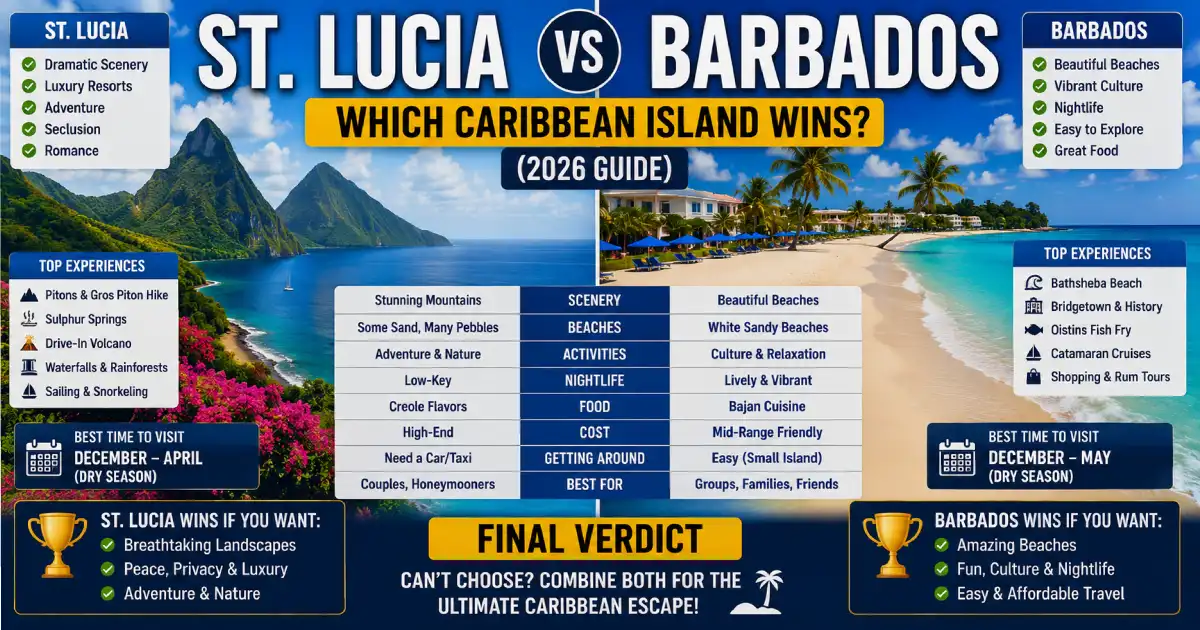
Quick Verdict: St. Lucia vs Barbados
Category
🌋 St. Lucia Wins
🏏 Barbados Wins
Winner
Scenery & Landscape
The Pitons, rainforest, volcanic peaks — most dramatic in Caribbean
Beautiful but flat — less dramatic than St. Lucia
🌋 St. Lucia
Romance & Honeymoon
Most romantic island in Caribbean — Pitons backdrop, jungle lodges
Romantic but more social and resort-forward
🌋 St. Lucia
West Coast Beaches
Beautiful but smaller; Sugar Beach exceptional
Platinum Coast — most consistently excellent west-coast Caribbean beach
🏏 Barbados
Hiking & Adventure
Gros Piton hike, rainforest trails, volcano, waterfall — best in Eastern Caribbean
Harrison’s Cave — limited hiking (island is flat)
🌋 St. Lucia
Cost
Moderately expensive; some value in south/inland
Most expensive island in Eastern Caribbean per night
🌋 St. Lucia
Rum Culture
Bounty Rum — good local rum tradition
Mount Gay (oldest rum brand in world 1703) — Rum Route tours, most celebrated rum island
🏏 Barbados
Food Scene
Friday Night Fish Fry Anse La Raye, Creole cuisine
Flying fish cutter, Oistins Fish Fry, most sophisticated dining scene in Eastern Caribbean
🏏 Barbados
Nightlife
More relaxed; Rodney Bay strip; Friday Fish Fry
Most active nightlife in Eastern Caribbean — St. Lawrence Gap, Oistins
🏏 Barbados
Snorkeling & Diving
Excellent — Anse Chastanet reef, Jalousie beach
Sea turtles on west coast — most reliable turtle snorkeling in Eastern Caribbean
🤝 Tie
Ease of Getting Around
Challenging — winding mountain roads; north to south takes 1.5 hours
Most easy to navigate of any Eastern Caribbean island — flat, well-signed
🏏 Barbados
Festivals
St. Lucia Jazz Festival (May) — most celebrated music festival in Eastern Caribbean
Crop Over (July–Aug) — most festive Caribbean carnival outside Trinidad
🤝 Tie (different events)
Mineral Hot Springs
Diamond Falls & Sulphur Springs — most accessible drive-in volcano in world
No volcanic activity
🌋 St. Lucia
First-Timer Caribbean
Most dramatically beautiful introduction to the Caribbean
Most comfortable and most developed — easiest first Caribbean island
🤝 Tie (depends on priorities)
St. Lucia: The Most Dramatically Beautiful Island in the Eastern Caribbean
The Pitons: The Most Iconic Scenery in the Caribbean
The Pitons — Gros Piton (2,619 feet) and Petit Piton (2,461 feet), the twin volcanic spires rising directly from the Caribbean coast on St. Lucia’s southwest shore, designated a UNESCO World Heritage Site in 2004 — are the most globally recognized and the most specifically extraordinary single landscape feature accessible at any Eastern Caribbean island. The Pitons’ specific visual drama: both peaks rise from sea level to 2,600 feet within a horizontal distance of less than a mile from the waterline, producing the most compressed vertical landscape accessible at any Caribbean island — a landscape that makes the backdrop of the Sugar Beach (a Viceroy Resort) the most specifically extraordinary beach backdrop photograph accessible in the Western Hemisphere, with the two peaks flanking the beach’s white sand and the Caribbean lapping at the base of the volcanic cliffs below the jungle.
Gros Piton Trail (hike, $35/person including mandatory guide): The most specifically rewarding and the most physically demanding single hike accessible in the Eastern Caribbean — the 5.5-mile round trip trail (2,619 feet elevation gain, approximately 5–6 hours round trip) delivers the most panoramic Caribbean island view accessible from any peak reachable on foot: St. Vincent visible to the south, Martinique to the north, and the entire south St. Lucia coast visible below in the most specifically rewarding mountain-top Caribbean vista accessible on any Eastern Caribbean island. Guides are mandatory by St. Lucia National Trust regulation; book at the Fond Gens Libre village at the trail’s base ($35/person guide fee is the most consequential single hiking investment in the Eastern Caribbean).
Petit Piton (more technical, restricted access): The steeper and the more technically demanding of the two peaks — accessible with a specialized guide; less frequently attempted than Gros Piton but the more dramatically sheer in its visual profile from the water
Sugar Beach (A Viceroy Resort, Jalousie Plantation site): The most specifically Piton-between-the-peaks positioned beach in St. Lucia — the white sand beach (artificially supplemented over the original black volcanic sand) with both Pitons visible from the waterline is the most photographically irreplaceable single beach position accessible in the Eastern Caribbean. Day passes available to non-resort guests ($100–$150/adult, includes beach chair, umbrella, and a food and drink credit)
St. Lucia’s Rainforest and Nature
St. Lucia’s volcanic interior — 60% forested, with the most specifically lush tropical rainforest accessible at any Eastern Caribbean island — produces the most diverse and the most dramatically positioned nature experiences in the region:
Tet Paul Nature Trail (Soufrière area, $15/person): The most accessible and the most panoramic nature trail in St. Lucia — a 45-minute guided walk through the working organic plantation above Soufrière, with the most specifically close-range Piton view accessible from any walking trail and the most productive panoramic Caribbean photography accessible in the southern St. Lucia mountains
Soufrière Drive-In Volcano (La Soufrière Sulphur Springs, $10/person): The world’s only “drive-in volcano” — the most accessible and the most specifically dramatic volcanic landscape accessible in the Eastern Caribbean: the sulfur steam vents, the bubbling mud pools, and the specific rotten-egg volcanic smell (the most honest single volcanic experience accessible at any Caribbean tourist attraction) combine with the specific geological education of standing inside a caldera that last erupted in 1766 and whose activity continues in the form of the hot springs and sulfur vents accessible from the paved road through the spring complex. The most specifically geologically educational $10 spent in the Caribbean.
Diamond Falls Botanical Gardens ($12/person): The most complete and the most specifically color-diverse botanical garden in St. Lucia — the mineral baths (natural sulfur spring pools at 90°F, accessible for bathing in the private and semi-private pools at the garden’s entrance for $10–$16/person additional) and the Diamond Falls waterfall (the most specifically rainbow-in-the-spray and the most specifically Instagram-rewarding waterfall accessible in any St. Lucia garden) make Diamond Falls the most complete single botanical garden visit accessible in the island’s southwest
Rainforest aerial tram (Castries, $75/adult): The most specifically overview-of-the-rainforest and the most comfortable introduction to St. Lucia’s forest canopy — the aerial tram above the Castries watershed’s rainforest delivers the most specifically bird’s-eye Caribbean rainforest view accessible without hiking in any St. Lucia nature experience
St. Lucia Beaches
St. Lucia’s beaches are the most scenically spectacular and the most diverse in character of any Eastern Caribbean island — though not the most consistently excellent for swimming in the west coast Caribbean-calm-water sense that Barbados’s Platinum Coast provides:
Reduit Beach (Rodney Bay): The most accessible and the most water-sport-complete beach in St. Lucia — the north coast’s calmest swimming water, the most jet ski and watersport rental density, and the most Grace Bay-adjacent west-coast Caribbean beach experience accessible in St. Lucia. The Rodney Bay resort corridor’s beach access point for the island’s north coast hotel cluster.
Anse Chastanet: The most snorkeling-specific and the most reef-immediately-adjacent beach in St. Lucia — the volcanic black-tinged sand beach below the Anse Chastanet Resort has the most accessible shore snorkeling in St. Lucia: the reef begins immediately at the waterline, with parrotfish, trumpetfish, and the most coral-dense shore snorkeling environment of any St. Lucia beach. Day passes for non-resort guests $50–$75.
Anse des Pitons (Jalousie Beach / Sugar Beach): The most photographically irreplaceable — described above under Piton section.
Anse Cochon: The most secluded and the most specifically wild-feeling beach in St. Lucia — accessible only by boat from Soufrière or by a challenging hike, the most specifically unspoiled and the most Robinson-Crusoe-feeling beach on the island.
St. Lucia: Romance Capital of the Caribbean
St. Lucia is the most specifically romantic and the most consistently honeymooner-celebrated island in the Eastern Caribbean — a designation earned by the specific combination of the Pitons’ cinematic backdrop, the jungle lodge accommodation category (Ladera Resort, with its three-sided open-air rooms with the Piton view as the fourth wall — the most dramatically and the most specifically romantic hotel room accessible in the Caribbean at $500–$1,200/night), the private catamaran day sail with sunset picnic under the Pitons (the most specifically St. Lucia honeymoon activity), and the overall character of an island that rewards the couple who rents a villa in the hills above Soufrière and watches the sun set behind the Pitons from the plunge pool with a bottle of the most local rum punch accessible in the most dramatic private terrace view in the Caribbean.
The specific St. Lucia honeymoon accommodation institutions:
Ladera Resort ($500–$1,200/night): The most dramatically positioned and the most architecturally specific romantic resort in the Caribbean — the three-sided open-air villas with the Pitons framed in the open fourth wall, a private plunge pool, and the most specifically “nowhere else on earth” room design accessible in any Caribbean resort. The most cited single St. Lucia honeymoon experience by returning couples.
Jade Mountain (St. Lucia’s most expensive resort, $1,200–$3,000/night): The most architecturally ambitious Caribbean resort — each “sanctuary” has three walls and the fourth wall completely open to the Pitons view, a private infinity pool, and the most specifically boundary-between-inside-and-outside-dissolved hotel architecture accessible in the Caribbean. For the visitor for whom no other St. Lucia honeymoon accommodation is sufficiently ambitious.
Anse Chastanet Resort ($450–$900/night): The most organically integrated into the landscape — the hillside and beachfront rooms of this long-established resort are the most specifically St. Lucia-lush and the most wildlife-adjacent: the resident hummingbirds, the most consistently present tropical birds in any St. Lucia resort grounds, feed at the room-side flowers.
Barbados: The Most Polished and Most British Caribbean Island
The Platinum Coast: The Most Consistently Excellent West Coast Beaches
Barbados’s west coast — the Platinum Coast running from Holetown in the north through Paynes Bay to Bridgetown’s outskirts in the south — is the most consistently excellent and the most comprehensively resort-developed Caribbean west coast beach corridor accessible in the Eastern Caribbean. The specific west coast characteristics:
Calm, turquoise, warm water: The Caribbean Sea’s west coast position shields Barbados from the Atlantic trade wind swells, producing the calmest and the most swimming-consistent coastal water of any Eastern Caribbean island’s west coast
Paynes Bay: The most consistently praised single Barbados west coast beach — wide, sandy, calm, with the most reliably consistent sea turtle sightings (hawksbill sea turtles feed on the seagrass beds offshore at Paynes Bay, producing the most accessible in-water turtle encounter accessible at any Barbados west coast beach without a boat tour)
Sandy Lane Beach: The most specifically celebrity-adjacent and the most particularly luxuriously positioned beach in Barbados — the Sandy Lane Hotel’s beach (one of the most expensive hotels in the Caribbean at $1,500–$5,000+/night) fronts the most well-maintained and the most exclusive-feeling beach on the Platinum Coast
Crane Beach (Atlantic Side): The most photographically extraordinary beach in Barbados — the pink-tinged coral sand (the specific pink color produced by the crushed coral fragments mixed with the local sand composition), the dramatic Atlantic cliff backdrop, and the most specifically non-west-coast-Caribbean and the most specifically Atlantic-dramatic beach character make the Crane Beach the most specifically beautiful single beach in Barbados. Rougher swimming than the west coast (Atlantic swell) but the most dramatically positioned and the most landscape-complete beach on the island.
Barbados Rum: The World’s Oldest Rum Island
Barbados is the most historically significant rum-producing island in the world — the island where rum was first commercially distilled (the earliest documented evidence of rum distillation dates from 1647 in Barbados, making Barbadian rum the most historically consequential and the most specifically originary spirit in the Americas) and home to Mount Gay Rum (founded 1703, the oldest existing rum brand in the world, the most historically specific rum available at any Caribbean duty-free). The specific Barbados rum experiences:
Mount Gay Rum Visitor Centre (Bridgetown, $35–$65/person): The most historically specific rum tour accessible in the Caribbean — the 1703 founding distillery’s visitor center delivers the most comprehensive rum education accessible at any Caribbean distillery, from the specific Barbadian molasses sourcing to the column still distillation process to the blending room where the most experienced rum blenders in the Western Hemisphere taste and assemble the Mount Gay Extra Old and the 1703 expression. The cocktail bar’s Mount Gay rum punch ($8–$12) is the most specifically locally-contextualized rum cocktail accessible anywhere in Barbados.
Foursquare Distillery (St. Philip, $25/person): The most critically acclaimed and the most whisky-enthusiast-adjacent Barbados rum distillery — the Foursquare Estate’s single blended rums (the Exceptional Cask Series is the most internationally celebrated Barbados rum outside of Mount Gay, with the most specific vintage-dating and the most whisky-collector-adjacent release strategy of any Caribbean rum producer) produce the most critically acclaimed rum available in Barbados and the most internationally awarded single rum accessible from any Eastern Caribbean island tour.
The Rum Route (self-drive tour of multiple distilleries): The most comprehensively rum-educational Barbados day — the self-drive Rum Route connects Mount Gay, Foursquare, and the St. Nicholas Abbey (the most architecturally historic and the most plantation-specifically preserved rum estate in Barbados, with a Jacobean great house built in 1658 and a functioning sugar and rum operation) in the most complete Caribbean rum heritage day accessible in any single Eastern Caribbean island.
Barbados Food: The Most Sophisticated Dining in the Eastern Caribbean
Barbados has the most developed and the most sophisticated food scene of any Eastern Caribbean island — a reflection of the island’s established luxury tourism infrastructure, the most specifically British-Caribbean culinary heritage, and the most locally celebrated single dish in Caribbean gastronomy:
The flying fish cutter: The most specifically Barbadian and the most nationally embedded single food in the Caribbean — a salt bread roll (the “cutter,” a specific Barbadian bread shape with a particular crust texture unavailable in any other Caribbean bread) filled with fried or steamed flying fish (the most specifically Barbadian marine species, featuring on the Barbadian coat of arms and the Barbadian $1 coin, caught in the Atlantic waters east of the island), pickled cucumber, tomato, and the most hot sauce the recipient can comfortably manage. $8–$14. The most specifically and the most irreplaceably Barbadian single food accessible at any price in any restaurant on the island.
Oistins Fish Fry (Friday and Saturday evenings): The most attended and the most specifically festive weekly food event in Barbados — the Oistins fishing village’s Friday and Saturday evening fish fry, where the most fresh-caught mahi-mahi, flying fish, and snapper are grilled and fried at the most casual and the most locally attended outdoor restaurant setting in the island. $15–$25/plate; rum punch $6; the most specific and the most irreplaceable Barbados evening experience accessible at any price.
The Cliff Restaurant ($150–$250/person): The most dramatically cliff-positioned and the most consistently awarded fine dining restaurant in Barbados — the torchlit terraces on the Platinum Coast’s north section, with the most specifically Caribbean-at-night dining atmosphere of any Barbados restaurant, and the most consistently praised cuisine of any Barbados fine dining establishment over the last two decades.
Cou-cou and flying fish (national dish): The most specifically and the most institutionally Barbadian plate — cornmeal and okra cooked in the most specific Barbadian preparation style, served with steamed flying fish in a tomato-onion-Scotch bonnet sauce: the most specifically Barbadian single dish accessible at any local restaurant, most authentically prepared at the lunch spots in Bridgetown’s market area ($12–$18).
Barbados Culture: “Little England” With Caribbean Heart
Barbados’s 350-year exclusively British colonial heritage (the only island in the Caribbean never to have been colonized by another European power — Barbados was continuously British from 1627 until independence in 1966, the longest-standing British Caribbean territory) produces the most specifically and the most visibly British-Caribbean cultural blend accessible in any Eastern Caribbean island: afternoon tea at the Sandy Lane Hotel, cricket at Kensington Oval (the most historically significant cricket ground in the Caribbean, where the 2007 Cricket World Cup Final was played), the Barbados Museum in the Garrison Historic Area (the most comprehensive Caribbean historical museum accessible in Barbados), and the specific social culture (the most formally educated and the most specifically achievement-oriented Caribbean society, with Barbados consistently ranking among the highest per-capita educational achievement rates in the Western Hemisphere).
Crop Over Festival (July–August): The most festive and the most specifically Barbadian annual cultural event — the end-of-sugar-harvest celebration that evolved into the most specifically Barbadian carnival (less internationally famous than Trinidad’s Carnival but equally festively committed), with the Kadooment Day finale parade (the most specifically Barbadian costumed band parade) on the first Monday in August producing the most colorful and the most community-attended single day of any Barbados annual calendar.
Garrison Historic Area (UNESCO World Heritage Site): The most specifically British military heritage and the most architecturally colonial public space in Barbados — the 17th-century military garrison complex (the most intact British colonial military infrastructure in the Caribbean) and the adjacent Barbados Turf Club (the most historically continuous horse racing track in the Caribbean, operating since 1845) collectively produce the most specifically “Little England” cultural experience accessible in any Barbados heritage attraction.
St. Lucia vs Barbados: Nightlife & Festivals
St. Lucia Nightlife — Rodney Bay and the Friday Fish Fry
St. Lucia’s nightlife is concentrated in the Rodney Bay Marina area (the most bar-and-restaurant-dense evening destination on the island, with the most consistently open restaurants and bars accessible in any St. Lucia resort corridor) and at the Friday Night Fish Fry at Anse La Raye (the most specifically authentic and the most locally attended weekly food-and-music event in St. Lucia — the village of Anse La Raye on the island’s west coast closes its main street to vehicles every Friday evening, lining it with fish vendors selling grilled and fried catch-of-the-day, rum punch, and the most specifically St. Lucia local music in the most community-embedded Caribbean weekly event accessible at any Eastern Caribbean fishing village). The Anse La Raye Fish Fry is the most consistently cited “most authentic single evening in St. Lucia” by returning visitors across all budget categories — $10–$20 buys the most specific and the most irreplaceable St. Lucia local food experience of any evening on the island.
Barbados Nightlife — The Most Active in the Eastern Caribbean
Barbados has the most active and the most consistently programmed nightlife of any Eastern Caribbean island — the St. Lawrence Gap (the most bar-and-club-dense single street in Barbados, running through the Christ Church parish between Worthing and Maxwell, the most specifically Barbados nightlife corridor), the Oistins Fish Fry (the most festive and the most attended weekly food-and-music event on the island, Friday and Saturday evenings, with the most rum punch consumption and the most specifically Caribbean party atmosphere of any Barbados weekly event), and the Crop Over Festival’s season of fêtes (the most specifically costumed and the most officially carnival-adjacent nightlife programming accessible in any Eastern Caribbean island between June and August) collectively produce the most vibrant and the most consistently active nightlife accessible in Barbados at any budget level. Barbados nightlife is categorically more developed than St. Lucia’s — the visitor who prioritizes evening social activity will find Barbados the more naturally configured destination for sustained nightlife over multiple evenings.
St. Lucia vs Barbados: Getting Around
St. Lucia — The Winding Mountain Challenge
Getting around St. Lucia is the most challenging logistical aspect of any St. Lucia visit — the island’s mountainous topography produces the most winding and the most time-consuming road network of any Eastern Caribbean island: the drive from the north coast (Rodney Bay resort area, adjacent to Hewanorra’s smaller Vigie Airport) to the south (Soufrière and the Pitons) takes 1.5–2 hours on mountain roads that are the most specific combination of narrow, steep, and slow of any Eastern Caribbean island’s main route. Most visitors choose to base themselves either in the north (Rodney Bay area, most resort infrastructure, most beach access, shorter airport transfer from George F.L. Charles Airport) or the south (Soufrière area, closest to the Pitons, most dramatic scenery, longer airport transfer from the main Hewanorra International Airport at the south end). Rental cars are available but the mountain roads are the most challenging for first-time drivers; many visitors prefer a hired driver ($150–$250/full day, the most efficient and the most locally knowledgeable island exploration format).
Barbados — The Most Navigable Eastern Caribbean Island
Barbados is the most navigable and the most logistically straightforward of any Eastern Caribbean island — the flat coral limestone terrain produces the most well-signed and the most easily drivable road network of any island in the region. Grantley Adams International Airport is centrally located on the south coast (20 minutes from the west coast resort strip, 10 minutes from the south coast’s St. Lawrence Gap). Rental cars (drive on the left, same as St. Lucia) are the most efficient way to explore all of Barbados in a day; public buses (the ZR vans) are the most affordable at $2 per journey but the most schedule-uncertain for the visitor with specific timing requirements. The complete island is circumnavigable in under 3 hours by car, making Barbados the most efficiently explorable and the most geographically compact major Eastern Caribbean island.
St. Lucia vs Barbados: Cost Comparison
Cost Category
🌋 St. Lucia
🏏 Barbados
Cheaper?
Midrange Hotel (per night)
$220–$380 (north); $280–$520 (Pitons area)
$280–$480 (west coast); $380–$650 (Platinum)
🌋 St. Lucia (north coast)
Luxury Hotel (per night)
Ladera $500–$1,200; Jade Mountain $1,200–$3,000
Sandy Lane $1,500–$5,000+; Coral Reef Club $600–$1,200
🌋 St. Lucia (dramatic view for less)
Casual Dinner (per person)
$25–$55
$30–$65
🌋 St. Lucia
Street/Local Food
Fish Fry Anse La Raye $10–$20
Flying fish cutter $8–$14; Oistins Fish Fry $15–$25
🤝 Comparable
Gros Piton Hike
$35/person (mandatory guide)
Not available (island is flat)
🌋 St. Lucia (has it)
Mount Gay Rum Tour
Bounty Rum tour available; less celebrated
$35–$65/person (most historic rum tour in world)
🏏 Barbados (has the best)
Rental Car (per day)
$65–$95 (4WD recommended for south)
$55–$85 (standard car sufficient anywhere)
🏏 Barbados
7-Day Total (per person, midrange)
~$2,800–$4,500
~$3,400–$5,500
🌋 St. Lucia (15–20% cheaper)
Cost verdict: St. Lucia is 15–20% cheaper than Barbados overall — the hotel differential at comparable quality tiers runs $60–$170/night less in St. Lucia, and the dramatic scenery available at St. Lucia’s jungle lodge price point (Ladera Resort’s Piton view for $500–$1,200/night) is the most compelling luxury value in the Eastern Caribbean: the same hotel investment that buys a standard west coast Barbados resort room buys a three-sided open-air Piton-view villa at Ladera. Barbados’s Platinum Coast luxury tier (Sandy Lane, $1,500–$5,000+/night) is the most expensive resort accommodation in the Eastern Caribbean. The budget-conscious Tier 1 traveler who wants the most dramatic scenery per dollar: St. Lucia delivers it at a lower price point than any comparable Barbados offering.
Who Should Visit St. Lucia?
Choose St. Lucia if you:
Want the most dramatic and the most photographically extraordinary island scenery in the Eastern Caribbean — the Pitons, the rainforest, the drive-in volcano, and the Diamond Falls botanical garden collectively produce the most landscape-diverse and the most cinematically specific Caribbean island experience accessible in the region
Are planning a honeymoon and want the most romantic island in the Caribbean — the Ladera Resort’s open-air Piton-view villas, the Jade Mountain sanctuaries, and the catamaran sunset sail under the Pitons are the most specifically and the most consistently honeymooner-celebrated experiences in the Eastern Caribbean
Want to hike the Gros Piton — the most rewarding and the most physically significant mountain hike accessible in the Eastern Caribbean, with the most panoramic Caribbean summit view accessible on foot from any Eastern Caribbean island beach resort base
Want the Friday Night Fish Fry at Anse La Raye — the most authentically local and the most specifically community-embedded weekly food-and-music event in St. Lucia, accessible to any visitor with $10–$20 and a taxi to the fishing village on a Friday evening
Want the Sulphur Springs drive-in volcano and the Diamond Falls mineral baths — the most specifically geologically interesting and the most specifically volcanic landscape accessible at any Eastern Caribbean island day attraction
Are on a luxury budget that wants the most dramatic scenery-per-dollar — Ladera’s Piton-view villa at $500–$1,200/night delivers the most specifically extraordinary Caribbean hotel view at a price point significantly below Sandy Lane’s comparable investment
Who Should Visit Barbados?
Choose Barbados if you:
Want the most consistently excellent west coast Caribbean beach experience — the Platinum Coast’s calm water, the most reliable sea turtle encounters at Paynes Bay, and the specific west-coast-Caribbean beach width and consistency are the most continuously praised single Barbados attribute across all visitor categories
Are a rum enthusiast — Mount Gay (oldest rum brand in the world, founded 1703) and Foursquare Distillery’s critically acclaimed single blended rums make Barbados the most historically significant and the most critically respected rum island in the world; the Rum Route is the most complete rum heritage experience accessible in any Caribbean island
Want the most sophisticated food scene in the Eastern Caribbean — the flying fish cutter, the Oistins Fish Fry, and the Cliff Restaurant’s torchlit Platinum Coast fine dining represent the most complete Caribbean gastronomic range accessible at any Eastern Caribbean island
Want the most active nightlife in the Eastern Caribbean — the St. Lawrence Gap, the Oistins Fish Fry, and the Crop Over Festival’s fête season produce the most programmed and the most consistently attended nightlife accessible in the region
Are a first-time Caribbean visitor who wants the most logistically straightforward and the most comfortable Eastern Caribbean island experience — Barbados’s flat terrain, the most well-signed road network, and the most developed tourist infrastructure of any Eastern Caribbean island make it the most immediately navigable and the most specifically accessible tropical island for first-time Caribbean travelers
Want the Crop Over Festival (July–August) — the most festive and the most specifically Barbadian annual cultural event, with the Kadooment Day finale parade being the most colorful and the most community-celebratory single day accessible in Barbados’s entire annual calendar
Can You Visit Both St. Lucia and Barbados?
Yes — and combining both islands in a single Caribbean trip is the most specifically complementary Eastern Caribbean island combination available: St. Lucia’s volcanic drama and jungle romance complement Barbados’s beach polish and rum culture in a single trip that delivers the most scenically varied and the most culturally complete Eastern Caribbean experience accessible in under 2 weeks. The routing:
10-day combination: Fly into Barbados (BGI, most direct flight options from London) → Barbados 4 days (Platinum Coast, Oistins Fish Fry, Mount Gay tour, Crane Beach) → inter-island flight to St. Lucia (LIAT or Caribbean Airlines, 45 minutes, $80–$150 each way) → St. Lucia 6 days (Gros Piton hike, Ladera or Jade Mountain, Sulphur Springs, catamaran day sail, Anse La Raye Fish Fry, Piton sunset) → fly home from UVF or return to BGI for the international departure
The inter-island flight: The 45-minute LIAT or Caribbean Airlines flight between Barbados (BGI) and St. Lucia (UVF) is the most efficient Eastern Caribbean island connector — book 2–4 weeks ahead for the best availability on peak season routes
St. Lucia vs Barbados: Practical Tips
Topic
🌋 St. Lucia
🏏 Barbados
Best Time to Visit
December–April (dry season, clearest weather); May for St. Lucia Jazz Festival
December–April (dry season, Platinum Coast at its most vivid); July–August for Crop Over Festival
Worst Time
July–October (hurricane season; rainforest roads can flood; travel insurance essential)
September–October (peak hurricane risk; Barbados less vulnerable than other Eastern Caribbean islands due to southerly position but travel insurance still essential)
Best Area to Stay
North (Rodney Bay) for beach and water sports access, easier navigation; South (Soufrière/Pitons) for maximum romance and drama — choose based on primary priority
West Coast (Holetown to Bridgetown) for Platinum Coast beach access; South Coast (St. Lawrence Gap, Worthing) for nightlife and more affordable accommodation
Don’t Miss
Gros Piton hike (book guide day before; start at 7 AM); Anse La Raye Friday Fish Fry ($10–$20); Ladera sunset cocktail (even if not staying — ask about sunset drinks access)
Oistins Fish Fry Friday evening ($15–$25); Mount Gay Rum Tour ($35–$65); Paynes Bay turtle snorkel at dusk (free if you’re swimming; $45–$65 guided tour)
Getting Around
Hired driver ($150–$250/day) most recommended for south exploration; rental car ($65–$95/day) for independent north coast; minibus taxis cheap but schedule-uncertain
Rental car ($55–$85/day) most efficient; ZR vans $2/journey most affordable; taxis metered for airport runs (fixed rate $35–$45 airport to west coast resort)
Tipping
10–15% standard (service charge often added — check bill); EC$5–$10 for local guides at volcanic/nature sites; $20–$30 for full-day hired driver tip
10–15% standard at restaurants (service charge usually added at tourist restaurants — check); Oistins Fish Fry vendors: round up to nearest $5 on your order; rum tour guide: $5–$10 tip
Frequently Asked Questions: St. Lucia vs Barbados
Which is more romantic — St. Lucia or Barbados?
St. Lucia is the most specifically and the most consistently romantic island in the Eastern Caribbean — the Pitons’ volcanic drama, the Ladera Resort’s three-sided open-air villa with the Pitons as the fourth wall, the catamaran sunset sail under the peaks, and the general character of an island whose landscape provides the most cinematically extraordinary backdrop for any Caribbean honeymoon photograph collectively make St. Lucia the most romantic choice by the widest margin of any Eastern Caribbean island comparison. Barbados is genuinely romantic — the Platinum Coast’s candlelit Cliff Restaurant dinner, the Crane Beach at sunrise, and the Sandy Lane’s gardens are all specifically romantic settings. Neither island produces more specifically romantic couples’ memories, gram-for-gram, than the view from the Ladera plunge pool at sunset. If the specific Piton-backdrop romance is the primary honeymoon priority: St. Lucia. If west coast beach luxury romance with the most developed spa and resort infrastructure is the priority: Barbados.
Which is easier to get around — St. Lucia or Barbados?
Barbados is significantly easier to get around — the flat coral limestone terrain, the well-signed road network, and the ability to circumnavigate the entire island in under 3 hours make Barbados the most navigable Eastern Caribbean island without a local knowledge advantage. St. Lucia’s mountain roads are genuinely challenging: the winding, narrow roads through the volcanic interior (particularly the route from the north coast to Soufrière, which involves the most hairpin-bend-dense section of highway accessible on any Eastern Caribbean island) require confidence in mountain driving or a hired local driver. The most honest advice for St. Lucia navigation: budget $150–$250 for a hired driver if the south (Pitons, Sulphur Springs, Diamond Falls) is on the itinerary; the cost is the most specific and the most consequential single St. Lucia planning investment available for the visitor who is not comfortable with narrow mountain roads.
Which island is better for first-time Caribbean visitors?
Both islands are excellent for first-time Caribbean visitors, with different specific advantages. Barbados is the most immediately comfortable and the most logistically straightforward — the flat terrain, the well-developed tourist infrastructure (the most hotel categories, the most organized tour operations, the most consistently English-first service), and the most accessible local culture (the Friday Oistins Fish Fry and the Mount Gay rum tour are the most approachable local cultural experiences in the Eastern Caribbean without a guide requirement) make it the most comfortable first Caribbean island visit. St. Lucia is the most dramatically beautiful introduction to the Caribbean — if the primary first-Caribbean-visit motivation is “the most extraordinary landscape and scenery accessible in the region,” St. Lucia’s Pitons deliver an immediate and permanent understanding of why the Caribbean commands the global fascination it does. The most honest first-Caribbean-visit recommendation: if you want to be comfortable and explore easily, start with Barbados. If you want to be overwhelmed by beauty and can tolerate mountain roads, start with St. Lucia.
Which has better diving — St. Lucia or Barbados?
Both islands have genuinely excellent diving but with different character. St. Lucia’s Anse Chastanet reef system (the most coral-dense and the most fish-diverse shore diving accessible from any St. Lucia resort beach) and the Piton Pinnacles (a dramatic wall and pinnacle dive accessible as a boat trip from the Anse Chastanet dive center) produce the most specifically exciting reef diving in the Eastern Caribbean outside Dominica. Barbados’s west coast diving is the most turtle-dense and the most accessible for beginner divers — the hawksbill sea turtle encounters (the most reliably available large-marine-animal encounter accessible from any Barbados west coast beach or dive boat) are the most consistently cited single Barbados diving highlight across all skill levels. Experienced divers with a specific interest in dramatic reef topography: St. Lucia. Divers who specifically want guaranteed sea turtle encounters in the most accessible possible format: Barbados.
Final Verdict: St. Lucia vs Barbados
St. Lucia and Barbados are the Eastern Caribbean’s two finest and most genuinely complementary islands — different in landscape, pace, culture, and the specific kind of extraordinary they each deliver, and both worth the journey from London, New York, Toronto, or Sydney on the clearest possible terms. The most honest single-sentence verdict:
Choose St. Lucia if you want the most dramatically beautiful, the most volcanically specific, and the most romantically positioned island accessible in the Eastern Caribbean — the Pitons rising 2,600 feet from the Caribbean coast in the most compressed vertical landscape accessible at any Caribbean island, the Ladera Resort’s open-air Piton-view villa where the fourth wall is the most specifically extraordinary Caribbean view available from any hotel room at any price in the region, the Gros Piton hike’s 5.5-mile roundtrip that delivers the most panoramic Caribbean summit view accessible on foot from any island resort base, the Friday Night Fish Fry at Anse La Raye where the most locally attended and the most specifically communal Caribbean weekly food event costs $10–$20 and is the most genuinely irreplaceable single evening in the Eastern Caribbean at any price, and the Sulphur Springs drive-in volcano where the most accessible and the most specifically dramatic volcanic landscape in the Caribbean is explored for $10/person in the world’s only drive-in caldera. St. Lucia is the most beautiful island in the Eastern Caribbean. It has the most winding roads. It requires the most specifically committed navigation and the most willingness to hire a driver. And it rewards that commitment with the most dramatically extraordinary landscape accessible in the Caribbean — the landscape that most first-time St. Lucia visitors describe as the most specifically unexpected and the most specifically beautiful thing they have seen in the Caribbean at any price.
Choose Barbados if you want the most polished, the most beach-consistent, the most rum-historically-significant, and the most specifically British-Caribbean-cultured island in the Eastern Caribbean — the Platinum Coast’s turquoise calm water and the most reliable west coast swimming conditions of any Eastern Caribbean island, the Mount Gay Rum Visitor Centre where the world’s oldest existing rum brand’s 1703 history is told in the most comprehensive rum tour accessible in any Caribbean distillery, the Oistins Fish Fry’s Friday evening flying fish and rum punch and soca music in the most festive and the most locally attended weekly food event in Barbados, the Crane Beach’s pink coral sand and Atlantic cliff drama, the Crop Over Festival’s Kadooment Day finale parade in August, and the specific Barbadian ease of navigation that lets any first-time Caribbean visitor rent a car in the morning and have seen the entire island by sunset without consulting a map more than once. Barbados is the most comfortable and the most polished Eastern Caribbean island. It has the flattest roads, the most developed tourist infrastructure, and the most consistently excellent west coast beaches of any Eastern Caribbean island. And it has the flying fish cutter — the most specifically, the most nationally embedded, and the most irreplaceable single food item accessible in any Caribbean island’s street food culture — available for $8–$14 at any Bridgetown market lunch counter, which is the most specifically Barbadian thing accessible at the most specifically honest price in the most specifically “Little England” Caribbean island that has ever been both of those things simultaneously and been better for it.
Both islands are genuinely extraordinary. St. Lucia is the more beautiful. Barbados is the more comfortable. The best Eastern Caribbean trip includes both — and the 45-minute inter-island flight between them is the most efficient single transportation connection between two genuinely complementary Caribbean island experiences accessible in the Eastern Caribbean.
—
For the most current visitor information, entry requirements, and travel advisories for St. Lucia and Barbados, consult these official government sources:
Saint Lucia Tourism Authority — Official St. Lucia Government Tourism — Official St. Lucia government tourism resource covering resort listings, Gros Piton trail booking information, national park fees, Anse La Raye Friday Fish Fry details, and all current St. Lucia visitor resources.
Visit Barbados — Official Barbados Tourism Marketing Inc. (Government) — Official Barbados government tourism authority covering Platinum Coast hotel listings, Crop Over Festival schedules, Mount Gay Rum tour booking, Oistins Fish Fry information, and all current Barbados visitor resources.
—
About Travel TouristerTravel Tourister’s Eastern Caribbean specialists have extensively explored both St. Lucia and Barbados — from the Gros Piton summit at dawn and Ladera’s Piton-view plunge pool to Mount Gay’s 1703 distillery and the Oistins Friday Fish Fry — to provide the most honest and most specific comparison available for Tier 1 travelers choosing between the Eastern Caribbean’s two most celebrated and most genuinely different island destinations.Need help planning your St. Lucia or Barbados trip? Our specialists can help you choose the right island base (north vs south in St. Lucia; west vs south coast in Barbados), book the Gros Piton guide, plan the Mount Gay Rum Route, time your Crop Over or Jazz Festival visit, and build the optimal St. Lucia + Barbados combination for any trip length or travel style.
—
Posted By: Vinay
As a lead contributor for Travel Tourister, Vinay is dedicated to serving our Tier 1 audience (US, UK, Canada, Australia). His mission is to deliver precise, fact-checked travel guidance and actionable, data-driven articles that empower readers to make informed decisions, minimize travel risks, and maximize their adventures without compromising safety, experience quality, or budget.
Posted By : Vinay
As a lead contributor for Travel Tourister, Vinay is dedicated to serving our Tier 1 audience (US, UK, Canada, Australia). His mission is to deliver precise, fact-checked news and actionable, data-driven articles that empower readers to make informed decisions, minimize travel risks, and maximize their adventure without compromising safety or budget.
Travel Tourister is a leading Travel portal where we introduce travellers to trusted travel agents to make their journey hasselfree, memorable And happy. Travel Tourister is a platform where travellers get Tour packages ,Hotel packages deals through trusted travel companies And hoteliers who are working with us across the world. We always try to find new and more travel agents and hoteliers from every nook and corners across the world so that you could compare the deals with different travel agents and hoteliers and book your tour or hotel with the one you have chosen according to your taste and budget.




 Call
Call Enquiry