Published on : 15 Sep 2026
By Travel Tourister | Updated Sep 2026
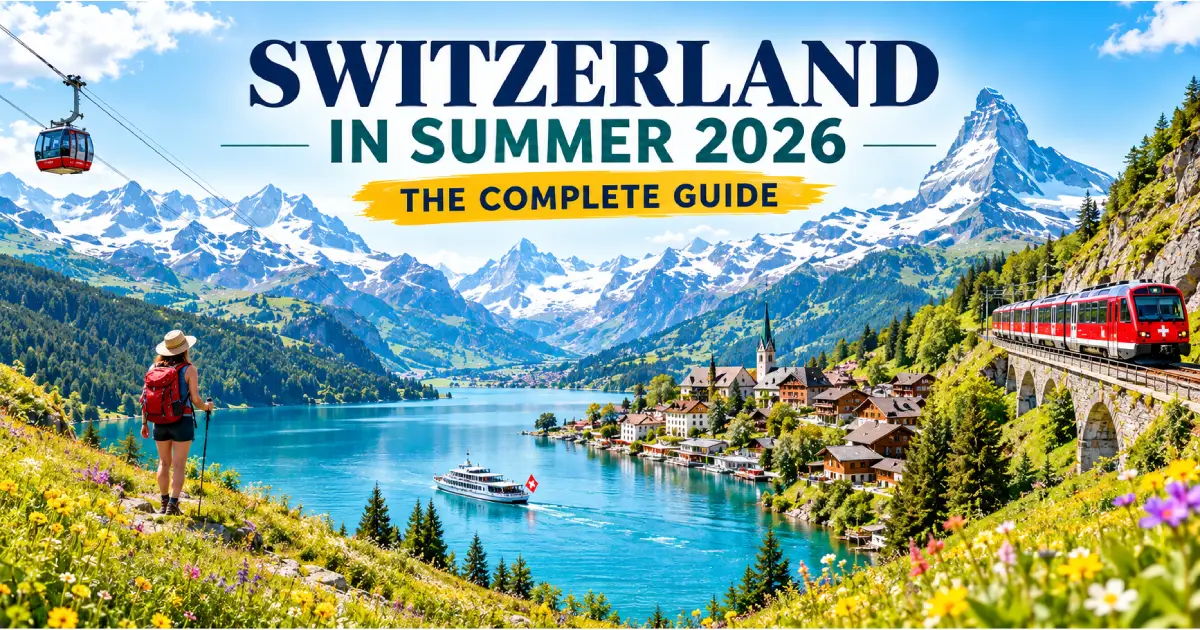
Switzerland in summer is the version of the country that every postcard, every travel magazine feature, and every Instagram account with a Swiss Alps hashtag presents — and for once, the reality consistently meets the expectation. From mid-June through September, the Swiss landscape achieves the specific combination of fully accessible mountain terrain (the hiking trail network above 2,000 meters clear of snow from mid-June, the high-altitude wildflowers at their peak through July and August, and the specific Alpine clarity of the summer mornings providing the mountain panorama conditions that photographers specifically target), warm lake swimming (Lake Geneva reaching 24°C, Lake Brienz’s turquoise water at its most vivid, the Aare River in Bern at its summer-current swimming warmth), and the complete operation of the mountain railway, cable car, and gondola network that makes Switzerland’s high-Alpine world accessible to all fitness levels and ages simultaneously.
But Switzerland’s summer is not monolithic — June, July, August, and September each provide meaningfully different versions of the season. June delivers the waterfall peak (spring snowmelt at its maximum, the Lauterbrunnen Valley’s 72 waterfalls at their most thundering, and the Trümmelbach Falls’ 20,000 liters per second of underground glacial cataract at their most overwhelming), the opening of the high-altitude trail network, and the pre-peak-crowd conditions that July and August don’t maintain. July and August provide maximum lake warmth, maximum daily light hours (Switzerland at 47° north latitude sees sunset after 9 PM in midsummer), the full summer event calendar (the Montreux Jazz Festival, the Locarno Film Festival, the Swiss National Day on August 1), and the maximum visitor concentration that requires specific timing strategy. September delivers arguably the finest single month of the Swiss year — the summer warmth persisting, the crowds retreating with the end of European school holidays, the mountain panoramas in their most crystalline autumn-approaching clarity, and the Bernese Oberland’s larch forests beginning the golden-needle color shift that October completes.
This complete guide covers Switzerland in summer 2026 with the depth and specificity that the season’s richness demands: hiking organized by region and difficulty, lake activities by body of water and experience type, the summer event calendar with practical attendance guidance, the scenic railways in their summer-peak operation, and the month-by-month calibration that allows visitors to maximize their specific summer Switzerland experience rather than simply arriving and hoping.
For complete planning resources, see our Switzerland Travel Guide 2026, Best Places to Visit in Switzerland 2026, Best Hikes in Switzerland 2026, and Swiss Travel Pass Guide 2026.
| Category | Details |
|---|---|
| Summer Season | June–September (peak: July–August) |
| Best Month Overall | September (clarity, reduced crowds, summer warmth, autumn colour beginning) |
| Best for Waterfalls | May–June (maximum spring snowmelt flow) |
| Best for Hiking | July–September (all high-altitude trails clear) |
| Best for Lake Swimming | July–August (warmest water, up to 24°C Lake Geneva) |
| Hottest Locations | Lugano/Locarno (Ticino) and Valais valley floor — up to 35°C in July |
| Mountain Temperatures | 15–22°C at resort altitude (1,600m); 5–10°C at 3,000m+ |
| UV Warning | UV index very high at Alpine altitude — sunscreen essential |
| Peak Crowd Times | July–August weekends; Swiss National Day Aug 1; school holidays |
| Best Jungfraujoch Month | September–October for clarity; June for pre-crowd conditions |
| Swiss Travel Pass Summer | Highest value month: July (all mountain railways at max frequency) |
Temperatures: Valley cities 22–27°C; Alpine resorts 15–20°C; summits 5–12°C Crowd level: Medium (increasing through the month) Prices: Below peak — booking ahead recommended but not critical for most destinations Special character: Waterfall maximum, wildflower opening, trail network recently cleared
June is Switzerland’s finest shoulder month — the specific combination of the spring snowmelt’s maximum waterfall flow (the Lauterbrunnen Valley at its most thundering, the Trümmelbach Falls underground cataracts at 20,000 liters per second, and the Staubbachfall’s 297-meter free fall at its most voluminous), the opening of the high-altitude trail network (most Swiss hiking trails above 2,000 meters clear of snow by mid-June, the specific freshness of newly snow-free terrain with the first wildflowers appearing in concentrated late-snow-melt botanical succession), and the pre-peak visitor conditions (the July–August crowd concentration not yet at full intensity, the mountain railway queuing minimal compared to July, and the accommodation booking pressure manageable with 4–6 weeks’ advance notice rather than the months-ahead requirements that August demands).
June-specific highlights:
Temperatures: Valley cities 26–32°C; Alpine resorts 18–24°C; summits 8–15°C Crowd level: Very High Prices: Peak — book everything 3–5 months ahead Special character: Maximum light hours, lake swimming warmest, full Swiss summer event calendar
July is Switzerland at its fullest and most crowded — the maximum daily light hours (sunset approaching 9:15 PM at the summer solstice on June 21, still well after 9 PM through July’s first weeks), the lake temperatures at their annual warmest (Lake Geneva approaching 24°C, Lake Brienz at 20–22°C, Lake Lucerne at 19–21°C, the Aare River in Bern at 18–20°C), the complete mountain railway network at maximum summer frequency, and the international visitor concentration at its annual peak all occur simultaneously.
Timing strategy for July: The July visitor volume creates specific management challenges at the most popular attractions — the Jungfraujoch, the Harder Kulm funicular, and the Château de Chillon all at their maximum crowding during July’s midday hours. The consistent early-morning solution: arriving at the most popular destinations before 9 AM (the Jungfraujoch Good Morning Ticket first-train arrival by 9:00–9:30 AM, the Harder Kulm first funicular, the Bachalpsee reflection lake before the afternoon wind develops) consistently provides the best conditions at every mountain destination while the mass tourist flow has not yet begun.
July summer events (see Summer Events section below for full detail):
Temperatures: Valley cities 26–32°C (hotter in the Valais and Ticino); Alpine resorts 17–23°C Crowd level: Very High (school holidays across most of Europe) Prices: Peak season maximum Special character: Lake warmest, Swiss National Day, Locarno Film Festival
August is Switzerland’s warmest month and its most specifically European-tourist-concentrated — the school holiday periods across Germany, France, the UK, the Netherlands, and Scandinavia all overlapping in August to create the maximum visitor concentration of any year. The specific August character: the lakes at their warmest (the optimal swimming conditions that the July temperatures begin but August peaks), the Ticino (Lugano, Locarno) at its most Mediterranean with Lago Maggiore temperatures reaching 27–28°C, and the two most important Swiss summer cultural events (the Swiss National Day on August 1 and the Locarno Film Festival in the first two weeks of August) providing the most concentrated single-month event calendar.
August 1 — Swiss National Day: Switzerland’s National Day (commemorating the 1291 Federal Charter that is the founding document of the Swiss Confederation — the date is historically contested by scholars but politically accepted since the 19th century as the symbolic founding) is celebrated with lakeside fireworks (Zurich’s fireworks over Lake Zurich, Lucerne’s over Lake Lucerne, Bern’s over the Aare River, and the most spectacular of all — the double lake fireworks visible from the Interlaken Höhematte meadow, where Lake Thun and Lake Brienz both catch reflection simultaneously), beacon fires on the surrounding summits (the specific Swiss tradition of lighting fires on Alpine summits visible from the valleys below, the chains of summit fires visible across multiple cantons on a clear National Day evening), and the general civic celebration that makes August 1 the single most festive single day in the Swiss civic calendar.
The best National Day positions:
Temperatures: Valley cities 20–26°C; Alpine resorts 12–18°C; summits 2–8°C Crowd level: Medium (declining rapidly from early September onward as European schools resume) Prices: Beginning to reduce from peak — 10–25% below July–August equivalents in most properties Special character: Best clarity, harvest season, autumn color beginning, most rewards with least crowding
September is the month that experienced Switzerland visitors most consistently recommend over the summer peak — the specific combination of the continued warmth (September temperatures are essentially equivalent to June’s, and September’s specific Golden September weather pattern [the persistent high-pressure systems that frequently settle over the Alps in September, delivering extended periods of warm, clear weather with exceptional mountain visibility] is legendary among Swiss outdoor enthusiasts), the dramatically reduced visitor concentration (the European schools’ September return removing the largest single visitor-generating demographic), and the first signs of the autumn transformation (the Bernese Oberland’s high-altitude larch forests beginning to turn golden in the second half of September, the grape harvest beginning in the Lavaux and other Swiss wine regions from mid-September, and the Appenzell Alpabzug [the cattle descent from the summer Alpine pastures — decorated cows with enormous cowbells descending the mountain roads to the valley farms] occurring from mid-September through mid-October).
September-specific highlights:
Männlichen Ridge Walk: 6 km, 1.5–2 hours, easy-moderate — the most consistently recommended single day hike in Switzerland, the Eiger-Mönch-Jungfrau filling the southern view throughout. Access: Grindelwald-Männlichen gondola (50% Swiss Travel Pass). See Best Hikes guide for full detail.
Schynige Platte to First: 16 km, 5–6 hours, strenuous — the finest full-day Bernese Oberland ridge traverse, free with Swiss Travel Pass for the Schynige Platte ascent (the rack railway from Wilderswil) with 50% discount on the First gondola descent. Available July–September.
Lauterbrunnen Valley Floor Walk: 12 km, 2.5–3 hours, easy — the most accessible significant valley walk in Switzerland, the 72 waterfalls descending on both sides throughout, the Trümmelbach Falls (CHF 13) the essential addition. Available year-round but most dramatic June for maximum flow.
Eiger Trail: 6.8 km, 3 hours, moderate — the trail running along the base of the Eiger’s north face between Eigergletscher and Alpiglen, the closest non-climbing approach to the north face available. Wengernalpbahn access, fully included Swiss Travel Pass. June–October.
Five Lakes Walk (Fünf-Seen-Wanderung): 9.6 km, 4–5 hours, moderate — Switzerland’s most celebrated single day hike, five lakes each reflecting the Matterhorn at different angles. Sunnegga funicular access (50% Swiss Travel Pass). June–October; morning departure essential for Stellisee reflection.
Schwarzsee to Zermatt via Zmutt: 8 km, 2.5–3 hours, moderate — the most intimate ground-level Matterhorn walk, the western face visible throughout the Zmutt Valley descent. Cable car to Schwarzsee (50% Swiss Travel Pass). June–October.
Haute Route: 180 km, 10–14 days, strenuous — the greatest long-distance Alpine trek, from Chamonix to Zermatt via the full Valais 4,000-meter peak zone. July–September only. SAC hut system required.
Via Engiadina: 90 km (various day sections), easy–moderate — the Upper Engadin lake-chain traverse connecting Maloja with Zernez through the UNESCO Biosphere. PostBus access (Swiss Travel Pass covered). June–October.
Muottas Muragl Philosophers’ Path: 8 km, 2.5 hours, moderate — the high-altitude plateau traverse above the Engadin with the complete lake chain visible below throughout. Funicular access (50% Swiss Travel Pass). June–October.
Piz Languard: 6 km return from Pontresina cable car mid-station, 2.5 hours return, strenuous — the highest accessible summit in the immediate St. Moritz area (3,262m), the Bernina massif at eye level. July–September.
Rigi Panorama Walk: 10–15 km (various circuits), moderate — Europe’s first mountain railway access (50% Swiss Travel Pass), the 360-degree Lake Lucerne panorama, Mark Twain’s historical walking ground. Year-round, best May–October.
Pilatus Tomlishorn and Summit Trails: 2–4 km (various), moderate–strenuous — the trails around the Pilatus Kulm summit (2,132m) providing the most varied ridge walking accessible from the Lucerne area. May–November.
Switzerland’s lakes are among Europe’s finest for summer swimming — not merely the touristically celebrated visual backdrop but genuinely warm, clean, and specifically beautiful bodies of water whose specific mineral compositions, depths, and surrounding landscapes create swimming experiences of genuinely distinct character.
Water temperature: 22–24°C in July–August | Best locations: Lausanne-Ouchy (the Vidy Beach, free public access), Geneva Plage (formal lido, CHF 6), Nyon lakefront, various small beach areas along the northern shore | Special character: The largest Alpine lake in Europe, the Lavaux vineyards visible above the northern shore throughout, the French Alps across the water on clear days
Lake Geneva’s exceptional size (73 km long, 14 km wide at maximum) means its thermal mass retains summer heat longer than smaller Alpine lakes — the warmest temperatures arriving in late July and persisting through August and into September’s first weeks. The specific Lavaux lake swim (entering the water at one of the small public beach areas below the UNESCO vineyard terraces, the vine rows directly above the swimmer’s head and the lake surrounding on all other sides) is the most specifically beautiful single Swiss lake-swimming context.
Practical tip: The Lausanne Ouchy lakefront (15 minutes from Lausanne HB by Métro M2, covered by Swiss Travel Pass) provides the most accessible Lake Geneva public swimming from any Swiss-French city center — the Vidy Beach area (west of Ouchy, free public access) being the most specifically local rather than tourist-facing swimming location.
Water temperature: 20–22°C in July–August | Best location: Iseltwald village (the famous turquoise water, 30 min by BLS steamer from Interlaken Ost, Swiss Travel Pass covered) | Special character: The most vivid turquoise Alpine lake water in Switzerland — the glacial mineral content creating a specifically intense blue-green that differs from every other Swiss lake’s coloration
Lake Brienz’s turquoise is genuinely more vivid than any comparable Swiss lake — the specific mineral suspension from the Aar and Lütschine glacial meltwater creating the color that makes the Iseltwald jetty photograph Switzerland’s most reproduced single lake composition. Swimming in the turquoise water from the Iseltwald shore (the sensation of the color surrounding the swimmer from below rather than appearing as a surface from above) transforms the postcard image into a three-dimensional physical encounter.
Water temperature: 19–21°C in July–August | Best location: Brunnen (at the Urnersee arm’s northern entrance, 45 min by SGV steamer from Lucerne, Swiss Travel Pass), Weggis (on the Rigi’s lake shore) | Special character: The most geographically dramatic Swiss lake — the four arms and the surrounding pre-Alpine peaks creating a constantly varied visual as any boat traverses the lake
Lake Lucerne’s specific swimming character: the water is cold earlier in the season than the larger lakes (the narrower arms warming more slowly than the broader Lake Geneva basin) but provides swimming in geological scenery of specific dramatic quality — the lake’s four-armed shape visible only partially from any single swimming position, the surrounding mountains pressing close to the water in the narrow Urnersee arm.
Water temperature: 18–20°C in July–August | Access: Multiple entry points along the Aare River through Bern | Special character: River swimming — floating downstream with the current (3 km/h) without swimming effort, the Old Town visible from the water level, the medieval city’s cliff edge above
The Aare river swimming in Bern (see Things to Do in Bern for full practical detail) is Switzerland’s most specifically social summer outdoor experience — the combination of the river current (carrying swimmers downstream without effort), the Old Town’s cliff above (the medieval city visible from the water in a perspective unavailable from the riverbank), and the hundreds of simultaneous Bern residents using the river as a daily evening routine creates an urban river culture specific to this city.
Water temperature: 26–28°C in July–August | Best location: Lido di Locarno, Ascona lakefront, Brissago Islands | Special character: Switzerland’s warmest lake, subtropical microclimate, palm trees, Italian cultural environment
Lake Maggiore’s water temperature (26–28°C in peak summer — 4–6°C warmer than the northern Alpine lakes at the same time of year) creates the most comfortable sustained swimming in Switzerland, the warmth allowing extended afternoon lake immersion without the cold-water management that northern lake swimming requires. The Ticino’s specific lakeside character (the Italian language, the palm trees, the Ticinese architecture) creates a swimming environment more reminiscent of Lake Como than of Lake Zurich.
Caves Ouvertes / Open Cellar Weekend (late May–early June): Lavaux and La Côte wine region open-cellar weekend — virtually every wine producer in both regions opens their cave for free public tasting simultaneously, the single most accessible annual entry to Swiss wine culture. Check cavesouvertes.ch for 2026 exact dates.
Zürich Street Parade Preview: The Street Parade preparation infrastructure and satellite events begin appearing in Zurich from June — the specific techno-parade culture that the August event concentrates is detectable from June’s advance events.
Montreux Jazz Festival (early–mid July): One of the world’s most prestigious and most specifically atmospheric music festivals — the Piazza Grande equivalent open-air concerts (the Stravinski Auditorium [4,500 capacity] and the Miles Davis Hall [1,700 capacity] for ticketed shows; multiple free outdoor stages throughout the festival area for free). Check montreuxjazzfestival.com for 2026 dates and program. Accommodation in Montreux books out months ahead for festival weeks.
Zurich Street Parade (mid-August): Switzerland’s largest single annual public event — the techno and electronic music parade through the Zurich lakefront (approximately 1 million attendees, the specific combination of the parade vehicles, the lakefront setting, and the scale creating an event unlike anything else in Switzerland). August timing varies — check zurichstreetparade.com for 2026 exact date.
Verbier Festival (late July): The Verbier Festival (one of Europe’s most significant summer classical music festivals, held in the mountain resort of Verbier in the Valais — the combination of internationally significant classical performances [the festival regularly features the world’s finest classical soloists and conductors] and the mountain resort setting [the concerts held in the specific Salle des Combins and various other Verbier venues] creating a music festival of unusual atmospheric quality). Check verbierfestival.com for 2026 program.
Swiss National Day (August 1): See the detailed August section above — the most specifically Swiss single annual event, the lakeside fireworks, the summit beacon fires, and the general civic celebration creating the year’s most distinctly Swiss experiential moment.
Locarno International Film Festival (early–mid August): One of the world’s oldest major film festivals (since 1946), the Piazza Grande’s 8,000-seat open-air cinema the most specifically extraordinary outdoor cinema format available at any film festival globally. Check locarnofestival.ch for 2026 exact dates. Accommodation in Locarno books out months ahead.
National Rowing Regatta (Lucerne, early July): The World Rowing Cup and various international rowing events on Lake Rotsee adjacent to Lucerne — the finest rowing venue in Switzerland, the compact lake providing clear water-level spectating from the entire shoreline.
Zurich Film Festival (late September–early October): Switzerland’s most internationally attended film festival after Locarno — the Zurich Film Festival draws major international film premieres and director appearances to the Zurich cinema circuit, the specific combination of urban festival atmosphere and cinema culture creating a distinctly different festival experience from Locarno’s outdoor summer format. Check zff.com for 2026 program.
Expovina Wine Fair (October): The Zurich wine fair held on a fleet of moored ships on Lake Zurich — the specific “wine ships” format (the fair’s exhibitors arranged across the decks of the moored vessels, the lake visible from every position) creating the most specifically Swiss-lakeside wine tasting event available anywhere. Check expovina.ch for 2026 exact dates.
Menznauer Lauberhornrennen and Various Alpine Village Festivals: September and October see multiple traditional Alpine village festivals throughout Switzerland — the Älpenfest events (celebrating the summer Alpine season’s end, the cheese production, and the Alpabzug cattle descent tradition), typically free public events of specific regional character. Appenzell Tourism (appenzell.ch) publishes the current Alpabzug calendar annually.
All Swiss scenic railway services operate at their maximum summer frequency in July and August — the Glacier Express, Bernina Express, GoldenPass Express, and Gotthard Panorama Express all running daily or more frequently, the mountain rack railways (Pilatus-Bahn, Rigi railways, Schynige Platte, Jungfrau Railway network) at maximum capacity, and the lake steamers (Lake Lucerne SGV, Lake Geneva CGN, BLS Lake Thun and Lake Brienz) at their full Belle Époque fleet operation.
Summer-specific scenic railway priorities:
The Glacier Express in summer: The Goms Valley’s wildflowers (June–July, the specific Alpine meadow botanical diversity at its peak) and the Rhine Gorge (the Ruinaulta limestone cliff vegetation in its summer green providing the most specifically lush version of the gorge’s characteristic landscape) make summer the most botanically colorful Glacier Express season. Book seat reservations (CHF 13 mandatory, 2nd class) at glacierexpress.ch — the summer peak season books window seats 4–8 weeks ahead.
The Bernina Express in summer: The Morteratsch Glacier’s ice face against the summer green of the lower valley (the color contrast between the blue-white glacier and the summer alpine meadow providing the most visually dramatic Bernina summer landscape) and the Brusio Circular Viaduct surrounded by its summer vineyard terracing at their greenest make summer the most specifically colorful Bernina Express season. Book at rhb.ch — peak summer seats fill 3–6 weeks ahead.
The GoldenPass Express in summer: The Simmental’s pastoral character at its most specifically summer-Swiss (the characteristic Bernese Oberland farmhouses surrounded by their summer grazing meadows, the cows with their cowbells visible from the train windows throughout the valley section) and the Lavaux vineyard approach (the train skirting the northern Lake Geneva shore with the UNESCO vine terraces above the water visible throughout the Montreux approach) make summer the most specifically agricultural and most botanically complete GoldenPass season.
Switzerland’s summer mountain weather follows a specific and highly reliable daily pattern that every summer hiking visitor should understand:
Morning: Clear, best visibility, lowest temperatures, minimum wind. The period from sunrise to approximately 11 AM–12 PM provides the finest mountain viewing and hiking conditions of the day.
Midday: Warming temperatures begin to generate thermal activity in the valley floors — cumulus cloud development begins to appear above the summits as the thermal columns rise from the heating terrain below.
Afternoon: The thermal activity peaks between approximately 2–4 PM, generating the afternoon convective thunderstorms that characterize alpine summer weather — these storms can arrive within 20–30 minutes of apparently clear conditions, bringing lightning, heavy rain, and hail. Any exposed high-altitude ridge or summit position during these storms carries genuine lightning risk.
Management strategy: Schedule high-altitude hiking for the morning (departure by 7–8 AM, descent from exposed ridges and summits by 1–2 PM maximum) and lower-altitude activities for the afternoon (valley walking, lake swimming, village exploration). The afternoon thunderstorm pattern is the primary reason that the Jungfraujoch, the Matterhorn Glacier Paradise, and any exposed Swiss summit should be visited on the morning Good Morning Ticket departure rather than the early-afternoon trains.
The UV index at Swiss Alpine altitudes (the Jungfraujoch at 3,454m, the Matterhorn Glacier Paradise at 3,883m, and virtually all cable car summits above 2,500m) is severe in summer — the reduced atmospheric filtering at altitude combined with the reflection from snow surfaces (which reflects 80–90% of UV radiation, amplifying total UV exposure significantly) creates burning conditions in as little as 20 minutes of unprotected exposure in July–August.
Non-negotiable sun protection for summer mountain days:
Switzerland’s mountain springs, streams, and municipal tap water are among the world’s purest — virtually all Swiss mountain spring sources are safe to drink without treatment (the specific geological characteristics of Swiss Alpine limestone and granite providing natural filtration), and Swiss tap water (Hahnenwasser) is of exceptional quality in all cities and towns. Carrying a refillable water bottle and refilling from marked mountain springs (the Trinkwasser [drinking water] designation appears on springs confirmed safe for drinking) or from any restaurant tap eliminates the need for bottled water and reduces the plastic waste that Alpine tourism creates.
Switzerland’s Alpine botanical diversity is among the highest of any comparably-sized European territory — the intersection of the Alpine, sub-Mediterranean, and Continental climate zones creating botanical zones of exceptional richness within short vertical distances.
June (1,500–2,000 meters): The immediate post-snow botanical succession — the first Alpine gentians (Gentiana verna, the specific vivid blue of early-season gentians against the still-brown last-year’s grass), the mountain avens (Dryas octopetala, the white eight-petalled flower that colonizes the most exposed recently-deglaciated terrain), and the various Soldanella species (the “snowbell” flowers that push through the remaining snow margins creating the most specifically Alpine botanical image of any early-season wildflower).
July (2,000–2,500 meters): The full high-altitude meadow bloom — the Arnica montana (the yellow daisy-like medicinal herb whose abundance above 2,000m creates the characteristic summer meadow color of the Bernese Oberland and Graubünden), the Alpine asters, the various Saxifraga species on the rocky terrain, and on south-facing slopes the Edelweiss (Leontopodium nivale — the specific woolly white Alpine flower that international visitors specifically seek, most reliably found on limestone rockface terrain between 1,800–2,500m).
August (2,000–3,000 meters): Late-season high-Alpine botanics — the specific cushion-plant community of the highest accessible terrain (Androsace, Minuartia, and Silene species creating the specific botanical carpet of the high-Alpine zone), the gentians transitioning from the early-season blue to the late-season yellow and purple species, and the first signs of the botanical year’s end (the high-altitude plants setting seed for the following year’s growth).
Schynige Platte Alpine Botanical Garden: The most specifically educational single Alpine botanical encounter available — 600+ Swiss mountain plant species in the University of Bern’s maintained collection above 1,900 meters (Schynige Platte rack railway from Wilderswil, adjacent to Interlaken Ost — fully included in Swiss Travel Pass). The garden is specifically designed for educational botanical engagement rather than decorative gardening — the labeling, the ecological groupings, and the staff’s expertise create the finest single resource for understanding Swiss Alpine flora in its regional context.
About Travel Tourister Travel Tourister’s destination specialists have experienced Switzerland across every summer month — from June Lauterbrunnen waterfall-peak valley walks and Jungfraujoch first-train June clarity sessions through July Iseltwald Lake Brienz turquoise swims and Montreux Jazz Festival Piazza Grande evenings to August 1 Interlaken Höhematte National Day fireworks and Locarno Piazza Grande Film Festival August nights to September Bachalpsee dawn Eiger reflections and Appenzell Alpabzug decorated-cattle-descent roadside mornings — to deliver the most complete and practically honest Switzerland summer guide for 2026 visitors.
Posted By : Vinay
Latest Article
2nd Floor, 39, Above Kirti Club, DLF Industrial Area, Kirti Nagar, New Delhi, Delhi 110015



Travel Tourister is a leading Travel portal where we introduce travellers to trusted travel agents to make their journey hasselfree, memorable And happy. Travel Tourister is a platform where travellers get Tour packages ,Hotel packages deals through trusted travel companies And hoteliers who are working with us across the world. We always try to find new and more travel agents and hoteliers from every nook and corners across the world so that you could compare the deals with different travel agents and hoteliers and book your tour or hotel with the one you have chosen according to your taste and budget.
Copyright © Travel Tourister, India. All Rights Reserved

 Call
Call Enquiry