Published on : 14 Sep 2026
By Travel Tourister | Updated Sep 2026
Switzerland’s cities are among Europe’s most underestimated urban destinations — a country whose international tourism identity is dominated by mountains, glaciers, and Alpine railways to such a degree that the cities often receive only the transit attention that visitors pass through on the way to and from the Jungfraujoch, Zermatt, and the Bernina Express. This underestimation is compounding: Zurich’s specific combination of a preserved medieval Old Town, world-class art institutions (the Kunsthaus Zurich houses one of the finest Impressionist and modern art collections accessible to the public in Europe), a genuinely cosmopolitan commercial culture, and a lakeside setting of specific beauty is routinely ranked among Europe’s five most liveable cities by quality-of-life surveys — a ranking that reflects real urban quality rather than marketing. Geneva’s specific international character (the UN European headquarters, the International Red Cross, 40+ international organizations in a single lakeside city of 200,000 residents) creates the most genuinely cosmopolitan small city in Europe. Basel’s museum density (40+ museums per square kilometer, the highest concentration on Earth) and the Art Basel fair’s annual concentration of the global contemporary art world make it Europe’s most specifically art-focused small city. And Bern’s UNESCO-designated Old Town (the most complete medieval city center in Switzerland, six kilometers of covered arcades, the Zytglogge astronomical clock, and the Bear Park) is consistently one of the most rewarding single days available in any Swiss destination.
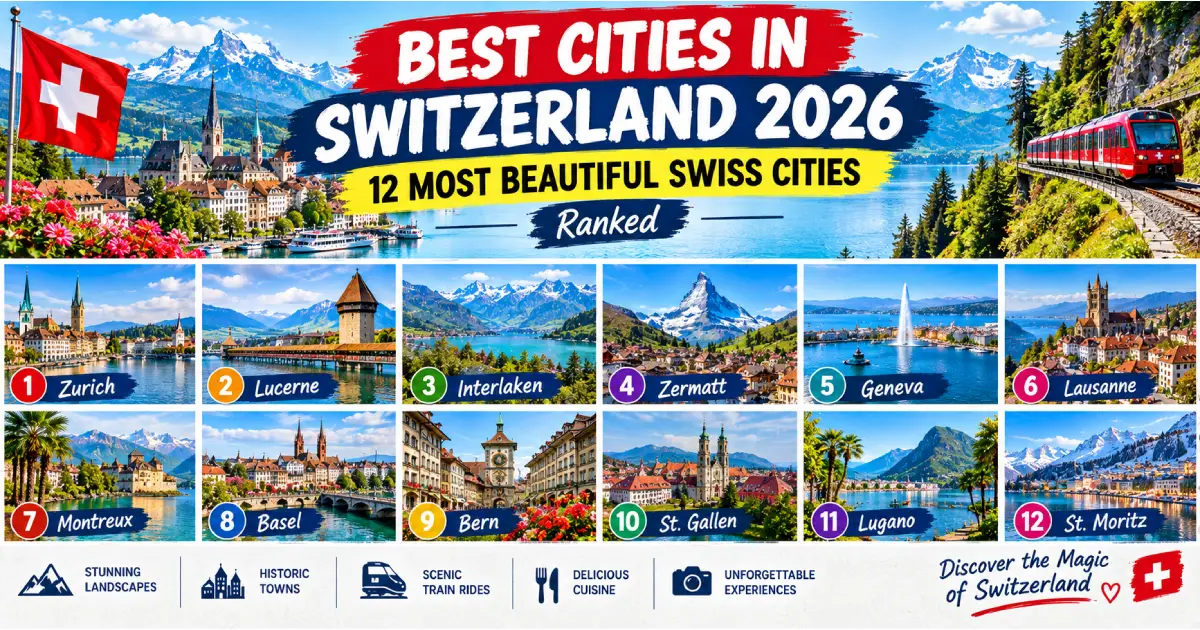
This guide ranks and describes the 12 best cities in Switzerland for 2026 visitors — not by population or economic significance but by their specific value as travel destinations: the specific experiences each provides that other Swiss cities don’t, the combination of accessibility and reward that makes some Swiss cities genuinely essential stops and others specifically worthwhile additions for longer itineraries.
For complete city guides, see our dedicated articles on Zurich, Geneva, Lucerne, Basel, Bern, Lausanne, Lugano, Locarno, and Montreux.
| Rank | City | Region | Best For | Recommended Stay |
|---|---|---|---|---|
| 1 | Zurich | German-Swiss | Art, lake, Old Town, nightlife | 2 nights |
| 2 | Geneva | French-Swiss | International culture, Lake Geneva, Old Town | 1–2 nights |
| 3 | Lucerne | Central Swiss | Chapel Bridge, lake, Pilatus access | 1–2 nights |
| 4 | Basel | German-Swiss | Art museums, Fondation Beyeler, Rhine, carnival | 1–2 nights |
| 5 | Bern | German-Swiss | UNESCO Old Town, arcades, Paul Klee, Aare swimming | 1 night |
| 6 | Lausanne | French-Swiss | Olympic Museum, Art Brut, Lavaux, night watch | 1 night |
| 7 | Lugano | Italian-Swiss | Lake Maggiore, Mediterranean character, Monte San Salvatore | 1–2 nights |
| 8 | Montreux | French-Swiss | Château de Chillon, Jazz Festival, lake promenade | 1 night |
| 9 | Locarno | Italian-Swiss | Film Festival, Lago Maggiore, Madonna del Sasso | 1–2 nights |
| 10 | Interlaken | Bernese Oberland | Jungfrau gateway, lakes, adventure sports | 2–3 nights |
| 11 | Zermatt | Valais | Matterhorn, car-free, skiing, car-free | 2–3 nights |
| 12 | St. Moritz | Graubünden | Luxury skiing, Engadin lakes, Bernina Express | 1–2 nights |
Note: Interlaken, Zermatt, and St. Moritz are resort towns rather than cities in the conventional sense — included here because they function as urban overnight bases for the surrounding Alpine landscape.
Population: 450,000 (city); 1.4 million (greater) | Language: Swiss German | Lake: Lake Zurich | Airport: Zurich Airport (ZRH) — Switzerland’s primary international hub | Recommended stay: 2 nights minimum
Zurich is Switzerland’s largest city and its most complete urban destination — the specific combination of a preserved medieval Old Town (the Altstadt’s twin-towered Grossmünster, the Fraumünster’s Chagall windows, and the guild houses of the Limmatquai creating the most historically layered Swiss city fabric), a world-class art museum landscape (the Kunsthaus Zurich — the finest encyclopedic art museum in Switzerland, with the most comprehensive Impressionist and modern collection in any Swiss public institution), a genuinely cosmopolitan commercial culture (Zurich’s status as the world’s fourth largest financial center, hosting the headquarters of UBS and Swiss Re among hundreds of financial institutions, creating the specific international professional culture that the Bahnhofstrasse’s luxury retail and the Seefeld district’s sophisticated restaurant scene serve), and a lakeside setting of exceptional quality (Lake Zurich’s 40-kilometer length, the Quaianlagen promenade, and the specific quality of the swimming facilities at Zürichhorn and the lake baths).
What makes Zurich irreplaceable:
The specific Zurich pleasure that no other Swiss city provides: the combination of genuine urban sophistication (the Zurich West district’s converted industrial culture — the Viadukt’s restaurant and bar strip, the Prime Tower, and the specific energy of a neighborhood where a Freitag recycled-bag flagship tower coexists with a modernist high-rise hotel) with immediate natural access (the Uetliberg hill [877 meters, 45 minutes by SZU S-Bahn from Zurich HB, free with Swiss Travel Pass] provides the finest single elevated city view in Switzerland — the entire lake visible, the Alps on clear days, and the specific urban-to-nature transition that takes less than 1 hour from the financial center).
Key Zurich experiences:
Best time to visit: May–September for the lake and outdoor pleasures; year-round for the Kunsthaus and Old Town; Christmas for the five simultaneous Christmas markets (the Christkindlimarkt at the Hauptbahnhof is Switzerland’s most spectacular indoor market, under the station’s glass roof).
Insider tip: The ZSG lake steamers (fully covered by Swiss Travel Pass) departing from the Bürkliplatz provide a complete Lake Zurich circuit (the “Grosse Rundfahrt” — approximately 1.5 hours each way to the lake’s southern end at Rapperswil) that gives the most specifically Swiss urban-and-lake combined experience available from the city, the Alps appearing progressively more distinctly as the steamer moves south toward the lake’s alpine end.
Population: 210,000 (city); 600,000 (greater Geneva, including French cross-border area) | Language: French | Lake: Lake Geneva (Lac Léman) | Airport: Geneva Airport (GVA) | Recommended stay: 1–2 nights
Geneva is Europe’s most genuinely international city — the headquarters of the United Nations European operations, the International Red Cross and Red Crescent, the World Trade Organization, the World Health Organization, and over 40 other international organizations in a city of 210,000 residents (approximately 40% of whom are non-Swiss nationals at any given time, making Geneva the most internationally diverse Swiss city by demographic proportion) creates an urban atmosphere of specifically concentrated internationalism that Brussels and The Hague approximate but that no other European city of comparable size achieves.
What makes Geneva irreplaceable:
The specific Geneva experience unavailable elsewhere in Switzerland: the Palais des Nations guided tour (the UN European Headquarters — the grand Art Deco to modernist complex that has hosted international diplomacy since 1936, the Council of Human Rights chamber, and the Assembly Hall contextualizing Geneva’s unique role in global governance), the Bains des Pâquis pier fondue (moitié-moitié fondue on a 1930s lake bath house’s wooden pier extending over Lake Geneva, CHF 20–25, free entry — one of Switzerland’s most specifically democratic luxury experiences: excellent fondue with a lake view at genuinely affordable prices), and the Old Town’s Place du Bourg-de-Four (Geneva’s most specifically atmospheric historic square, the most Italian-feeling public space in French-speaking Switzerland, the restaurant terraces on three sides creating an evening atmosphere genuinely different from any other Swiss city square).
Key Geneva experiences:
Best time to visit: April–September for the lakefront and Jet d’Eau; December for the Geneva Christmas market (the largest in Switzerland by some measures); year-round for the museums and international organization visits.
Population: 82,000 (city); 220,000 (greater) | Language: Swiss German | Lake: Lake Lucerne (Vierwaldstättersee) | Recommended stay: 1–2 nights
Lucerne is Switzerland’s most immediately photogenic city — the Chapel Bridge (Kapellbrücke, 1333) with its octagonal water tower, reflected in the Reuss River against the snow-capped Pilatus and Rigi mountains, creates the single most consistently reproduced Swiss city image in global tourism media. The combination of the specific lakeside and riverfront setting (the Reuss River flowing through the Old Town before entering Lake Lucerne, the Chapel Bridge spanning the river at the Old Town’s heart, and the lake’s four-armed form providing mountain views in multiple directions from the lakefront) with the ease of mountain access (Pilatus by world’s steepest rack railway plus aerial gondola, Rigi by Europe’s first mountain railway, both with 50% Swiss Travel Pass discount) makes Lucerne one of the highest value-per-day Swiss cities for first-time visitors.
What makes Lucerne irreplaceable:
The Lion Monument (the Löwendenkmal — the 1820 sandstone carving of a dying lion, described by Mark Twain as “the most mournful and moving piece of stone in the world,” commemorating the 786 Swiss Guards killed defending the French royal family in 1792 — a 10-minute visit that connects Lucerne’s specific mercenary military history with Swiss national mythology in a single emotionally immediate image), the SGV lake steamers (the historic paddle steamers operated on Lake Lucerne by the SGV fleet, fully covered by Swiss Travel Pass — the Belle Époque vessels providing the most historically atmospheric lake transit in Switzerland), and the Pilatus Golden Round Trip (the most varied single mountain excursion in Switzerland — boat to Alpnachstad, world’s steepest rack railway to the summit, aerial gondola descent, bus return).
Key Lucerne experiences:
Best time to visit: May–September for the lake and mountain excursions; December for the Lucerne Christmas market (smaller than Zurich’s but more specifically Swiss in character); year-round for the Chapel Bridge and lion.
Population: 180,000 (city); 800,000 (tri-national metropolitan area) | Language: Swiss German (Basel-Deutsch dialect) | River: Rhine | Airport: Euro Airport Basel-Mulhouse-Freiburg (shared with France and Germany) | Recommended stay: 1–2 nights
Basel is Switzerland’s most intellectually serious city — the highest museum density per square kilometer on Earth (40+ museums in a city of 180,000 residents), the Art Basel fair’s annual June concentration of the global contemporary art world, the Rhine swimming tradition (one of Switzerland’s most characteristically urban outdoor summer pleasures — floating downstream in the Rhine’s current with a Wickelfisch [the city’s specific waterproof bag design] carrying clothing and valuables), and the Basel Fasnacht carnival (the three-day, 72-hour early morning Morgenstraich tradition — Switzerland’s most extraordinary annual cultural event and one of Europe’s most atmospheric carnivals).
What makes Basel irreplaceable:
The Fondation Beyeler in Riehen (15 minutes by tram from Basel center — the finest private art collection open to the public in Switzerland, a Renzo Piano building whose natural-light galleries house the most consistently powerful Impressionist and modern art encounter in any single European art institution below the top three museums) and the Vitra Campus in adjacent Weil am Rhein, Germany (the world’s most concentrated collection of significant contemporary architecture on a single site — Zaha Hadid’s first completed building, Frank Gehry’s first European building, and buildings by Tadao Ando, Álvaro Siza, SANAA, Herzog & de Meuron, and Buckminster Fuller all on the same campus).
Key Basel experiences:
Population: 140,000 (city); 430,000 (greater) | Language: Bernese German (Berndeutsch — the most recognizable Swiss-German dialect to non-Swiss ears) | River: Aare | Recommended stay: 1 night (essential stop); 2 nights (to include Aare swimming and Paul Klee)
Bern is Switzerland’s most consistently underrated major city — the federal capital that international visitors most commonly bypass in transit, failing to discover that the UNESCO Old Town (the most architecturally coherent medieval city center in Switzerland, 6 kilometers of continuous covered arcades [the Lauben], the Zytglogge astronomical clock, and the 11 historically significant Renaissance fountains distributed through the arcade streets) provides the single most complete encounter with medieval Swiss civic character available in any Swiss city.
What makes Bern irreplaceable:
The Lauben (the 6 km of continuous covered arcades that line virtually every Old Town street at ground level, making Bern the most weather-protected urban walking experience in Europe — the arcades’ specific vaulted-stone architecture creates a simultaneously outdoor and sheltered street environment of extraordinary quality), the Night Watch tradition (the cathedral’s appointed guardian calling the hour from the tower’s four windows nightly 10 PM–2 AM, in a tradition uninterrupted since the 14th century — the single most extraordinary free cultural experience available in any Swiss city), and the Zentrum Paul Klee (Renzo Piano’s three-wave building housing 4,000+ Klee works — the world’s most comprehensive single-artist museum for any 20th-century Swiss-German artist).
Key Bern experiences:
Population: 140,000 (city); 450,000 (greater) | Language: French | Lake: Lake Geneva | Recommended stay: 1 night
Lausanne is Switzerland’s most academically energetic city — the combined university population of approximately 50,000 students (EPFL, the University of Lausanne, and various other institutions) providing the demographic energy that makes Lausanne’s Flon district, restaurant scene, and cultural programming specifically more vital than the city’s population size would predict. The Olympic Museum (the IOC’s official museum, one of Switzerland’s most visited attractions), the Collection de l’Art Brut (the world’s most important single collection of outsider art — 65,000 works assembled by Jean Dubuffet and donated to Lausanne in 1971), and the Cathedral’s Night Watch tradition (the only city in Switzerland and one of a handful in the world still maintaining a medieval night watchman who calls the hour from the tower, 10 PM to 2 AM nightly) create a cultural landscape of specific distinction.
What makes Lausanne irreplaceable:
The Collection de l’Art Brut (the museum that essentially created the art historical category of outsider art — the Wölfli drawings, the Darger illustrations, and the 65,000-work collection assembled by Dubuffet across a 30-year period), the Lausanne Métro M2 (the world’s longest fully automated urban metro, ascending 245 meters from the Ouchy lakefront to the upper city in 7 minutes — a piece of infrastructure whose technical achievement deserves specific attention), and the Cathedral Night Watch (the guet calling “C’est le guet, il a sonné l’heure” from the four tower windows at 10 PM, 11 PM, midnight, 1 AM, and 2 AM in an uninterrupted 14th-century tradition).
Population: 65,000 (city); 145,000 (greater) | Language: Italian | Lake: Lake Lugano (Lago di Ceresio) | Recommended stay: 1–2 nights
Lugano is Switzerland’s most surprising major city — the Italian-speaking (the only official language is Italian, making Lugano the largest Italian-language city in Switzerland) lakeside city whose Mediterranean microclimate (palm trees, oleanders, and subtropical plants growing outdoors year-round) and Italian civic culture (the Piazza della Riforma’s café culture, the Via Nassa’s fashion retail, and the specific Italian-Swiss piazza atmosphere of the Old Town) create the most complete departure from the German-Swiss city experience available in Switzerland without crossing into the Ticino’s southern Italian-border areas.
What makes Lugano irreplaceable:
Monte San Salvatore (912 meters — the 12-minute funicular ascent from Paradiso providing the finest single elevated view of Lake Lugano’s angular shape, the lake’s branches extending southward into Italy visible in their complete topographic logic from the summit), the Santa Maria degli Angioli church (Bernardino Luini’s 1529 fresco of the Passion of Christ — 17 meters wide, 8 meters high, Switzerland’s single largest fresco surface, a masterwork by a pupil of Leonardo da Vinci that most visitors to Lugano don’t know exists), and the LSC lake boat network (fully covered by Swiss Travel Pass — the Gandria fishing village, the Brissago Islands subtropical botanical garden, and the Morcote medieval village all accessible by boat).
Population: 26,000 (city) | Language: French | Lake: Lake Geneva | Recommended stay: 1 night
Montreux is Switzerland’s most romantic city — the combination of the Mediterranean-climate lakeside promenade (palm trees, oleanders, and the Quai des Fleurs’ year-round flowering display), the Château de Chillon (Switzerland’s most visited historic monument, the 12th-century island castle on Lake Geneva whose specific lakeside-and-mountain composition is the single most photographed medieval Swiss building), the Freddie Mercury statue (the Queen frontman who spent his final productive years in the city, the bronze statue on the promenade becoming one of Switzerland’s most visited free attractions), and the Montreux Jazz Festival (one of the world’s most prestigious and most specifically atmospheric music festivals — the Piazza Grande-equivalent open-air concerts seating 8,000+ under the Ticino stars equivalent available here with 8,000+ under the Vaud night sky).
What makes Montreux irreplaceable:
The Château de Chillon (the island castle where Lord Byron specifically visited in 1816 and carved his signature on the dungeon pillar — the combination of the castle’s extraordinary lakeside position, its architectural completeness, and the Byron connection creating the most historically and aesthetically rich single historic building in French-speaking Switzerland), and the Christmas market (the Montreux Noël — consistently voted among Europe’s finest Christmas markets, the lakeside floating stalls creating a specifically Montreux visual that no other Swiss Christmas market provides).
Population: 16,000 (city); 57,000 (greater) | Language: Italian | Lake: Lake Maggiore (Lago Maggiore) | Recommended stay: 1–2 nights
Locarno holds the Swiss record for annual sunshine hours (2,300+ per year — approximately 60% more than Zurich) and functions simultaneously as a lake resort city and an internationally significant cultural venue. The Locarno International Film Festival (one of the world’s oldest major film festivals, since 1946, the Piazza Grande’s 8,000-seat open-air cinema creating Switzerland’s single most extraordinary annual cultural event in August) and the surrounding Valle Verzasca (the Lavertezzo bridge’s emerald-green river pools, the Verzasca Dam’s GoldenEye bungee jump) make Locarno specifically worthwhile for visitors who want the Ticinese character in its most concentrated form.
Population: 5,500 (permanent) | Region: Bernese Oberland | Lakes: Lake Thun and Lake Brienz | Recommended stay: 2–3 nights
Interlaken is Switzerland’s most consequential single travel planning decision point — the lakeside city between two Alpine lakes whose railway network (the BOB narrow-gauge trains to Grindelwald and Lauterbrunnen, the Schynige Platte rack railway, the Wengernalpbahn to Kleine Scheidegg and the Jungfrau Railway to the Jungfraujoch) provides access to more world-class Alpine destinations from a single base than any other Swiss city. The Höheweg promenade (the Eiger-Mönch-Jungfrau visible across the open Höhematte meadow in a mountain composition of specific grandeur), the adventure sports industry (paragliding, skydiving, canyoning, and white-water rafting all operating from Interlaken bases with established safety records), and the BLS lake steamers on both Lake Thun and Lake Brienz (both fully covered by Swiss Travel Pass) create a destination whose value as a base exceeds its value as a destination in its own right — the precise ratio of gateway function to independent charm that the Interlaken planning decision must weigh.
Population: 5,800 (permanent) | Region: Valais | Access: Train only (car-free since 1947) | Recommended stay: 2–3 nights
Zermatt is the world’s most visually iconic Alpine resort — defined by the Matterhorn’s (4,478 meters) specific pyramidal summit profile that appears above the car-free village’s rooflines from virtually every outdoor position on the main Bahnhofstrasse, creating the most consistently dramatic single-peak-and-village visual composition available in the Alps. The car-free character (private motor vehicles prohibited since 1947, electric taxis and horse-drawn carriages providing the only motorized transport) creates the specific quietness and air quality that differentiates Zermatt from road-accessible equivalents — the silence of a mountain village without engine noise, the stars visible from the village center without light pollution from car headlights, and the specific purity of mountain air uncontaminated by exhaust creating a sensory environment that Grindelwald, Saas-Fee, and the other car-free peers share but that the Matterhorn’s specific visual dominance makes uniquely Zermatt.
Population: 5,000 (permanent) | Region: Graubünden (Upper Engadin) | Language: Romansh (traditional), German (current primary) | Recommended stay: 1–2 nights
St. Moritz is the birthplace of modern winter tourism — Johannes Badrutt’s 1864 wager with British summer guests (that the Engadin winter was beautiful enough to justify a return visit, the bet won decisively and the global luxury ski resort industry launched) created the template that every subsequent Alpine winter resort has modified without improving upon. The specific St. Moritz identity (the White Turf horse racing on the frozen lake in February, the snow polo World Cup on the same lake in January, the Bernina Express’s most glamorous departure point, and the Palace Hotel’s 160-year tradition of hosting the European cultural and financial elite) creates a resort destination whose self-confidence — the quiet assurance of a place that knows it invented something rather than imitating it — is perceptible and distinctive.
The optimal 7-day Swiss city circuit (see our 7-Day Switzerland Itinerary): Zurich (2 nights) → Lucerne (1 night) → Interlaken (2 nights) → Zermatt (1 night) → Geneva (1 night)
This circuit covers Switzerland’s three most essential city-types (German-Swiss cosmopolitan, central-Swiss picturesque, French-Swiss international) alongside the two mountain bases that provide Jungfraujoch and Matterhorn access.
Basel (2 nights) + Zurich (2 nights) + Bern (1 night) + Lausanne (1 night)
This circuit provides the Fondation Beyeler, the Kunstmuseum Basel, the Kunsthaus Zurich, the Zentrum Paul Klee, and the Collection de l’Art Brut — the most concentrated single circuit of world-class art institutions available in any comparable European geographic area.
Lugano (2 nights) + Locarno (2 nights)
The most complete Ticino city circuit — Lake Lugano and Lake Maggiore, the Lungolago and the Piazza Grande, Monte San Salvatore and Madonna del Sasso, the Brissago Islands and the Valle Verzasca, with the Bernina Express connection from St. Moritz making this the natural circuit completion after the Graubünden section of a longer Switzerland itinerary.
Geneva (2 nights) + Lausanne (1 night) + Montreux (1 night)
The Lake Geneva circuit — the Jet d’Eau and Old Town, the Olympic Museum and Night Watch, the Château de Chillon and Jazz Festival — covering the full range of French-Swiss city character from Geneva’s international cosmopolitanism through Lausanne’s academic energy to Montreux’s Belle Époque lakeside romanticism.
About Travel Tourister Travel Tourister’s destination specialists have spent extended time in every city on this list — from Zurich Kunsthaus Giacometti rooms and Geneva Bains des Pâquis pier fondue through Lucerne Kapellbrücke dawn crossings and Basel Rhine summer evening swims to Bern Zytglogge midnight chime positions, Lausanne Art Brut Wölfli drawing hours, Lugano Lungolago camellia mornings, Montreux Château de Chillon dungeon explorations, Locarno Piazza Grande Film Festival evenings, and Zermatt Matterhorn pre-dawn alpenglow positions — to deliver the most practically honest ranked guide to Switzerland’s best cities for 2026 visitors.
Posted By : Vinay
Latest Article
2nd Floor, 39, Above Kirti Club, DLF Industrial Area, Kirti Nagar, New Delhi, Delhi 110015



Travel Tourister is a leading Travel portal where we introduce travellers to trusted travel agents to make their journey hasselfree, memorable And happy. Travel Tourister is a platform where travellers get Tour packages ,Hotel packages deals through trusted travel companies And hoteliers who are working with us across the world. We always try to find new and more travel agents and hoteliers from every nook and corners across the world so that you could compare the deals with different travel agents and hoteliers and book your tour or hotel with the one you have chosen according to your taste and budget.
Copyright © Travel Tourister, India. All Rights Reserved
 Call
Call Enquiry