Published on : 14 Sep 2026
By Travel Tourister | Updated Sep 2026
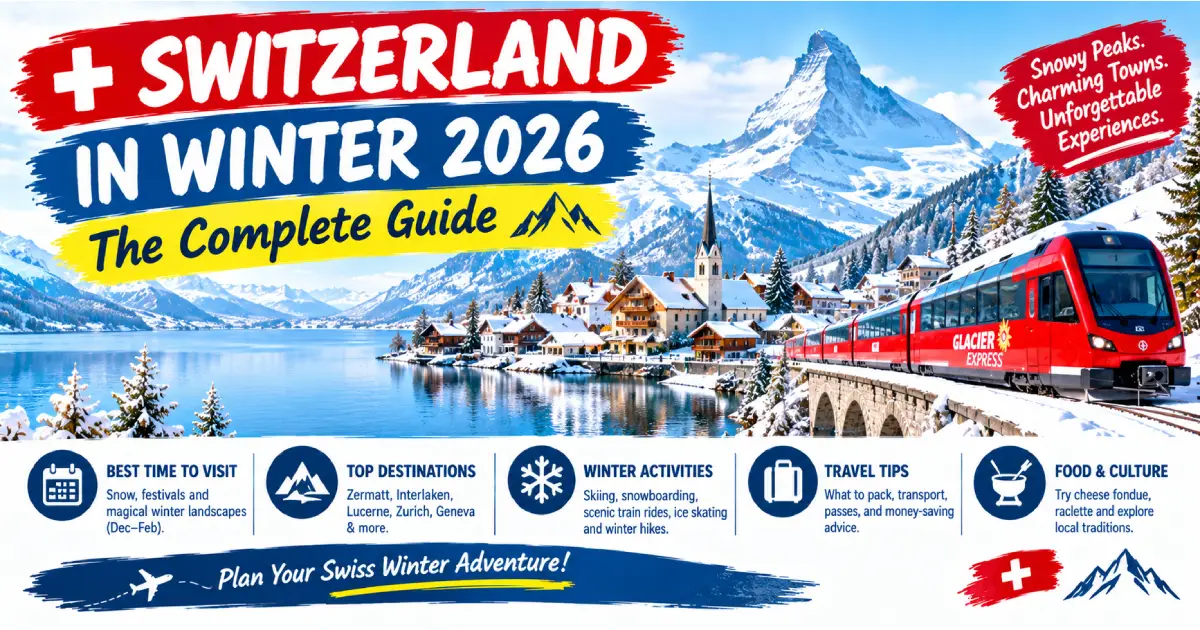
Switzerland in winter is a genuinely different country from Switzerland in summer — not merely the same landscape with snow added, but a fundamentally transformed version of the country whose most celebrated natural elements (the mountains, the lakes, the villages) acquire specific new characters in the cold months that the summer version cannot replicate. The Matterhorn under fresh powder snow with no valley haze, the Jungfraujoch’s Aletsch Glacier in January’s crystal-clear air at -20°C, the Bernese Oberland’s car-free villages (Wengen, Mürren, Zermatt) silent under snowfall without summer’s international crowd concentration, and the Swiss Christmas market tradition (the most architecturally authentic and most specifically Swiss in character of any Christmas market tradition in the German-speaking world) together create a winter travel proposition that Switzerland’s summer-dominated tourism marketing consistently undersells.
Winter in Switzerland spans three distinct periods with meaningfully different characters: the Christmas and New Year period (December 20 through January 3 — the festive peak, maximum prices, maximum holiday energy, the Christmas markets at their finest in the first two weeks of December before they close on December 24, and the New Year transitions in cities and mountain resorts of specific Swiss character), the deep winter ski season (January through March — the snowpack at its established maximum, the ski areas at full operation with optimal snow conditions, the mountain resort accommodation at peak but without the Christmas holiday premium, and the specific winter Alpine atmosphere at its most consistently dramatic), and the shoulder winter period (November and late March/April — the quietest and most affordable, with beautiful clarity, reduced crowds, and the specific pleasures of late-season or pre-season mountain environments without the full resort infrastructure operating).
This complete guide covers every dimension of Switzerland in winter for 2026 visitors: the skiing (organized by resort character rather than alphabetically, allowing genuine comparison between the major ski areas’ specific identities), the Christmas markets (with the honest assessment of which markets are worth the specific journey and which are tourist-facing approximations of the tradition), the winter city pleasures (the fondue seasons, the winter thermal spa culture, and the specific urban pleasures that winter concentrates), and the non-skiing mountain experiences (the Jungfraujoch in winter clarity, the Glacier Express in snow, and the winter hiking that Switzerland’s prepared Winterwanderweg networks provide in most Alpine villages).
For complete planning, see our Switzerland Travel Guide 2026, Swiss Travel Pass Guide 2026, Best Time to Visit Switzerland 2026, and Jungfraujoch: Complete Visitor Guide 2026.
| Category | Details |
|---|---|
| Ski Season | December–April (peak snowpack January–March) |
| Christmas Markets | Late November–December 24 |
| Best Winter Cities | Zurich, Geneva, Basel, Bern (Christmas markets); Lucerne (year-round charm) |
| Best Ski Resorts | Zermatt, Verbier, St. Moritz, Grindelwald, Mürren, Davos |
| Best Non-Ski Winter | Jungfraujoch, Harder Kulm, Glacier Express, Appenzell |
| Average Temperatures | Valley cities: 0–5°C; Alpine resorts: -5 to -15°C; Summit: -15 to -25°C |
| Winter Mountain Clothing | Down jacket, thermal layers, waterproof shell essential; extra layers for summit visits |
| Swiss Travel Pass in Winter | Excellent value — covers all city transport, intercity trains, mountain railways to ski base |
| Peak Prices | Christmas/New Year and February school holidays |
| Best Value Weeks | January (post-New Year) and early March |
Ski area: Matterhorn Ski Paradise (350+ km marked runs) | Altitude range: 1,620–3,883 meters | Day pass: CHF 85–96 | Village: Car-free | Access: MGB train from Visp only (STP covered)
Zermatt provides the most specifically visually extraordinary skiing in the Alps — the Matterhorn’s (4,478 meters) specific pyramidal profile visible from virtually every point on the ski area, the Klein Matterhorn at 3,883 meters providing the highest lift-accessed skiing in Switzerland, and the car-free village’s specific quietness (no exhaust, no road traffic, the village audible only in horse-drawn sleigh bells and electric taxi motors) creating a resort atmosphere unlike any road-accessible equivalent.
The specific Zermatt skiing identity: The resort’s connection with Switzerland, Italy, and the border-crossing skiing (the Matterhorn Ski Paradise’s connection with the Italian resort of Cervinia allows cross-border skiing — on the Italian side, the Cervinia runs add significant additional skiable terrain to the Zermatt pass, requiring a passport for the border crossing even within the Schengen Area for customs purposes) creates a skiing territory of specific international character. The Italian descent (from the Klein Matterhorn’s 3,883-meter top station down to Cervinia at 2,050 meters — approximately 1,800 meters of vertical in a single descent, the longest continuous skiing descent accessible from Zermatt) is the Matterhorn Ski Paradise’s most specifically extraordinary single run.
Best for: Experienced to intermediate skiers who prioritize visual drama, altitude, snow reliability, and the specific car-free village character over terrain variety at lower altitudes.
Insider tips: The Matterhorn Glacier Paradise (the cable car sequence to 3,883 meters) is worth the ascent on a clear winter day specifically for the summit view rather than only for the skiing — the 38 peaks above 4,000 meters visible simultaneously from the outdoor viewing platform at -20°C in January constitutes one of the most specifically extraordinary Alpine panoramas available by cable car anywhere in the world. The Swiss Travel Pass provides 50% discount on the cable car sequence.
Ski area: 4 Vallées (330 km connected) | Altitude range: 820–3,330 meters | Day pass: CHF 78–89 | Village: Road accessible (car or cable car from Le Châble) | Character: Expert terrain, off-piste reputation, lively nightlife
Verbier (in the Val de Bagnes above Martigny, accessible by road or by the Mont-Fort connection) is Switzerland’s most specifically expert-skier-oriented major resort — the 4 Vallées connection (linking Verbier with Nendaz, Veysonnaz, Thyon, and La Tzoumaz for a combined 330 km of marked runs) and the specific extreme terrain (the Stairway to Heaven off-piste route from the Mont-Fort summit at 3,330 meters, the various couloirs and glacier descents that the Freeride World Tour stops at Verbier annually showcase) create the Swiss Alps’ most challenging single resort environment for advanced skiers.
The Verbier après-ski (the Farinet Bar and the various other Verbier nightlife venues that make the resort specifically notorious as the most party-oriented of Switzerland’s major ski destinations) creates a resort social character distinctly different from the more family-oriented Zermatt or the more internationally-elite St. Moritz.
Best for: Expert and advanced skiers, off-piste enthusiasts, the Freeride World Tour audience, and visitors who want the Swiss Alps’ most demanding terrain alongside its most active nightlife.
Ski area: Engadin St. Moritz (350 km across three areas: Corviglia, Corvatsch, Diavolezza-Lagalb) | Altitude range: 1,720–3,451 meters | Day pass: CHF 75–92 | Village: Road accessible | Character: Luxury, glamour, Olympic heritage, event calendar
St. Moritz (the resort that Johannes Badrutt’s 1864 bet with British summer guests founded as a winter destination, the host of two Winter Olympics [1928 and 1948], and the annual venue of the White Turf horse races on the frozen lake and the Polo World Cup on Snow) is Switzerland’s most specifically historic winter resort — the place where modern Alpine skiing culture began.
The Corviglia ski area (directly above St. Moritz Dorf via the Signal gondola — a 5-minute walk from the Palace Hotel’s front steps) provides wide, well-groomed intermediate runs with the distinctive Engadin lake chain visible below throughout, while the Corvatsch (above Silvaplana, 3,451 meters at the summit — the highest accessible point in the Engadin ski region) provides the resort’s most challenging terrain and the longest continuous descent.
Winter events calendar:
Best for: Intermediate skiers who prioritize the event calendar, the Engadin landscape, and the resort’s specific glamour and historical identity over demanding terrain.
Ski area: Jungfrau Ski Region (213 km across Grindelwald-First, Kleine Scheidegg-Männlichen, and Mürren-Schilthorn) | Altitude range: 943–2,970 meters | Day pass: CHF 72–90 | Villages: Grindelwald (road accessible), Wengen (car-free), Mürren (car-free) | Special feature: The Lauberhorn Downhill race (January)
The Jungfrau Ski Region is the Bernese Oberland’s answer to Zermatt’s Matterhorn — skiing with the Eiger north face directly above the slopes at Kleine Scheidegg, the most dramatically positioned ski terrain in the Bernese Alps. The three connected areas (Grindelwald-First, the main Kleine Scheidegg-Männlichen area, and the Mürren-Schilthorn) provide the most varied single-lift-pass skiing in the Bernese Oberland, with the specific added dimension of the Lauberhorn Downhill race (the FIS Alpine Ski World Cup race held annually in January — the world’s fastest and longest downhill race at 4.45 km and 160 km/h, the most traditionally atmospheric World Cup race venue in the circuit) adding a specific event-skiing identity.
The Mürren-Schilthorn area: The most specifically dramatic of the three Jungfrau Ski Region areas — the Schilthorn (2,970 meters, the James Bond Piz Gloria revolving restaurant, and the Inferno race [15 km, 2,170 meters vertical, the world’s longest amateur ski race held annually in January]) above the car-free cliff village of Mürren creates a skiing environment of specifically extraordinary visual character. The Inferno race weekend (mid-January, with up to 1,800 amateur participants from 30+ countries) is one of the Swiss skiing calendar’s most specifically festive and most specifically Bernese Oberland events.
Best for: Families, intermediate skiers who want the most variety in a single ski pass area, visitors who want to combine skiing with the Jungfraujoch excursion (the same lift pass system connects with the mountain railway infrastructure), and spectators for the Lauberhorn or Inferno race events.
Ski area: Davos-Klosters (300 km, including the Parsenn, Jakobshorn, Pischa, and Rinerhorn sectors) | Altitude range: 1,124–2,844 meters | Day pass: CHF 71–85 | Town: Davos is Switzerland’s highest city (1,560 meters) | Special: World Economic Forum annually in late January
Davos (Switzerland’s highest city at 1,560 meters altitude, the World Economic Forum venue whose annual January gathering of global political and business leaders transforms the resort for one week annually and creates the world’s most photographed ski-resort security operation) provides Switzerland’s largest single connected ski area — the Parsenn’s 200+ km of skiing alone constituting the most extensive single connected ski area in Switzerland, the runs descending to Klosters in the adjacent valley on the northwest-facing Parsenn side providing the resort system’s most naturally snow-preserved terrain.
The Davos winter non-skiing offer: Davos Lake (the largest natural ice rink in Europe when frozen, approximately 5 km in circumference — the ice hockey and speed skating tradition on the lake among Switzerland’s most specifically winter-urban outdoor pleasures) and the specific Thomas Mann connection (Mann wrote “The Magic Mountain” in Davos’s sanatorium culture of the early 20th century, the specific literary history visible in the Waldhotel Davos and the literature-focused exhibitions that the town maintains around the Mann connection) add cultural dimensions to the standard ski resort offer.
Ski area: Saas-Fee glacier skiing (145 km) | Altitude range: 1,800–3,600 meters | Day pass: CHF 72–85 | Village: Car-free from Saas-Grund | Special: Year-round glacier skiing on the Fee Glacier
Saas-Fee (the car-free village in the Saas Valley of the Valais, beneath the “Crown of the Alps” — 13 peaks above 4,000 meters in a semicircle around the village) maintains year-round glacier skiing on the Fee Glacier (accessible by the Metro Alpin — the world’s highest underground funicular, ascending within the mountain to 3,500 meters) that makes Saas-Fee specifically the most year-round alpine skiing destination in Switzerland. The winter ski area’s combination of the glacier terrain (consistent snow quality through the season due to the altitude) and the car-free village atmosphere (all deliveries by Saas-Grund cable car, the village’s traditional Valais Mazots [raised-on-stone-pillar granaries] visible throughout the resort’s developed infrastructure) creates a specific Valais mountain character.
Switzerland’s Christmas market tradition (Weihnachtsmärkte in German-Swiss cities, Marché de Noël in French-Swiss — typically running from late November to December 24, with the most celebrated markets opening the last week of November) is among Europe’s most specifically architecturally authentic — the Swiss Christmas market tradition’s emphasis on handcrafted goods over the mass-produced imports that have diluted equivalent German markets and the specific quality standards that the major Swiss markets maintain create markets of genuine cultural value alongside the commercial activity.
1. Zurich Christkindlimarkt (Hauptbahnhof): The single most spectacular Swiss Christmas market installation — the Zurich main station’s glass-roofed hall transformed annually into an indoor Christmas market under a 15-meter Christmas tree at the hall’s center, the specific combination of the Belle Époque station architecture and the Christmas decoration creating the most photographically dramatic indoor Christmas market in Switzerland. Simultaneously, the outdoor Weihnachtsdorf at the Sechseläutenplatz and the Niederdorf markets provide outdoor alternatives within walking distance. Running late November to December 24 — the closing-day pressure (the last days before Christmas Eve are the most crowded but also the most specifically festive) is the most dramatic single Christmas market experience, the combination of the decorations, the crowds, and the specific urgency of pre-Christmas purchasing creating a specific atmosphere unavailable earlier in the market season.
2. Montreux Noël: Consistently voted among Europe’s finest Christmas markets — the specific combination of the lakeside setting (the market stalls along the Lungolago with Lake Geneva reflecting the Christmas lights), the floating market (vendors on pontoons directly on the lake surface, unique among Swiss Christmas markets), and the Montreux microclimate’s relative warmth (the outdoor market significantly more comfortable than in the colder German-Swiss cities) creates the most specifically atmospheric Swiss Christmas market experience. Running late November to December 24 — the specific floating market element is Montreux Noël’s most visually extraordinary single feature.
3. Basel Christmas Market (Münsterplatz and Barfüsserplatz): The most specifically craft-quality Swiss Christmas market — Basel’s market (the Münsterplatz market directly in front of the cathedral and the Barfüsserplatz market in the Old Town’s second main square) maintaining specific quality standards for the handcraft goods that distinguish it from the more commercially oriented major markets. The Münsterplatz setting (the medieval cathedral behind, the Christmas market stalls in front, the illuminated Münster tower above) creates the most architecturally complete single Christmas market scene in Switzerland. Running late November to December 23.
4. Bern Christmas Market (Münsterplatz and Waisenhausplatz): The most historically complete Swiss Christmas market — the Bern Münsterplatz market (directly below the Gothic cathedral, in the most specifically medieval urban Christmas market setting available in German-speaking Switzerland) alongside the Waisenhausplatz’s parallel market creates the Bern Christmas experience’s specific combination of historical depth and craft quality. The Unterseen market (in the medieval founding village of Interlaken, immediately adjacent — worth noting for visitors in the Bernese Oberland during November–December) provides the smaller, more locally-attended alternative to the main Bern market.
5. Lucerne Christmas Market (Franziskanerplatz and Old Town): The smallest of Switzerland’s five major Christmas markets by scale but the most specifically intimate in character — the Lucerne market’s concentration in the Old Town’s compact lanes (the Franziskanerplatz and the adjacent lanes) creating a market experience at human scale, the Chapel Bridge illuminated in the background and the market stalls’ warm light reflected in the Reuss River below the Old Town creating the most photographically atmospheric Swiss Christmas market evening scene available in any Swiss city.
Cost: Standard price CHF 195; Good Morning Ticket CHF 147; 50% Swiss Travel Pass discount on Jungfrau Railway | Temperature: -15°C to -25°C (dress accordingly — this is not metaphorical) | Best months for clarity: January and February
The Jungfraujoch in January or February provides statistically the most likely excellent summit visibility of any month in the year — the winter high-pressure systems that periodically settle over the Alps in mid-winter produce days of crystal clarity at the summit (visibility extending 250+ kilometers to Mont Blanc, the Black Forest, and the Vosges on the finest days) that summer’s warmer, more humid air consistently fails to match.
The specific winter Jungfraujoch experience: the Aletsch Glacier’s blue-white surface visible in its full 23-kilometer extent under fresh snow covering the surrounding terrain, the summit temperature’s immediate physical impact (the -20°C air on any exposed skin creating the most instant reminder of altitude and environment available at any publicly accessible Swiss summit), and the near-complete absence of the July–August visitor concentration (the January early-morning train carries 50–100 visitors where July’s equivalent train carries 500+) creating a summit encounter of extraordinary peace and immediacy.
Critical winter Jungfraujoch preparation: The clothing requirement is emphatically not casual: a down jacket alone is inadequate at -20°C with wind chill. Bring thermal base layers (merino wool ideally), a heavy fleece or down mid-layer, a windproof outer shell, warm hat and gloves (the mountain has these for rental at CHF 5–10, but bringing your own is more comfortable), warm socks, and waterproof footwear. The railway station and indoor facilities are heated — the cold is only encountered on the outdoor Sphinx terrace and the glacier walk. Plan 15–30 minutes maximum outdoor exposure in very cold conditions unless specifically prepared for extended cold.
Switzerland maintains a specific winter hiking trail network (Winterwanderwege — marked with orange diamonds rather than the yellow summer trail markers) connecting mountain communities across the Alpine region, prepared and maintained specifically for hiking in snow without requiring crampons or technical equipment. These trails provide one of Switzerland’s most underutilized winter experiences: the pleasure of walking through snow-covered Alpine terrain on maintained paths with mountain views available throughout, at a fraction of the cost of skiing and without the technical skill requirement.
Best winter hiking destinations:
Zermatt area: The Zermatt Winterwanderweg network covers several routes from the car-free village, including the Zermatt–Furi trail (1.5 hours, maintained, stunning Matterhorn views throughout) and the Riffelberg approach trail (accessible from the Gornergrat railway mid-station)
Mürren: The cliff-top village’s plateau provides winter walking above the Lauterbrunnen Valley’s frozen character below — the Mürren-to-Allmendhubel funicular (CHF 12, 4 min) accesses a higher starting point
Arosa: The most specifically developed Swiss winter hiking network — the Arosa area maintains over 60 km of prepared Winterwanderwege through the surrounding forest and meadow terrain
Davos-Klosters: The Parsenn Winterwanderweg from the Weissfluhgipfel down through the Klosters side provides one of Switzerland’s finest winter walking days
Snowshoeing (Schneeschuhwandern — rental equipment typically CHF 20–35/day from most Swiss Alpine resort rental shops, the snowshoe frame distributing weight across the snow surface and allowing off-trail winter walking that the Winterwanderwege’s maintained paths don’t require) provides the most free-form winter outdoor experience available in Switzerland’s Alpine areas: the ability to walk through untracked snow in any direction the terrain allows, the specific silence of fresh snow absorbing sound, and the particular quality of the winter light on untracked snowfields.
Best snowshoeing regions:
Switzerland’s Alpine wellness tradition (the combination of thermal mineral water, mountain air, and traditional Alpine wellness practices including hay baths and Kneipp water treatments) is most specifically rewarding in winter — the contrast experience of outdoor thermal bathing in -5°C air temperature being one of Switzerland’s most physiologically memorable single pleasures.
Leukerbad (Valais): The largest Alpine thermal spa in Europe — outdoor thermal pools at 36–40°C operating year-round, the surrounding cliff walls (the Gemmi Pass cliffs rising 800 meters directly above the village on three sides) partially snow-covered in winter creating the most dramatically enclosed alpine thermal bathing environment available in Switzerland. The specific winter Leukerbad experience: soaking in the outdoor thermal pool while snowflakes fall (a regular occurrence in December–February), the cliff faces white above, the steam rising from the pool surface into the cold air. CHF 28–35 for pool access. Access: SBB to Leuk + bus to Leukerbad (both STP covered).
Bad Ragaz (St. Gallen): Switzerland’s most established thermal spa resort — the natural thermal springs (34°C constant temperature, the specific mineral composition including sulphate and calcium from the Tamina Gorge spring source) channeled into the Grand Resort Bad Ragaz’s world-class spa facilities. The Tamina Gorge (the specific geological formation from which the thermal water emerges — a limestone gorge accessible via a gallery that has been operational since 1242, the spring visible at the gorge’s end) is freely accessible as part of the spa experience’s historical context.
Sion Thermae (Valais): The most centrally located Valais thermal facility — the Thermes Parc in Sion provides outdoor pools in a setting facing the Valais Alps (the specific Valais winter landscape of snow-covered vineyard terraces and mountain peaks visible from the outdoor pool terrace) at prices meaningfully below the mountain resort thermal facilities.
Bergbad Brigels (Graubünden): The most specifically “Swiss hidden gem” winter thermal experience — the Brigels thermal bath in the modest Surselva village of Brigels maintains outdoor thermal pools at 2 meters above the surrounding snowscape, the specific combination of the Romansh-speaking village’s pre-tourism character and the outdoor thermal bathing in winter Alpine conditions creating the most intimate and least commercially-packaged Swiss winter thermal experience.
St. Nicholas Day (December 6): The most specifically Swiss version of the Father Christmas tradition — in many Swiss communities (particularly in French-speaking Switzerland), December 6 is the primary gift-giving occasion rather than December 25, with costumed St. Nicolas figures visiting homes and schools and various public processions. The Fribourg St. Nicolas procession (the “Cortège de Saint-Nicolas” in Fribourg — one of the most elaborately staged, with the traditional Père Fouettard [Black Pete] companion figure included in the Fribourg version) is the most specifically historically complete Swiss St. Nicholas event.
Christmas Markets: Running from approximately November 24 through December 24 in all major Swiss cities (see above). The first weekend of December provides the markets in their best atmospheric condition — the decorations fresh, the crowds building but not yet peak, and the specific anticipatory energy of early December’s Christmas buildup present without the last-week panic purchasing that the final days produce.
New Year’s Eve: Major Swiss cities (Zurich, Geneva, Lucerne) and the mountain resorts (Zermatt, St. Moritz) all celebrate New Year’s Eve with varying degrees of organized fireworks and public events — Zurich’s lakefront fireworks (visible from the Quaianlagen or from the Uetliberg above the city) and Geneva’s Jet d’Eau illumination (the fountain lit in specific colors for the New Year countdown) are the most dramatically staged city New Year events. The mountain resorts’ New Year skiing (the midnight torchlight ski descent — a tradition maintained at Zermatt, Grindelwald, and various other resorts where the ski instructors ski the mountain’s main run in torchlight formation at midnight) provides the most specifically Alpine New Year experience.
Lauberhorn Downhill (mid-January): The Lauberhorn World Cup Downhill race in Wengen — the longest and most atmospheric single ski race event in the World Cup calendar, the race starting above Kleine Scheidegg and finishing in Wengen village itself, the public gallery sections along the course accessible free to spectators who hike up from Wengen (the Hundschopf cliff jump section, approximately 1.5 hours’ hiking from Wengen, providing the most dramatic single-spectator position of any World Cup race). Check lauberhorn.ch for exact 2026 dates — typically the third weekend of January.
Inferno Race (mid-January, Mürren): The world’s longest amateur ski race — the 15 km descent from the Schilthorn (2,970 meters) to Lauterbrunnen (800 meters) with 1,800+ participants from 30+ countries. The Inferno Race week in Mürren creates the most specifically festive and most internationally attended single non-World Cup ski event in Switzerland. Check inferno-muerren.ch for exact 2026 dates.
St. Moritz White Turf (January–February): The horse races on the frozen St. Moritz Lake (the first race meeting typically in late January, with two further meetings in February) — the most specifically extraordinary free-spectating sporting event in Switzerland. The specific visual (thoroughbred racehorses and skijoring competitors on a frozen alpine lake at 1,856 meters altitude, the Engadin mountains visible above the racetrack) creates a sporting event experience available nowhere else in the world.
Basel Fasnacht (early March — the three days starting the Monday after Ash Wednesday): Basel’s most extraordinary cultural event falls in late February or early March depending on the Easter calendar — the Morgenstraich at 4 AM (all city lights extinguished, the thousands of masked revelers with illuminated lanterns appearing from the darkness simultaneously, the specific piccolo-and-drum Fasnacht music beginning as the lanterns move through the silent streets) is Switzerland’s most specifically extraordinary free cultural experience and one of the most extraordinary in Europe.
February School Holidays: The Swiss school holiday system creates specific regional ski-season crowding in February — the winter Sportwoche (sports holiday week, approximately 1 week per school district in a rotating schedule across the 7 weeks between February 1 and the end of March) fills the ski resorts with Swiss domestic visitors in the specific school-holiday week for each district. Checking the specific regional school holiday calendar for 2026 (available at ferien.ch) and avoiding the weeks corresponding to the major cantons (Zurich, Bern, and Vaud representing the largest domestic visitor sources) significantly reduces ski resort crowding without eliminating the winter season’s appeal.
Valley city temperatures in December–February: typically 0–5°C daytime, -5 to 0°C overnight. Rain and light snow equally possible in most years at city elevation.
Essential:
Resort village temperatures: typically -5 to -10°C daytime, -10 to -15°C overnight.
For skiing:
For non-skiing mountain winter (walking, gondola visits):
Summit temperatures: typically -15 to -25°C; wind chill can extend effective cold to -35°C in severe conditions.
Non-negotiable:
About Travel Tourister Travel Tourister’s destination specialists have experienced Switzerland across every winter month — from Zurich Christkindlimarkt December evenings and Montreux Noël floating market nights through January Jungfraujoch -20°C Sphinx terrace panoramas and Lauberhorn Hundschopf cliff jump spectating to February Leukerbad outdoor thermal pool snowfall sessions, Zermatt Matterhorn alpenglow pre-dawn winter positions, and Basel Fasnacht Morgenstraich 4 AM lantern appearances — to deliver the most complete and practically honest Switzerland winter guide for 2026 visitors.
Posted By : Vinay
Latest Article
2nd Floor, 39, Above Kirti Club, DLF Industrial Area, Kirti Nagar, New Delhi, Delhi 110015



Travel Tourister is a leading Travel portal where we introduce travellers to trusted travel agents to make their journey hasselfree, memorable And happy. Travel Tourister is a platform where travellers get Tour packages ,Hotel packages deals through trusted travel companies And hoteliers who are working with us across the world. We always try to find new and more travel agents and hoteliers from every nook and corners across the world so that you could compare the deals with different travel agents and hoteliers and book your tour or hotel with the one you have chosen according to your taste and budget.
Copyright © Travel Tourister, India. All Rights Reserved

 Call
Call Enquiry