Published on : 01 Oct 2026
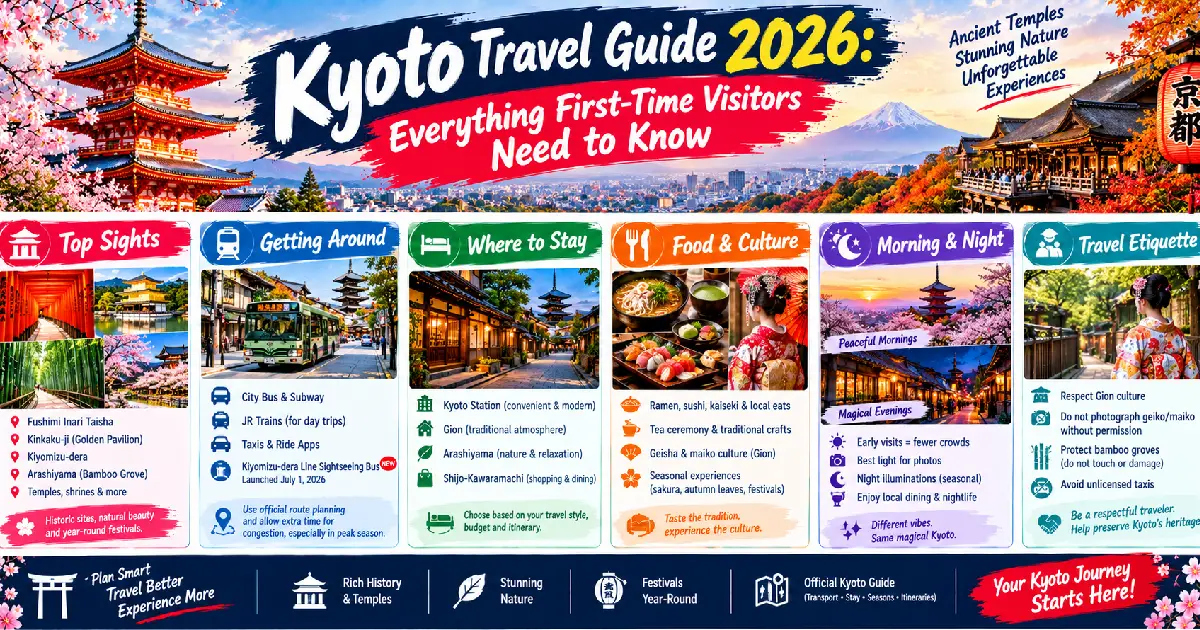
Kyoto operates on a genuinely different register from Tokyo, and understanding that difference before arrival changes how a first-time visitor should plan the trip. Where Tokyo rewards scale and constant motion, Kyoto — Japan’s imperial capital for over a thousand years (794–1868), and one of the only major Japanese cities spared the widespread WWII bombing that leveled much of the rest of the country — rewards slowness: a compact historical core where roughly 1,600 Buddhist temples and hundreds of Shinto shrines sit within walking or single-bus-ride distance of each other, and where the single biggest planning mistake is treating it like a faster-paced Tokyo day trip rather than a city that wants a visitor to actually stop and sit still in front of a single garden for twenty unhurried minutes.
This guide covers what a first-time tier-1 visitor needs to plan a Kyoto trip: the districts and what each is actually for, how to get in and around the city, where to base yourself, and the practical details that make a Kyoto stay run smoothly. For day-by-day planning, see our Japan 7-Day Itinerary and Japan 14-Day Itinerary, both built around a three-night Kyoto base.
| Population | ~1.46 million (city proper) |
| Language | Japanese; English signage common at major temples and the station, less consistent elsewhere than Tokyo |
| Currency | Japanese Yen (¥) |
| Best Time to Visit | Late March–early April (cherry blossoms), mid-to-late November (autumn foliage) |
| Closest Airports | Kansai International (KIX, ~75 min via Haruka Express); or arrive via Shinkansen from Tokyo (2h15m) or Osaka (15 min) |
| Getting Around | Kyoto City Bus network (primary), limited subway, JR local lines for outer sights |
| Time Zone | Japan Standard Time (UTC+9), no daylight saving |
| UNESCO Sites | 17 — more than any other city in Japan |
Kyoto’s most essential walking district, stretching from Kiyomizu-dera down through the preserved Sannenzaka and Ninenzaka lanes toward Gion — wooden machiya townhouses, traditional craft shops, and some of the city’s most photographed streetscapes, all genuinely walkable in a single unhurried afternoon.
Kyoto’s historic geisha (geiko) entertainment district, centered on Hanami-koji street — the city’s most atmospheric evening district, where a respectful, photography-restrained walk at dusk carries a real chance of spotting a geiko or maiko moving between appointments.
Western Kyoto’s bamboo grove and riverside district, home to the famous Arashiyama Bamboo Grove, Tenryu-ji’s UNESCO-listed garden, and the Togetsukyo Bridge — best visited in the early morning before the day-trip crowds from central Kyoto arrive.
Southern Kyoto, home to Fushimi Inari Taisha and its thousands of vermilion torii gates climbing Mount Inari — a specifically pilgrimage-oriented district best visited at dawn, both for the light and for having the lower gates largely to yourself.
Kyoto’s main shopping and dining core, anchored by Nishiki Market’s five-century-old covered food street, and the most convenient base for visitors who want walkable access to both Gion and the city’s everyday retail and restaurant district.
The practical, transit-focused district around Kyoto Station itself — less atmospheric than Higashiyama or Gion, but the most convenient base for visitors prioritizing easy Shinkansen access and bus connections to outlying sights.
Home to the Golden Pavilion (Kinkaku-ji) and Ryoan-ji’s famous rock garden — a quieter, more spread-out area best combined into a half-day with Arashiyama given their relative proximity on the city’s western side.
By Shinkansen from Tokyo: The Tokaido Shinkansen covers Tokyo to Kyoto in approximately 2 hours 15 minutes on the Hikari service (JR Pass-covered) or faster on the Nozomi (not JR Pass-covered) — the standard, most comfortable route for visitors combining Tokyo and Kyoto on one trip.
By Shinkansen from Osaka: A remarkably short 15-minute journey from Shin-Osaka Station, making Kyoto and Osaka genuinely easy to combine as a single regional base.
By air via Kansai International (KIX): For visitors flying directly into the Kansai region rather than via Tokyo, the Haruka Limited Express runs directly from KIX to Kyoto Station in approximately 75 minutes.
Unlike Tokyo’s extensive subway network, Kyoto’s public transport runs primarily on buses — the Kyoto City Bus day pass (approximately ¥700) covers unlimited rides on the city’s main bus network and is the most economical option for a full day of temple-hopping. Kyoto’s subway system is more limited, covering only two lines, though useful for a handful of specific routes.
For outer sights — Fushimi Inari, Arashiyama — JR local lines (JR Pass-covered) are often faster and less crowded than the bus equivalent. Bicycle rental is also a genuinely practical option in Kyoto given its flatter terrain and more compact scale than Tokyo, popular among visitors covering the Arashiyama and central districts.
| Area | Best For | Price Range (double, per night) |
|---|---|---|
| Higashiyama/Gion | Atmosphere, walking access to major sights | ¥12,000–¥30,000 |
| Central Kyoto (Kawaramachi) | Shopping, dining, central convenience | ¥10,000–¥25,000 |
| Kyoto Station area | Shinkansen convenience, practical base | ¥8,000–¥22,000 |
| Arashiyama | Quieter, nature-adjacent, slightly removed | ¥10,000–¥28,000 |
Ryokan note: Kyoto is one of the best cities in Japan for a traditional ryokan stay, with tatami rooms, futon bedding, kaiseki dinners, and sometimes an in-room or shared onsen bath — a genuinely worthwhile one-night splurge (¥20,000–¥50,000+) even for visitors otherwise staying in standard hotels.
Kyoto’s cherry blossom season (late March–early April) and autumn foliage season (mid-to-late November) are its two most spectacular and most crowded windows — see our full Japan in Spring and Japan in Autumn guides for exact forecasts. Booking note: Kyoto’s accommodation supply is tighter relative to demand than Tokyo’s during these two peak windows specifically — book 4–6 months ahead if traveling during either.
Kyoto is home to some of Japan’s most historically rigorous kaiseki (traditional multi-course tasting cuisine), using Kyoto-grown vegetables and centuries-old preparation techniques — see our 25 Best Restaurants in Japan guide for specific Kyoto kaiseki picks including Kikunoi and Gion Karyo. Nishiki Market, central Kyoto’s covered food street, offers an easy, no-reservation-required way to graze through local specialties like yuba (tofu skin) and Kyoto-style pickles.
Nara (45 minutes by JR Nara Line) offers Nara Park’s free-roaming sacred deer and Todai-ji’s Great Buddha — Kyoto’s single most popular day trip.
Osaka (15 minutes by Shinkansen or 30 minutes by regular JR) offers Dotonbori’s neon street food district, Osaka Castle, and Kuromon Ichiba Market.
Uji (20 minutes by JR) is Japan’s historic center of matcha green tea production, home to Byodo-in Temple (the building pictured on the ¥10 coin) and some of the country’s finest traditional tea houses.
About Travel Tourister Travel Tourister’s destination specialists have based dozens of itineraries out of Kyoto — from pre-dawn Fushimi Inari torii gates and Arashiyama’s early-morning bamboo calm to Gion’s quiet evening lanes and ryokan kaiseki dinners — to deliver a practical, district-by-district Kyoto guide for 2026 first-time visitors.
Posted By : Vinay
Latest Article
2nd Floor, 39, Above Kirti Club, DLF Industrial Area, Kirti Nagar, New Delhi, Delhi 110015



Travel Tourister is a leading Travel portal where we introduce travellers to trusted travel agents to make their journey hasselfree, memorable And happy. Travel Tourister is a platform where travellers get Tour packages ,Hotel packages deals through trusted travel companies And hoteliers who are working with us across the world. We always try to find new and more travel agents and hoteliers from every nook and corners across the world so that you could compare the deals with different travel agents and hoteliers and book your tour or hotel with the one you have chosen according to your taste and budget.
Copyright © Travel Tourister, India. All Rights Reserved

 Call
 Enquiry